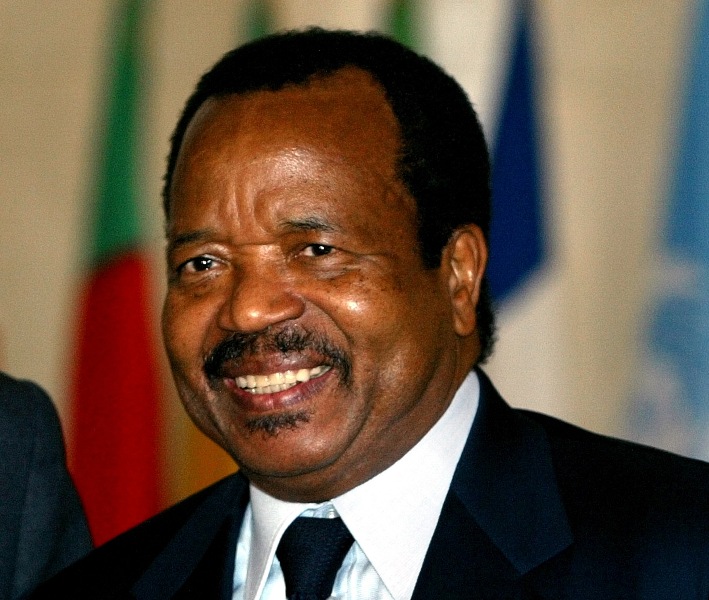
Paul Biya, a self-confessed believer in the religion of Christ whose dream of becoming a priest was cut short at 16, came to power exactly one month from a day like this, 40 years ago.
During his first decade in office, Neil Armstrong and Buzz Aldrin landed in the moon, researchers at Pasteur Institute in France isolated and identified HIV, the famous Berlin wall fell, and Africa lost Thomas Sankara and Steve Biko.
Biya had served as prime minister under President Ahmadou Ahidjo for seven years before becoming president. When Ahidjo unexpectedly resigned in 1982, Biya, bejeweled by trappings of power, staged a coup, eliminated his opponents, and assumed office with pomp, like nothing unusual had happened. He has repeatedly, suspiciously “won” re-election since 1992 with extraordinary margins in what observers have described as official coronation rituals.
In 1984, for instance, a sole candidate, “won” the presidential election by 99.98 per cent. As of the time of writing, he was the longest serving non-loyal head of state in the world, having been in power for 46 years. But Biya is not just the longest serving head of state in Africa; he holds other less impressive records as well. He is known for his dislike for journalists and human rights activists. In him John Acton’s dictum “power tends to corrupt; absolute power corrupts absolutely” finds a safe home. Mimi Mefo Takambou, Cameroonian journalist, narrates thus:
For decades, the country had been a living nightmare. Bad governance, corruption and total disregard for human rights were the hallmarks of Paul Biya’s government. When lawyers and teachers in the two Anglophone regions began staging peaceful protests, the public looked on with indifference. The general assumption was that this was just another flare-up in Cameroon’s tempestuous history.
In Tyrants, The Worlds 20 Worst Living Dictators, popular historian David Wallechinsky reports that, in 2004, annoyed by the criticisms of international vote-monitoring groups, Biya paid for his own set of international observers, six ex-U.S. congressmen, who certified his election as free and fair.
Not the one who makes regular appearances in public, Biya has centralized his administration, monopolized all instruments of violence, and captured key state independent institutions. In 2017, when separatists in Southern Cameroon called for self-determination, Biya’s government responded with violence and extrajudicial killings that United Nations confirmed amounted to genocide. “For decades, the country had been a living nightmare. Bad governance, corruption and total disregard for human rights were the hallmarks of Paul Biya’s government,” Takambou writes in Hounded: African Journalists in Exile.
Albert Benard Bongo, better known as Omar Bongo, served as the President of Gabon for 42 years until his death in 2009. He became world’s longest-ruling non-loyal leader after Cuba’s Fidel Castro stepped down in February 2008. He mismanaged the economy, promoted cronyism and privatized state power. Installed as president by imperial agents, Bongo, the youngest of twelve siblings was only 31 when he assumed office; only three heads of state in Africa were younger than he at the time.
One year after assuming office, Bongo turned Gabon into a one-party state and perpetuated electoral coups throughout his stay in office. In the 1973 general elections, for instance, he (the sole presidential candidate) and his party’s candidates won with at least 99.56 per cent. Between 1967 and 1981, he was both president and prime minister and minister for defense, information, planning and interior.
Towards the end of his presidency, the U.S Senate Permanent Subcommittee established that Bongo was one of the wealthiest heads of state in the world having amassed up to $130 million in his bank’s personal account. His son Ali Bongo, who has been in office since 2009, inherited his style of leadership non mutantur.
A spitting image of his father in the art of sleaze, Ali is a cynical bourgeois whose career reads like a fairytale in which limitless pursuit of power after power is the main theme. If providence allows, Ali is certainly willing to outshine his father’s legacy, especially on who stayed longer in office.
The second longest serving head of state in Africa, by the time he was leaving office in 2017, Jose Eduardo do Santos was a man about town. He captured the economy, persecuted dissents, and looted the country approximately to the tune of $32 billion. He lived large in a country where almost 70 per cent of the population lives on less than $2 a day. His daughter Isabel dos Santos was once the richest woman in Africa with a net worth of more than $2 billion, according to Forbes magazine. In 2018, The Angolan government launched a legal process to seize Isabel’s wealth believed to have been built on corruption proceeds.
Dennis Sassou Nguesso, the Congolese president is a kakistocrat strongman of terrible repute who leads the life of Riley. He has been in power for 38 years and has shown great determination to stay even longer. He has executed multiple electoral and constitutional coups, eliminated opponents, siphoned public resources, and turned the oil-rich Republic of Congo into an unofficial monarchy.
In 2019, Global 1 Witness, a non-profit corruption watchdog, reported that his daughter and Member of Parliament Claudia Sassou Nguesso had purchased an apartment for $7 million in New York using stolen money. In April 2021, Nguesso was re-elected by 88 per cent of the vote, in an election in which the leading opponent died on the Election Day, allegedly of Covid-19.
By appointing his son and Member of Parliament Denis Christel Nguesso (unscrupulous as the father) minister for international cooperation in May 2021, the kleptocrat Roman Catholic certainly considered following in the footsteps of his peers in Chad, Gabon and Togo who reduced presidency into a family affair. Commenting in The Continent, the brilliant Samira Sawlani argued that President Denis Sassou-Nguesso apparently decided that his son, Denis-Christel, was now old enough to have his very own ministry. As the formidable British journalist Michela Wrong puts, it: If a leader is surrounded by shifty, money- grabbing aides and family members, it’s because he likes it that way.
“Sassou– the warlord who overthrew democratically elected Pascal Lissouba to reinstate himself as leader, igniting a civil war that left thousands dead and remains an open wound in the country – wants unlimited powers for the duration of his life,” writer Vava Tampa commented in the Guardian.
Jean-Bedel Bokasa’s blood-curdling story reads like one from a gothic horror movie in which an insatiable vampire cuts it loose. As a son of a village chief who was executed by colonial officers for rebelling against imperial slavery, Bokasa was exposed to these things at a pretty young age. While men like Mobutu ran around with rudimentary ideas of self-preservation – emasculating the judiciary, eliminating dissents, capturing independent institutions like electoral agency and stuff like that – Bokasa had different, eccentric ideas.
The former cook meant business.
At 10:43 am on December 4, 1977, having turned the republic into an empire the previous year, Bokasa was crowned as “His Imperial Majesty” Bokasa I. Born in sin; Bokasa’s Central African Empire was a disgraced story in which grave crimes against humanity dotted every corner of the country. Between 17th and 19th April 1979, for instance, when pupils protested against paying for and wearing the expensive, mandatory school uniforms with Bokasa’s image emblazoned on them, the police killed at least 100 children.
On 12 June 1987, Bokasa was sentenced to death after being found guilty on 20 different charges including murder, treason, assault, illegal use of property and embezzlement. He was absolved of the hair-raising charge of cannibalism. To cut a long story short; if there is hell, surely Bokasa is the type of men who should not struggle to secure admission on account of their conduct here on earth. But that judgment is for the authorities of the world below.
Dada, Idi Amin, the self-styled general from Northwestern Uganda went down in history as one of the world’s 20 worst dictators who have walked the face of the earth. With little formal education and an inspiration from men like Mobutu Sese Seko, Amin had cut his stuff from a red cloth, the de rigueur that was the fad among such men. When he disagreed with his best friend President Milton Obote in 1971, he organized a coup and ousted Obote.
The embattled Obote ran to Tanzania where his friend President Julius Nyerere offered him refuge; some 20,000 Ugandan refugees would soon cross over to Tanzania when the new administration continued an onslaught on dissents, largely from Acholi and Lango ethnic groups. The fastidious Nyerere refused to recognize Amin’s leadership. But Idi Amin was not the type of men things like diplomatic standoff could frustrate.
In 1975, he became field marshal, and one year later declared himself president for life. By the time he left office in 1979, it is estimated that his government was responsible for the deaths of at least 500,000 human beings. In 1973, Thomas Melady, the then U.S ambassador, described Amin’s regime as “racist, erratic and unpredictable, brutal, inept, bellicose, irrational, ridiculous, and militaristic.” Nigerian novelist Chinua Achebe wrote in The Trouble with Nigeria that one of the penalties of exalted power is loneliness. Idi Amin enjoyed exalted, near-absolute power during his eight years of fame, but when death knocked in a hospital bed in Jeddah, Saudi Arabia on August 16, 2003, he died in loneliness, thousands of miles away from home.
Little is known about who exactly killed Captain Thomas Sankara, foremost revolutionary pan-Africanist and a true son of the soil. However, most accounts incriminate his deputy and close friend Blaise Campaore.
On October 15, 1987, Campaore is believed to have led a military coup in which Captain Sankara and his allies were executed extrajudicially.
One account has it that when the rebel soldiers arrived at Sankara’s office – Campaore conspicuously missing, though – where he was having a meeting with staff, he told his audience to calm down, stepped outside and raised his hands in surrender, whereupon the rebel soldiers sprayed him with bullets. In April 2021, a military court in Burkina Faso indicted Blaise Campaore and 13 others for complicity in the assassination of Thomas Sankara and his allies, concealment of corpses and attacking Burkinabe state security.
Shortly after assuming office, Campaore is reported to have ordered the arrest and execution of Jean Boukary and Henri Zonyo, his comrades in crime with whom he reportedly shared state power. During his 27 years in office, Campaore subsisted on the single meal that every dictator craves: power for power’s sake. He committed electoral coups with impunity in 1991, 1998, 2005 and 2010. For the longest time, Campaore had his cake and faithfully ate it until the moment in the sun came to a nasty tumble on October 30, 2014 when angry citizens stormed parliament building, chased out the lawmakers and set the not-so-honoroubale house on fire. “As it was in the beginning, so it shall be in the end, “the good book prophesies.
American author Sarah Kendzior argues in Hiding in Plain Sight that: Once an autocrat gets into office, it is very hard to get them out. They will disregard term limits, they will urge the agencies that enforce accountability, and they will rewrite the law so that they are no longer breaking it. They will take your money, they will steal your freedom, and if they are clever, they will eliminate any structural protections you had before the majority realise the extent of the damage.
Also Read: The Last of the Kano Rice: A Tragic Story of Capitalism, Neoliberalism and State Negligence
Robert Gabriel Mugabe, the son of a carpenter, is remembered for his invaluable contribution towards liberation of Zimbabwe, his unwavering camaraderie spirit and his true love for Africa. He will be celebrated as a statesman and an incorrigible Pan-Africanist. He spent ten years in prison without trial during the struggle for independence and, among his peers like Mummar Gaddafi, supported Africa National Congress in the fight against apartheid. But Uncle Bob is equally remembered for his greed and cronyism. “Mugabe was the face of devil incarnate,” one Zimbabwean told a BBC reporter when Mugabe died in 2019. He came to power as a liberator before morphing into a despot with a high sense of self-importance. He ruled Zimbabwe for nearly four decades: from 1980-1998 as prime minister then as president from 1998-2017. During his reign, Zimbambwe experienced extensive brain drain, runaway corruption and high levels of unemployment.
Daniel Moi, a primary school teacher from the quite fields of Kabarak village, Baringo County, was a down – to- earth person to whom modesty was fire and ice.
He would navigate the treacherous maze of power games with the assistance of former attorney general Charles Njonjo to succeed Jomo Kenyatta in 1978. If Moi allowed power to corrupt him, he did so with little pretense. He let power enter his head and carry him with pride of a cat for the next 24 years He quashed multi-party system and made Kenya a de jure one party state.
Michela Wrong, observes in It’s our Turn to Eat that: “Moi liked to be known as the Professor of Politics, and the man dismissed by his enemies as a ‘passing cloud’ when he succeeded Kenyatta in 1978 had proved a remarkable survivor, riding out a shift to multi-party politics that many had assumed would unseat him.”
His regime, like that of his predecessor, was repressive and dictatorial. He jailed opposition politicians, intellectuals, captured the church and censored civil societies. Moi represented everything bad with Kenya. He presided over a retrogressive system that undermined fundamental gains acquired from independence and entrenched a sense of entitlement.
Idriss Derby would have become the longest serving leader in the world had he lived to finish his sixth term, cut short by sudden death in April 2021. The 68-year-old son of a herder died from injuries sustained while fighting rebels in the country’s war-torn north. Derby, who revered military life, rose to power through the army.