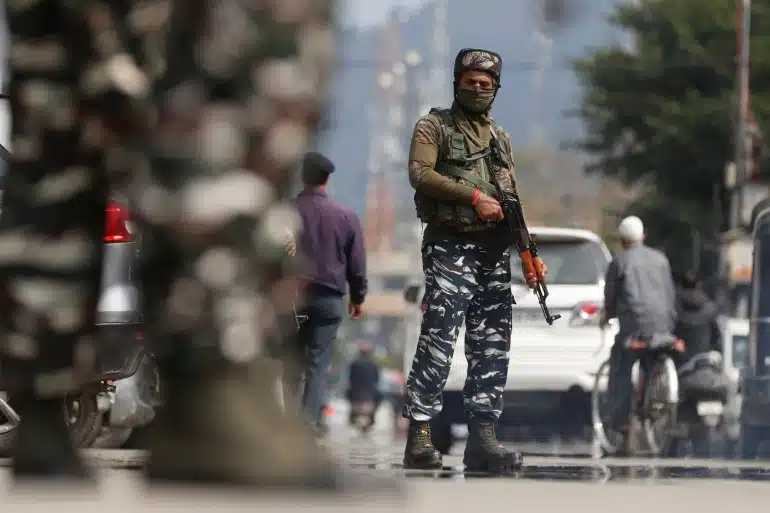
In January 2021, top intelligence officers from India and Pakistan held secret talks in Dubai in a fresh attempt to address security crisis in Himalayan region of Kashmir. The crisis started when an Indian military convoy in Kashmir was bombed in 2019 reportedly by Pakistan-based fighters. New Delhi responded by sending warplanes to Pakistan and withdrawing Kashmir’s autonomy; in the process provoking outrage in Pakistan. The rhythm of war drums is still ringing loud in Kashmir and the neighboring regions.
India was and is still keen on making amends with Pakistan primarily because she is already embroiled in a border confrontation with China. Pakistan, on the other hand, is interested in strengthening security on its Afghan border at the West with the withdrawal of American soldiers; in April 2021, President Joe Biden announced the withdrawal of American troops from Afghanistan after 20 years in what many saw as a massive failure. Also, Pakistan is going through far-reaching economic meltdown and is therefore keen on fixing things at home.
For the better part of last year, tens of thousands of Indians at home and abroad took to the streets to protest the new Citizenship Amendment Act 2019 that was pushed through parliament by the ruling Hindu Nationalist Party, Bharatiya Janata Party (BJP) and ratified by President Ram Kovind on December 12, 2019.
The amendment, described by UN High Commissioner for human rights Michelle Jeria as fundamentally discriminatory in nature, granted persecuted minorities; Hindus, Sikhs, Jains and Christians – but not Muslims – from neighboring countries of Bangladesh, Pakistan and Afghanistan Indian citizenship. Narendra Modi’s Hindutva version of nationalism, says Priyamvanda Gopal, English scholar at Cambridge University, has made significant strides towards the achievement of an exclusively and extremist “Hindu nation”.
Also Read: Defining Public Morality: How Politicians Employ the Principle of Notoriety to Cultivate Likability
The contentious law, which received red-hot opposition from academics, clerics, students and the international community alike, was designed to make religion a basis for citizenship, a move that would see India plunge into yet another civil war, but one that she is not particularly new. Muslims, who form 15 per cent of India’s 1.3 billion population, risk losing their Indian citizenship and at least 200 million of them could face possible deportation. The absolute number of war deaths has been declining since 1946. In some years in the early post-war era, around half a million people died through direct violence in wars. “In recent years, the annual death toll tends to be less than 100,000… the number of war victims varies hugely between different wars: whereas 1,200,000 died during the Korean War (1950–1953), other wars had ‘just’ 1,000 victims,” Our World in Data observes.
This article pulls together the thread connecting the genesis of the feud between Hindus and Muslims in India and the history behind it.
Maurya Empire
Thousands of years ago, according to ancient Indian epics, people simply identified as “tribal” inhabited a Kingdom called Varga in the region that is now Bangladesh. Little has been written about the region before 200’s BC when it formed part of the Maurya Empire. The Maurya Empire emerged after the death of Alexander the Great who had invaded India in 326 B.C. and conquered the northwestern region.
This empire broke up in 185 B.C., or thereabout that saw local kings become rulers of the state of Bengal. From about A. D. 320 to 500, the region was part of the Gupta Empire. Buddhist rulers gained control of Eastern Bengal in the mid-700. And their culture spread throughout the region. After about 300 years of Buddhist rule, Hindu came to power. Beginning in the 1200’s, Turkish Muslims who had conquered northern India extended their control into eastern Bengal.
From A. D. 450 until the late 1400’s, many peoples invaded India. First, the Huns, brought their armies into India from central Asia. Muslim came from Arabia during the early 700s and from Persia and Afghanistan during the 1000s.
Bengal became a province of British India. Under British rule, industrial development and educational reforms advanced rapidly in western Bengal, where most of the people were Hindus. Many Hindus gained economic and political power. But eastern Bengal, where most of the people were Muslims, remained backward and agricultural.
In 1905, the governor of British India divided Bengal into two sections – West Bengal and East Bengal. East Bengal became part of a new province. Many Hindu Bengalis objected to the division. They feared a loss of their economic and political power. But Muslims favored the division because they made up the majority of the province population.
The conflict led to bloody rioting between Hindus and Muslims in Bengal. The British reversed the division in 1911, and Bengal again became a single province. But the bitterness between Hindus and Muslims would persist for very many years.
The British divided Bengal into two countries. Western Bengal became a state of India, and Eastern Bengal became East Pakistan.
Emergence of Islam and the Mogul Empire
The first Muslim sultanate was established in Delhi in 1206 and lasted until 1526. Barbar (1483-1530), a war Lord, established Mogul Empire and made himself emperor.
Babar’s grandson, Akbar (1542 -1605), became the greatest of Mogul emperors. He reigned for 49 years and conquered all northern India and Afghanistan. He extended his rule as far south as the Godavari River. Akbar, a Muslim, ruled wisely and won the loyalty of Hindus by his religious tolerance.
During the 1600s, fierce attacks by the Maratha people of West-central India endangered the Mogul Empire. Trouble in the Empire started during the rule of Aurangzeb (1618-1707). He became emperor in 1658. He has been described as narrow-minded and a cruel autocrat. He imposed a special tax on Hindus and destroyed their temples. He also tried to force non-Muslims to convert to Islam. For these reasons, the Mogul Empire fell after the death of Aurangzeb in 1707.
Until the Mogul emperor Akbar conquered the region, independent Muslim rulers governed parts of state of Bengal until 1576. Bengal became part of the Mogul Empire, which spread across most of what is now Afghanistan, India, and Pakistan. Muslim art and architecture flourished under Mogul rule. By about the 1600’s, most of the people of eastern Bengal had converted to Islam.
Also Read: The Last of the Kano Rice: A Tragic Story of Capitalism, Neoliberalism and State Negligence
The Mogul emperors appointed governors called “nawabs” to rule the provinces of the empire. In the early 1700’s, the empire began to break up, partly because powerful Hindu groups in central and Western India rebelled against Muslim rule. At the same time, Bengal and other provinces became increasingly independent as the nawabs took more for themselves.
During the 1500’s, British, Dutch, French, and Portuguese traders competed for control of the profitable trade between the East Indies and Europe. By the 1600’s, European trade settlements had been established in the state of Bengal.
At first, the Europeans met strong resistance from the provincial nawabs, who demanded taxes in return for trade privileges. But soon after, the Mogul nawabs, nobles, and generals competed among themselves for power. The Europeans took sides in many of these conflicts, offering their support in return for monopoly trade privileges and other rewards.
British East India Company
The British East India Company was chartered by the British government in 1600 to develop trade with India and the Far East.
By the mid 1700’s, the company had become the strongest trade power in Bengal. Around 1757, company forces led by Robert Clive defeated the nawab of Bengal in the battle of Plassey. Clive put in a puppet nawab in office, but the British East India Company allegedly ruled Bengal. Corrupt company officials made huge profits on jut production in eastern Bengal, but they did little to improve the welfare of the people.
Opposition to the company spread, not only in Bengal, but also in other areas of India that the firm controlled. The discontent led to the Sepoy Rebellion in 1857. Although the revolt failed, it caused the British government to take over the company in 1857. All the Indian Territory that the firm had governed became known as British India.
The Sepoy Revolution
In 1857, the Indian people rebelled against the East India Company that had become a leading power in India in 1757. Indian soldiers started the rebellion when British officers ordered them to bite open cartridges greased with or hog fat. The religious beliefs of the soldiers forbade them to obey the order.
The Hindu soldiers could not eat beef, and the Muslim troops were forbidden to eat pork. Deep discontent among the people caused the rebellion to spread. The British suppressed the rebellion in 1858 lack of leadership and support wrecked the protests causing deep divisions.
During the struggle to independence, many Muslims feared the Indian National Congress formed in 1885 because the great majority of its members were Hindus. They believed that if the Congress became powerful, it would keep them politically weaker than the Hindus. Ethnic antagonism would emerge later.
In 1906, unsatisfied and desperate to chart a different path, they organized the Muslim League. The league worked chiefly to improve the position of Muslims in India and became the de facto voice of the Muslim minority.
During the 1930s, the Muslim League greatly increased its political activities. The league feared that the various plans for an independent India would give Hindus too much powers over Muslims by keeping them from taking active roles in provincial governments that were created through the Indian Act of 1935 in the wake of a new constitution.
In 1934, Muhammad Ali Jenna (1876-1948), became leader of the Muslim League. Under his leadership, the league won a number of seats in the provincial legislatures, and its membership increased rapidly.
In 1937, Jinnah declared that Muslims could not expect fair play under a government planned by the Indian National Congress. Three years later, in 1940, Jinnah demanded that an entirely separate Muslim country out of India. The name Pakistan which means “land of the Pure” would become widely used for the proposed nation.
Early in 1946, Great Britain offered independence to India whenever Indian leaders could agree on a form of government. Representatives of the Indian National Congress and the Muslim League still could not settle their differences.
The Muslim League then declared August 16, 1946 as Direct Day to establish the separate Muslim nation of Pakistan. On August 17, a bloody riot between Hindus and Muslims took place in Calcutta.
India would soon be partitioned between the warring factions. The same year, India became an independent dominion in the British Commonwealth of nations on August 15, 1947, two days before the riots.
Pakistan claimed the northern state of Kashmir because most of the people there were Muslims and invaded the state. The invasion caused Kashmir’s Hindu ruler to make his state a part of India for protection against Pakistan.
India and Pakistan fought over Kashmir until 1949, when the United Nations arranged a cease-fire although more fights were reported again in 1964. Kashmir would acquire special status in 1954 through the famous Article 370. This partly informs the reason why protesters in the Kashmir region have vehemently opposed migration of foreigners from Bangladesh in the ongoing protests.
In 1971, during the reign of Indira Gandhi – the first woman prime minister of India – civil war broke out in Pakistan, and millions of East Pakistan refugees fled into India.
India assisted East Pakistani in the fight against West Pakistan and won in December, of the same year. East Pakistan became independent nation of Bangladesh. The refugees would return to Bangladesh shortly after its establishment.
Last year, Muslim students were among those who were attacked by a group of people believed to be sympathizers of Bharatiya Vidyarthi Parishad (BVP) in what could be seen as systematic ethnic cleansing by the state.
Discrimination on the basis of religion or irreligion is no better or worse than it is on the basis of race, ethnic origin, gender or sexual orientation. What is happening in India is not a Muslim problem; it’s a manifestation of devastating rabid nationalism that is political in orientation.