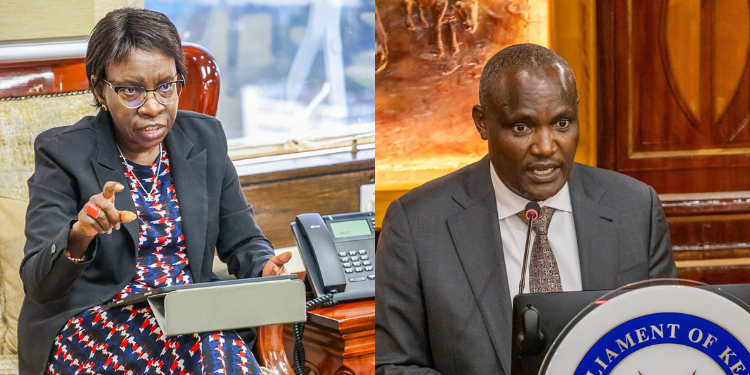
The Office of the Auditor General has raised concerns over the National Infrastructure Fund Bill 2026.
In a detailed review submitted to Parliament, Nancy Gathungu, the Auditor General, has highlighted legal, governance, and institutional gaps that may undermine constitutional safeguards on borrowing, procurement, and public expenditure.
The office has warned that several provisions could weaken financial oversight and expose public resources to mismanagement.
The findings come at a time when Kenya is under pressure to finance major infrastructure projects while managing rising public debt.
Auditor General flags Borrowing Powers and Board Governance.
The Auditor General highlighted Clause 5, noting that the proposed Fund’s borrowing process lacks clear alignment with Article 206 of the Constitution and the Public Finance Management Act of 2012.
According to the Auditor General, this omission may create loopholes in debt management and increase the risk of unsustainable public borrowing.
Also Read: Kenya Raises Expenditure in 2025/26 Supplementary Budget
Representation of representatives to the fund has also been criticized, as, in addition to the Principal Secretary to the National Treasury, the fund’s board needs to be redesigned to have some non-independent Directors with professional knowledge in project financing and infrastructure planning.
Disparities in Investment, Procurement, and Remuneration
Clause 12 of the Bill gives the board powers to invest in projects through equity and debt, and to dispose of assets. However, the Auditor General notes that the Bill does not clearly outline specific procedures in safeguarding, such as competitive bidding or public auctions, as required under the Public Procurement and Asset Disposal Act Cap 412c, of 2015.
Concerns have also been raised over Clause 13, which gives responsibility for setting directors’ remuneration to the Cabinet Secretary for the National Treasury.
In addition, the bill presented does not require consultation with the Salaries and Remuneration Commission, as required by the Constitution.
In addition, Clause 21 gives the board the power to develop investment policies and monitor agreements, without reference to the Investment Promotion Act Cap 485B, which provides similar powers to the National Investment Council. The Office notes that similar powers are already provided to the National Investment Council, raising the risk of overlapping mandates and institutional conflict.
Also Read: Inside Treasury’s Car Loan Scheme for State Officers and Who Qualifies for Up to KSh5 Million
Disparities have also been identified in Clause 24, which grants the Cabinet Secretary the power to develop standards for competitive tendering, public participation, and procurement timelines. These areas are already comprehensively regulated by the Public Procurement and Asset Disposals Act, 2012, and its regulations, 2020.
Auditor General warns that duplicating these duties could create legal uncertainty and conflicts between the statutes.
Auditor General Calls for Legislative Action on the Bill
Gathungu has urged the parliament to address the loopholes before the bill is enacted into the existing laws.
“As I conclude, it is my expectation that the feedback provided in this Stakeholder Engagement will provide valuable insights for Parliament’s consideration on the National Infrastructure Fund Bill, 2026. I urge the Committee to consider the proposed amendments to ensure that the Fund is aligned with other laws already
enacted by Parliament,” added Nancy Gathungu.
Follow our WhatsApp Channel and X Account for real-time news updates.