



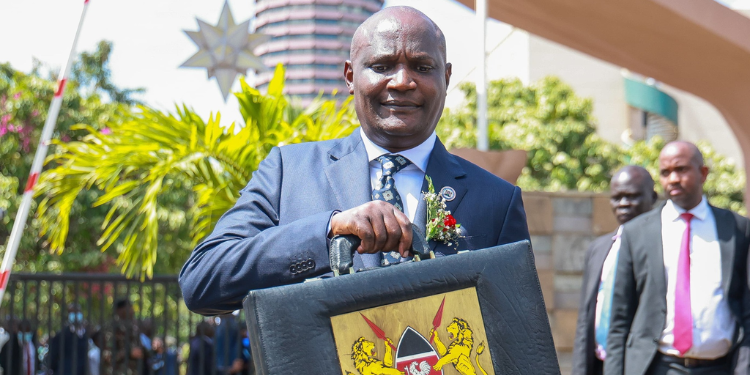
Treasury Cabinet Secretary John Mbadi announced that Kenyans earning a gross salary of KSh30,000 or less will be exempt from Pay as You Earn (PAYE) if Parliament approves a proposal scheduled for tabling in Parliament after the recess.
Speaking during budget forums, Mbadi added that for the 244,000 Kenyans earning between Ksh30,000 and Ksh50,000, the government would also reduce the tax rate on salaries by 5% to 25%, from the previous 30%.
On February 4, President William Ruto defended the proposal to raise the minimum taxable income from the current KSh24,000 to KSh30,000 during a meeting with United Democratic Alliance (UDA) aspirants at State House.
President Ruto noted that planned changes in the Tax Amendment Bill aim to remove tax payments for those earning below KSh30,000 and reduce payments for those earning up to KSh50,000.
“When Parliament resumes next week we will present a proposal that every Kenyan earning less than Ksh.30,000 will not pay any taxes because we have steadied the economy,” said Ruto.
Also Read: Naphtaly Rono: Meet the Lawyer Nominated by CS Mbadi to Head the Financial Reporting Centre (FRC)
How the Payslip Will Look After the PAYE Is Scrapped
Kenyans are subjected to several statutory deductions, including:
- PAYE (Pay as You Earn – Income Tax)
- NSSF (National Social Security Fund)
- SHIF (Social Health Insurance Fund)
- Housing Levy
They are also entitled to a tax relief of 2,400.
January Payslip for a Kenyan earning a gross pay of 30,000
PAYE (Income Tax): Ksh 731.25
NSSF (Tier I): Ksh 540.00
NSSF (Tier II): Ksh 1,260.00
SHIF: Ksh 825.00
Housing Levy: Ksh 450.00
The total deduction will be 3,806.25, and the Net Salary that one takes home will be 26,193.75
Under the proposed cut, the deduction will include:
PAYE – 0
NSSF (Tier I) – Ksh 540.00
NSSF (Tier II) – Ksh 1,260.00
SHIF – Ksh 825.00
Housing Levy – Ksh 450.00
The total deduction will be 3,075, and the Net pay will be Ksh. 26,925
Also Read: Win for Kenyans as Bankers Push for Further 5.0% PAYE Cut Across All Bands
CS Mbadi on Tax Payment
Speaking during the Privatization and Budget People’s Dialogue in Meru, Mbadi said the proposal aims to ease the financial burden on low-income earners, who have borne the brunt of rising taxes, statutory deductions, and persistent inflation, at a time when the national debt is easing.
According to Mbadi, most Kenyans are not paying the required taxes or paying them at all.
He stated that this paralyzes the government’s plans and does not help reduce the huge national debt the current government inherited from the previous one.
“The government should be receiving between Ksh82 billion to Ksh100 billion as taxes from Kenyans. You people are only giving us Ksh17 billion. The rest of the burden you have left it to the government,” Mbadi stated.
He concluded by stating that such irregularities are the factors behind the government’s decision seeking to exempt the estimated 1.7 million Kenyans from paying taxes.
Bankers propose further 5% PAYE cut after Govt’s tax relief plan
The Kenya Bankers Association (KBA) has since proposed a 5% reduction in Pay As You Earn (PAYE) tax rates across all existing tax bands
According to the bankers, both employers and employees will be required to contribute up to 6% of pay by February 2027, a move that significantly raises the overall deduction burden, especially for workers and firms without pension schemes.
In addition to the PAYE reduction, the bankers recommended capping the highest PAYE rate at 30%, in line with the National Tax Policy approved in 2023, which states that personal income tax rates should not exceed the corporate tax rate.
Follow our WhatsApp Channel and X Account for real-time news updates.



They have done a very good thing to cushion the suffering civil servants in the lower ranks; but they have also equally done a very bad thing to overburden the very few overburdened tax bearers.
We are not wishing to break down, but you have made it automatic for us to break down – this one our good God above will tell you for free : we pay taxes to both the government and public every day, every hour and almost every minute.
We are the target of every WhatsApp distress call group: we foot all the bills of every funeral , every medication bill , every emergency and every calamity and every every misfortune around us, and it’s inescapable ; some of us live very miserable lives in those permanent houses you see 👀.
We feel betrayed and we are very sorry because very soon we genuinely and sincerely fear that we will just collapse – infact some are wondering why work so hard and sacrifice our formative years hoping to escape poverty and suffering, only to suffer in disguise as poor rich people.