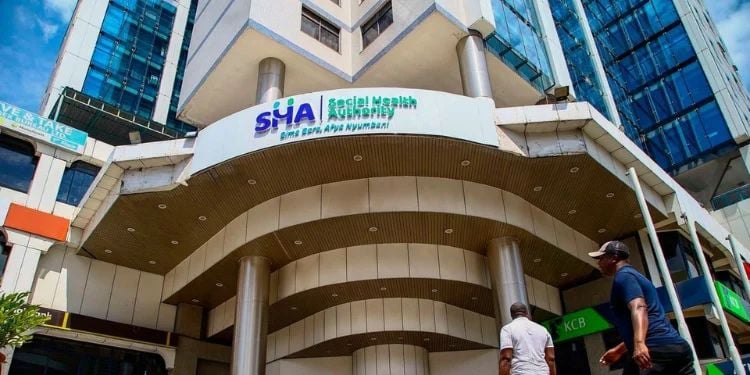
The Government of Kenya has scrapped the Social Health Authority (SHA) tariff-locking system used under the Public Officers Medical Scheme Fund (POMSF).
In a notice dated March 23 2026, the government stated that it’s part of an operational shift to stabilize healthcare delivery for civil servants.
“We, the undersigned representatives of the Ministry of Health (MoH), the Social Health Authority (SHA) and the Union of Kenya Civil Servants (UKCS), convened a consultative meeting today to address the urgent operational challenges affecting the delivery of healthcare services to civil servants under the Public Officers Medical Scheme Fund (POMSF),” read the statement.
The decision follows disruptions in service provision, including billing disputes, delayed approvals, and reports of patients being detained in health facilities over payment disputes.
Immediate Withdrawal of the SHA Tariff Locking System
The parties have agreed the the immediate withdrawal of tariff locking from SHA’s system, a mechanism that had been used to enforce fixed reimbursement ceilings for medical services, restricting how much health facilities could bill under the scheme.
Also Read: Governor Threatens to Expose Duale Over SHA Irregularities
According to the statement, SHA will now remove these system-level restrictions that previously dictated pricing at the point of care.
This is aimed at easing operational bottlenecks that had emerged between contracted health facilities and the scheme administrator around claims processing and service authorization.
“SHA will immediately withdraw the tariff locking currently configured in the system, the notice read.
Facilities now remain bound by their contractual obligations under POMSF and cannot independently charge patients beyond approved scheme arrangements.
Strict Enforcement of Zero Co-Payment Rule
The agreement maintains a firm stance on patient protection through a strict zero co-payment policy.
All health facilities contracted under the scheme are barred from charging civil servants any out-of-pocket fees during the interim period.
“All health facilities offering POMSF services are strictly prohibited from charging any civil servant or public officer any out-of-pocket fees,” read part of the statement.
The policy effectively reinforces a walk-in, walk-out service model, where civil servants are expected to receive treatment without making direct payments at the facility level.
SHA has warned that any violation of this rule will result in a material breach of contract, attracting enforcement measures, including potential de-contracting of providers.
Also Read: SHA Explains How Kenyans Can Update Newly Registered Mobile Numbers on the System
Tariff Negotiations and System Reorganization
Following the system adjustment, SHA will immediately begin nationwide tariff negotiations with private and faith-based health facilities categorized under Levels 3 to 6.
Talks are scheduled to begin on 28 April 2026 and run for four weeks, focusing on developing a harmonized reimbursement framework based on clinical and cost data.
To support implementation, a Joint Rapid Response Desk will be established involving SHA, the State Department for Public Service, and UKCS.
The unit will handle urgent interventions such as securing the release of any civil servants detained in hospitals and processing refunds for unauthorized payments already made during the period of disruption.
SHA will also strengthen oversight mechanisms through regular claims audits, utilization reviews, and fraud-detection systems to improve accountability within the scheme. Access to healthcare will also be limited strictly to contracted facilities, with SHA set to publish and continuously update an official list of approved providers.