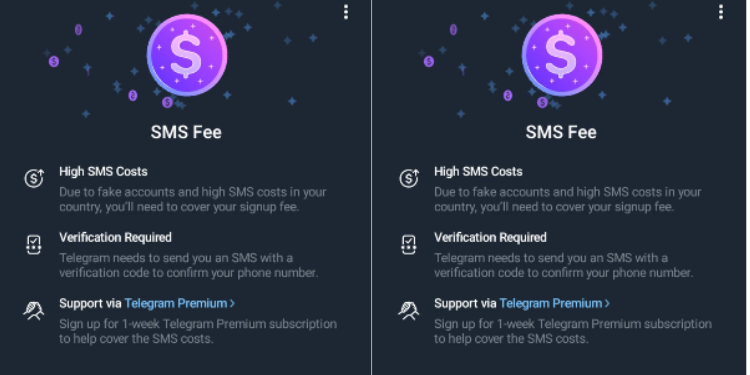
Telegram users in Kenya and parts of Sub-Saharan Africa are reporting a new sign-up fee that requires payment before receiving SMS verification code.
When a user tries to log in to a new device, they the prompted to cover the SMS verification charges.
According to Telegram, the update has been attributed to higher SMS charges and Fake accounts in the respective countries.
“Due to fake accounts and high SMS costs in your country, you’ll need to cover your signup fee,” reads a prompt appearing during registration and login on new devices.
SMS Verification Costs and Regional Paywall Rollout
In Kenya, Telegram is charging KSh 200 for a one-week Telegram Premium subscription, which is linked to Telegram’s SMS verification system.
Also Read: Global Facebook Outage Leaves Users Locked Out of Accounts
Telegram has been incurring higher SMS costs in countries including Kenya, Uganda, South Africa and other Sub-Saharan Africa , where mobile operators charge higher rates for application-to-person messages.
The messaging platform aims to offset the rising SMS costs, especially in regions where service providers charge third-party services high rates for sending One-Time Passwords (OTPs).
This update is also linked to Telegram’s Peer-to-Peer (P2P) feature that was announced in 2024 to allow users to volunteer their phone numbers, send up to 150 OTP SMS messages per month to other users in exchange of free Premium subscription.
Telegram accounts can be signed in to different devices. Currently, not all users are affected, especially those who have not signed in on different devices.
Anti-Bot Measures and Rising Fraud Allegations
Telegram’s system is built around phone numbers as the primary identity, meaning users must have a real SIM-based identity to create an account.
Telegram has long struggled with abuse from automated accounts, spam networks, and impersonation profiles. Academic and cybersecurity research shows that messaging platforms like Telegram are frequently targeted by “sockpuppet” and bot networks.
Attackers have been creating accounts with fake identities to spread scams and promote fraudulent investment schemes
According to reports, Telegram channels have also been used in several financial scams, including crypto-related “pump-and-dump” schemes and Ponzi-style frauds.
These scams have been linked to bot-driven traffic for fake engagement.
These activities rely on mass account creation to amplify reach. To control this, Telegram introduced SMS verification OTP’s at service charge.
Also Read: Mark Zuckerberg’s Meta to Lay Off 8,000 Workers in Major AI Shake-Up
Access Challenges and Limited User Options
For users affected by the new verification system, Telegram’s options remain limited and fully controlled by the platform.
The verification process is tied to phone-based authentication, meaning access depends on SMS delivery systems or an alternative verification system within the app.
If a user is already logged on another device, such as a phone, tablet, or desktop, the platform provides an internal verification method that does not rely on SMS.
Telegram sends the login code directly via an in-app message, allowing the user to approve the new login without receiving an OTP.
Follow our WhatsApp Channel and X Account for real-time news updates.