



A defense witness in the Shakahola massacre trial has told the High Court that members of the forest settlement used the word “weddings” to describe deaths, saying the group believed those who died were not gone forever but had moved on to a spiritual life.
In a statement on April 21, the Office of the Director of Public Prosecution (ODPP) stated that, appearing before Justice Diana Kavedza at the Mombasa High Court, Steven Ngugi, one of the accused persons, gave testimony during cross-examination by Deputy Director of Public Prosecutions Jami Yamina.
Ngugi admitted that he took part in burying individuals who died at the Shakahola settlement but maintained that he did so in what he described as “good faith” as a member of the religious community.
“In his testimony, Mr Ngugi said he assisted in digging graves and burying individuals who had died at Shakahola, maintaining that he acted in “good faith” as a member of the community. He, however, told the court that he could not determine the exact causes of the deaths,” stated ODPP.
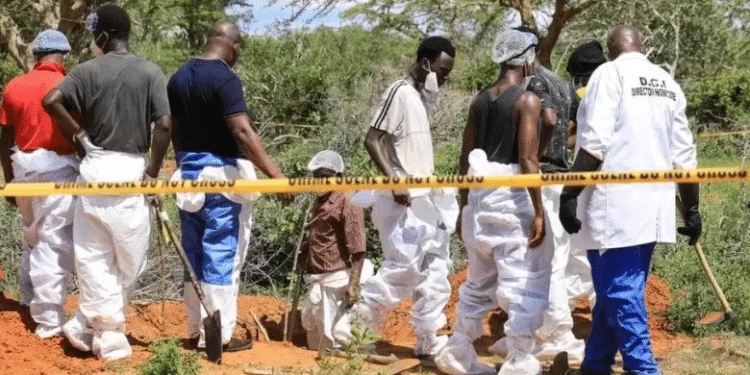
Ngugi told the court that he assisted in digging graves and conducting burials for deceased members of the group.
He said he was unable to establish the exact causes of death, stating that deaths were treated as spiritual events rather than medical occurrences.
Also Read: Judge Urges Court to Prioritize Women and Children in Dispute Resolution
Defense Witness Outlines Shakahola Sect Beliefs, Fasting Practices, and Burial Customs
According to Steven Ngugi’s testimony, members of the sect believed that faithful followers did not truly die but instead transitioned into a spiritual state.
This belief, he explained, led to the use of coded language within the settlement, with deaths being referred to as “weddings.”
He also said terms such as climbing the mountain) and descending the mountain were used to signify the beginning and end of fasting periods.
The witness further told the court that prolonged fasting was a central practice within the group, rooted in its religious teachings.
He admitted that he personally participated in fasting and, at one point, required hospital treatment for dehydration after spending extended periods in the forest without adequate food or water.
Ngugi said his commitment to the teachings of the group prompted him to abandon his university studies and relocate to Shakahola in 2023.
He testified that he purchased land in the forest settlement for Ksh 1,500 and settled there as a follower.
According to ODPP, Steven described a strict belief system that discouraged formal education, medical treatment, and engagement with aspects of modern life, which the group viewed as inconsistent with spiritual purity.
“The witness explained that his religious convictions led him to abandon his university studies and relocate to Shakahola in 2023, where he acquired a piece of land for Ksh 1,500. He described a strict belief system that discouraged formal education, medical treatment, and certain aspects of modern life, which were viewed as contrary to spiritual teachings,” read part of the ODPP statement.
The hearing continues as prosecutors seek to establish the extent of knowledge and responsibility among the accused persons regarding the deaths that occurred at Shakahola.
Also Read: Insider Leaks Supreme Court Secrets, Names Justice Who is Abusive to Clerks
How a Radical Faith Led to Mass Deaths and Sweeping Criminal Charges
The Shakahola tragedy, which emerged in 2023, led to the discovery of hundreds of bodies, many of them children, buried in shallow graves across the forest. Post‑mortem examinations revealed that most victims died from starvation, while others showed signs of suffocation, strangulation, and blunt force trauma.
Investigators established that The Shakahola sect was led by Paul Nthenge Mackenzie, the founder and leader of Good News International Ministries.
Mackenzie is the principal accused person and is facing multiple criminal cases, including 191 counts of murder, manslaughter, child cruelty, radicalization, and facilitating terrorist acts.
The ODPP alleges that Mackenzie instructed followers to starve themselves to death to “meet Jesus” and oversaw the settlement’s operations in Shakahola Forest.
Alongside Mackenzie, more than 30 followers and close associates are charged as co‑accused. Court proceedings have identified several of them as village elders, enforcers, guards, cooks, recruiters, and grave diggers within the Shakahola settlement.
These accused people allegedly played operational roles in enforcing prolonged fasting, restricting movement, denying medical care, and concealing deaths through secret burials.



How could something like the Shakahola massacre happen?I believe I am echoing the reaction of millions of people around the world who have followed this story. Scant comfort but it is uncannily
reminiscent of another cult-inspired tragedy years earlier and thousands of kilometers away, in Guyana,
where more than 900 people took poison and died in a macabre ritual led by one ”Reverend” Jim Jones.
”Ye shall know them by their fruits.”