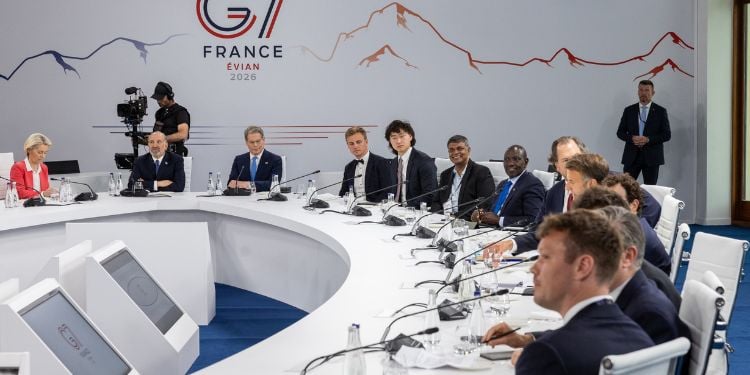
As leaders of the world’s most powerful economies gather at the G7 Summit, many Africans may view the event as another meeting of wealthy nations discussing issues far removed from the realities of ordinary citizens in Nairobi, Lagos, or Johannesburg.
That perception would be mistaken.
The decisions emerging from the G7 have direct implications for Africa’s economic future. From debt restructuring and trade access to artificial intelligence, industrialization, climate financing, and strategic minerals, the summit is shaping the environment within which African economies operate.
For Kenya, the significance is even greater.
At a time when many developing nations are struggling with rising debt burdens, unemployment, and declining purchasing power, participation in high-level global economic discussions is no longer a diplomatic luxury. It is an economic necessity.
The world is undergoing a profound economic transformation. Global supply chains are being reorganized. Artificial intelligence is reshaping productivity. Strategic minerals are becoming geopolitical assets. Nations are competing for investment, technology, and market access.
“The relevance of the G7 to Kenya is not aid—it is access to capital, technology, markets, and influence.”
Africa cannot afford to remain a spectator.
For decades, the continent has exported raw materials and imported finished products. The result has been persistent trade deficits, weak industrial capacity, and limited value creation. Yet Africa possesses some of the world’s youngest populations, largest untapped markets, and most strategic natural resources.
The question is whether Africa will continue to supply raw materials to power other economies or become a manufacturing and innovation hub in its own right.
“Africa’s challenge is no longer poverty reduction; it is economic transformation.”
Also Read: Ruto Reveals How Africa Will Drive Global Economic Growth
Aid alone cannot industrialize Africa.
What Africa requires is access to affordable capital, technology transfer, expanded markets, modern infrastructure, and fair participation in global value chains. The continent does not need charity. It needs opportunity.
“Aid cannot industrialize Africa. Capital, technology, markets, and innovation can.”
The G7 presents an opportunity to advance these goals. A reformed global financial architecture could reduce borrowing costs for African nations. Greater support for infrastructure financing could unlock industrial growth. Strategic partnerships on artificial intelligence could prevent Africa from becoming merely a consumer of technologies developed elsewhere.
The summit also highlights one of the greatest contradictions of our time. Africa possesses critical minerals essential for the green energy transition yet captures only a fraction of the value generated from these resources.
“Africa does not need a bigger seat at the table; it needs a greater share of the value chain.”
The future of Africa should not be dug out of the ground and shipped overseas. It should be manufactured, financed, and commercialized within Africa itself.
“The future of Africa should not be exported as raw materials; it should be manufactured within Africa.”
Yet there remains a fundamental question: Is Kenya prepared to capitalize on the opportunities emerging from this changing global economic order?
Unfortunately, the evidence increasingly suggests otherwise.
While the current administration has invested considerable effort in international engagement and economic diplomacy, it has struggled to articulate a coherent fiscal, industrial, and investment strategy capable of attracting and retaining long-term productive capital.
Investors do not follow diplomatic invitations. They follow predictable policies, affordable energy, stable regulations, efficient infrastructure, and confidence in the economy’s future direction.
“Investors are attracted by policy certainty, not diplomatic visibility.”
Kenya’s challenge today is not visibility. It is credibility.
The country’s economic messaging often appears internally contradictory. On one hand, the government actively negotiates labor export agreements and celebrates the migration of Kenyan workers abroad. On the other hand, it speaks of building domestic manufacturing industries capable of generating large-scale employment.
While both objectives may have merit independently, they reflect different development pathways and require a clearly integrated national strategy.
“A country cannot export its workforce and industrialize simultaneously without a clearly integrated economic strategy.”
Similarly, fiscal policy has increasingly emphasized revenue extraction while insufficient attention has been given to enterprise expansion. Businesses continue to grapple with rising taxation, multiple levies, expensive credit, regulatory uncertainty, delayed government payments, and weakening consumer demand.
Many entrepreneurs increasingly feel that government views business primarily as a source of revenue rather than a partner in national development.
“A nation cannot tax its way into industrialization.”
Also Read: What Ruto Secured at G7 Summit: Three Declarations Kenyans Must Know About
This contradiction undermines investor confidence.
The administration’s foreign policy markets Kenya as an investment destination, yet domestic policies often increase the cost of investment and production. While leaders court investors abroad, local entrepreneurs face mounting obstacles at home.
“Economic diplomacy abroad cannot compensate for economic frustration at home.”
Kenya possesses enormous advantages: a strategic location, a sophisticated financial sector, a dynamic entrepreneurial culture, and access to regional markets. Yet these strengths can only be translated into prosperity through coherent policy direction.
The world is searching for new investment destinations. Capital is looking for productive opportunities beyond traditional markets. The G7 discussions may accelerate these trends.
However, opportunities alone do not create prosperity.
Nations prosper when leadership aligns foreign policy, fiscal policy, industrial policy, trade policy, and investment policy behind a clear national economic vision.
“Kenya’s challenge is not a lack of opportunities; it is a lack of strategic coherence.”
The danger for Kenya is not exclusion from the global conversation. The danger is participating in the conversation without the domestic policy coherence necessary to convert opportunity into economic transformation.
Ultimately, the true relevance of the G7 for Kenya is not the symbolism of being invited to the table. It is whether that seat can be converted into jobs, industries, investment, exports, innovation, and prosperity for Kenyan citizens.
“The world may be opening its doors to Kenya, but Kenya must first open doors for Kenyan businesses.”
Africa must enter the global marketplace with confidence—not as a recipient, but as a partner.
For Kenya, the challenge is simple but urgent: align domestic economic policy with global economic opportunity, or risk watching others benefit from a moment that should have been ours.
Follow our WhatsApp Channel and X Account for real-time news updates.
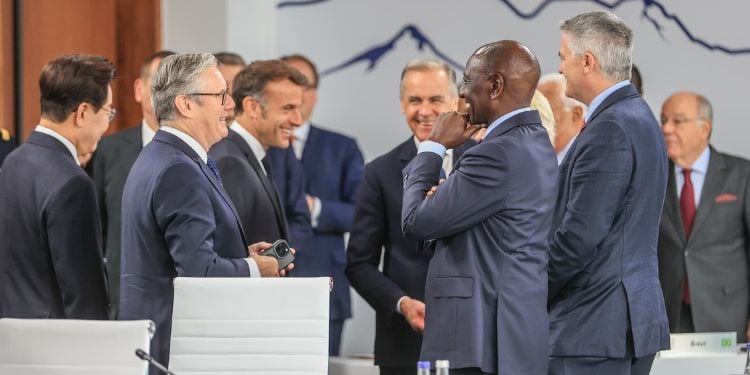
PHOTO | William Ruto | X