Micro, Small, and Medium Enterprises (MSMEs) constitute 98% of all businesses in Kenya. MSMEs account for approximately 83.82% (18.1 million informal sector workers) on the lower side to over 90% of the total employment of 21.6 million in June 2025. The upper bound of MSMEs’ contribution to Kenya’s GDP is estimated at 50%.
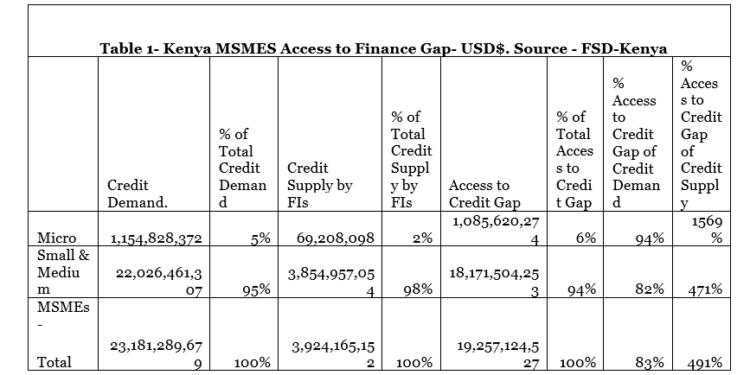
Table 1 below shows the Kenyan MSME financing gap estimate by FSD-Kenya at USD 19,326,332,625.
Supply Side (MSMEs) – Poor Record Keeping, High Bankruptcy Rate and Non-Performing Loans
Many MSMES lack bookkeeping systems. What this means for banks is that they do not receive financial statements to evaluate the loan, and they do not have visibility into cash flows. The solutions include training MSMEs in bookkeeping; digitizing their payments via Pochi la Biashara, tills, paybills (Pay With Equity (PWE), Lipa na M-PESA), and internet banking; implementing cash and liquidity management systems; and providing MSME customers with cloud-hosted accounting systems, e.g., Barclays/Sage.
MSMEs have lower survival rates, with 80% dying before their 5th birthday. The cure for this is Business Development Services, financial literacy and entrepreneurship education, mentorship and coaching.
Also Read: Simple Ways for Kenyans Protect Their Savings – Truthful Advice by a Banking Economist
High levels of non-performing loans among MSMEs are behind high interest rates in the sector, e.g., Equity Group Holdings Plc at 12.9% in Q1 2026. Solutions include derisking MSMEs by having banks sign MOUs with DFIs such as KFW, Proparco, BII, and the European Investment Bank.

The Government of Kenya’s pending bills (national government: Kshs.468.48 billion and county governments: Kshs.163.74 billion on 31st December 2025) are a key contributor to MSMEs’ high loan defaults, high MSME deaths, and banks’ reluctance to lend to government procurement suppliers. The solution to the pending bills crisis includes auditing, payments, and government adoption of accrual accounting.
High MSMEs Informality and Information Asymmetries
The majority of MSMEs are in the informal sector. Many do not have credit scores or SME Ratings from Credit Reference Bureaus. This means the banks are not able to easily differentiate between MSMEs with low and high risk of non-repayment. This causes the banks to impose high interest rates, which puts off low-risk borrowers, pulls in high-risk borrowers, and causes low levels of lending to the entire MSME sector. The solutions include banks making MSMEs their agents and merchants, providing MSMEs with cloud-hosted ERPs, digitizing MSMEs’ payments, and adopting ecosystem banking by linking MSMEs to corporates. Meaningful taxpayer-funded MSME credit guarantee schemes and expanding the number of Kenyans, MSMEs, mobile money, shylocks, mobile money, landlords, and utilities reporting to Credit Reference Bureaus.
CAMPARI – Character, Ability to Run the MSME, Margin (Collateral Securities)
CAMPARI is an abbreviation of the seven factors that banks use in deciding whether to give or deny MSME loans. Character assessment seeks to determine whether the bank can have confidence in the MSME’s banking and borrowing history, background, experience, premises, current assets, and age relative to the loan period. MSMEs need to invest in the strength of their relationship with their banks.
Ability assessment seeks to determine whether the MSME is well-run by reviewing its qualifications, experience, organizational structure, staff quality, business history, and succession planning. MSMEs need to invest in professional management with well-organized teams.
Margin (Collateral) represents the MSME asset, such as title deeds or log books, that banks hold to sell if the MSME fails to repay loans. The top 9 Tier 1 banks in Kenya hold Kshs 5.7 trillion of borrower assets as collateral. The solutions include group-lending guarantees, savings, cash-flow-based lending, and ecosystem banking.
CAMPARI- Loan Purpose, Amount, Repayment and Insurance
Purpose is the good reason as to why the MSME needs the loan, which will generate relevant returns. Banks hate MSMES who divert disbursed funds to other uses. What this means for MSMEs is that banks will frequently visit your premises, cross-sell their payment channels, or distribute drawdowns per milestones.
Amount is the loan size backed by capacity to repay cash flows. Repayment reviews the sources of money and timing of future repayments. MSMEs have to show the sources of cash flows for loan repayment and the diversification of income streams.
Loan life insurance, business insurance, and personal guarantees are further safeguards against non-repayment. The key person risk problem can also be addressed through CEO succession planning, family business training, seeking loans from banks with credit guarantee schemes, and MOUs with providers such as FMO Nasira, IFC, and AFDB.
Other Demand Side (Financial Institutions) Problems and Solutions
The high cost of credit, driven by high interest rates, deters MSMEs from borrowing or repaying loans. Banks can mobilize low-cost savings and current account (CASA) deposits to charge lower interest rates. CBK and the Kenya Bankers Association’s Total Cost of Credit marketplace allows MSMES to compare loan costs. The government’s fiscal and monetary policies can reduce inflation and interest rates, and lower government domestic debt, competing with MSMEs for bank loans.
Also Read: How to Start a Profitable M‑Pesa Business in Kenya
Data show banks’ preference for lending to traders, real estate, and transporters, while shying away from lending to MSMEs in the agriculture, manufacturing, and creative sectors. The solution is bank credit risk guarantee schemes.
Banks may lack customized products for MSMEs. The solution is a world-class MSME banking business model design, products, sales channels, human resources, ICT, and credit risk management.
Tips on Access to Finance for MSMEs
- Start with women and youth group lending methodology before transitioning into individual borrowing.
- Prioritize getting free financial literacy and entrepreneurship education training by banks like Equity and KCB.
- Read books on Personal Financial Management (PFM) and use bank PFM apps.
- Save and invest in accumulating assets you can use as collateral for big loans.
- A healthy entrepreneur equals a healthy MSME that bankers can trust.
- Partner with banks as their agent or merchant to get loans and many other benefits.
- Digitize your payments via till numbers and paybills to access loans.
- Automate transfers from your savings account to investment accounts.
Frequently Asked Questions (FAQs)
- Why do banks insist on getting collateral? CBK non-performing loan classifications require banks to deduct the value of collateral and set aside portions of their income as expenses for non-repayments, thereby protecting depositors.
- Why do banks insist on health insurance for the founders and CEOs of MSMEs? This is because the health of the MSME is closely tied to the health of the founder and CEO.
- What role do CRBs play when MSMEs apply for loans? CRBs are like a clearing house, helping banks to know the MSME’s previous loans, non-repayments, over-indebtedness exposure, and to deter MSMEs from defaulting.
Follow our WhatsApp Channel and X Account for real-time news updates.