Wednesday, October 14, 2026
  • News
    • Latest News
    • Breaking News
    • Fact Check
    • Investigations
    • Explainers
  • Politics
    • Global Politics
    • Elections
    • Government & Policy
    • Diplomacy
    • Conflicts & Security
    • Political Analysis
  • Business
    • Global Economy
    • Markets
    • Technology
    • Startups
    • Energy
    • Finance
  • World News
    • Americas
    • Asia
    • Asia Pacific
    • Africa
    • Europe
    • Middle East
  • Africa
    • Central Africa
    • East Africa
    • West Africa
    • Southern Africa
  • Health
    • Global Health
    • Public Health
    • Health Policy
    • Medical Research
    • Diseases & Conditions
    • Mental Health
    • Nutrition
    • Climate & Health
    • Health Explainers
  • Sports
    • World Cup 2026
    • Athletics
    • Basketball
    • Boxing
    • Cricket
    • Football
    • Formula 1
    • Golf
    • Rugby
  • Weather
    • Climate Business
    • Climate Change
    • Climate Solutions
    • Living Green
  • Culture
    • Arts
    • Film & TV
    • Food and Recipes
    • Music
    • Lifestyle
    • People
    • Travel
  • Opinion
    • Editorials
    • Letters
  • Behind The Brand
REGISTER
LOGIN
No Result
View All Result
The Kenya Times
  • News
    • Latest News
    • Breaking News
    • Fact Check
    • Investigations
    • Explainers
  • Politics
    • Global Politics
    • Elections
    • Government & Policy
    • Diplomacy
    • Conflicts & Security
    • Political Analysis
  • Business
    • Global Economy
    • Markets
    • Technology
    • Startups
    • Energy
    • Finance
  • World News
    • Americas
    • Asia
    • Asia Pacific
    • Africa
    • Europe
    • Middle East
  • Africa
    • Central Africa
    • East Africa
    • West Africa
    • Southern Africa
  • Health
    • Global Health
    • Public Health
    • Health Policy
    • Medical Research
    • Diseases & Conditions
    • Mental Health
    • Nutrition
    • Climate & Health
    • Health Explainers
  • Sports
    • World Cup 2026
    • Athletics
    • Basketball
    • Boxing
    • Cricket
    • Football
    • Formula 1
    • Golf
    • Rugby
  • Weather
    • Climate Business
    • Climate Change
    • Climate Solutions
    • Living Green
  • Culture
    • Arts
    • Film & TV
    • Food and Recipes
    • Music
    • Lifestyle
    • People
    • Travel
  • Opinion
    • Editorials
    • Letters
  • Behind The Brand
  • News
    • Latest News
    • Breaking News
    • Fact Check
    • Investigations
    • Explainers
  • Politics
    • Global Politics
    • Elections
    • Government & Policy
    • Diplomacy
    • Conflicts & Security
    • Political Analysis
  • Business
    • Global Economy
    • Markets
    • Technology
    • Startups
    • Energy
    • Finance
  • World News
    • Americas
    • Asia
    • Asia Pacific
    • Africa
    • Europe
    • Middle East
  • Africa
    • Central Africa
    • East Africa
    • West Africa
    • Southern Africa
  • Health
    • Global Health
    • Public Health
    • Health Policy
    • Medical Research
    • Diseases & Conditions
    • Mental Health
    • Nutrition
    • Climate & Health
    • Health Explainers
  • Sports
    • World Cup 2026
    • Athletics
    • Basketball
    • Boxing
    • Cricket
    • Football
    • Formula 1
    • Golf
    • Rugby
  • Weather
    • Climate Business
    • Climate Change
    • Climate Solutions
    • Living Green
  • Culture
    • Arts
    • Film & TV
    • Food and Recipes
    • Music
    • Lifestyle
    • People
    • Travel
  • Opinion
    • Editorials
    • Letters
  • Behind The Brand
No Result
View All Result
The Kenya Times ~ Trending, Breaking News and Videos
No Result
View All Result
ADVERTISEMENT

Protests in Kenya and Uganda Highlight Corruption at the Top – But Political Elites Don’t Give in Without A Fight

The ConversationbyThe Conversation
August 2, 2024
Reading Time: 8 mins read
A Collage Protests In The Streets Of Nairobi During The Anti-Government Demos (Left) And A Photo Of Protesters In Uganda. Photo/[Tkt/Courtesy]

A collage protests in the streets of Nairobi during the anti-government demos (left) and a photo of protesters in Uganda. photo/[TKT/Courtesy]

FacebookTwitterLinkedInRedditWhatsApp
Advertisement

The recent protests by young people in Kenya and Uganda have highlighted a form of corruption that is difficult to deal with: political corruption.

Compared to its cousin, administrative or bureaucratic corruption (such as a civil servant soliciting a bribe to provide a public service), political corruption is much more difficult to fight. This is because it is perpetrated by people who hold political power and influence. This class can fight back. Corruption gives them both the incentive and the means to hold on to power.

Political corruption takes place at the highest levels of the political system. It involves decision-makers who have the power to define the “rules of the game” and to make the laws. They include politicians elected (or nominated) to parliament, government ministers and politically nominated senior civil servants.

It is political corruption when people in high office abuse their public power for private benefit. It is political corruption when they divert public money for personal use, accept money in return for government contracts, and exert their influence in favour of private businesses (and businesses in which they have a stake).
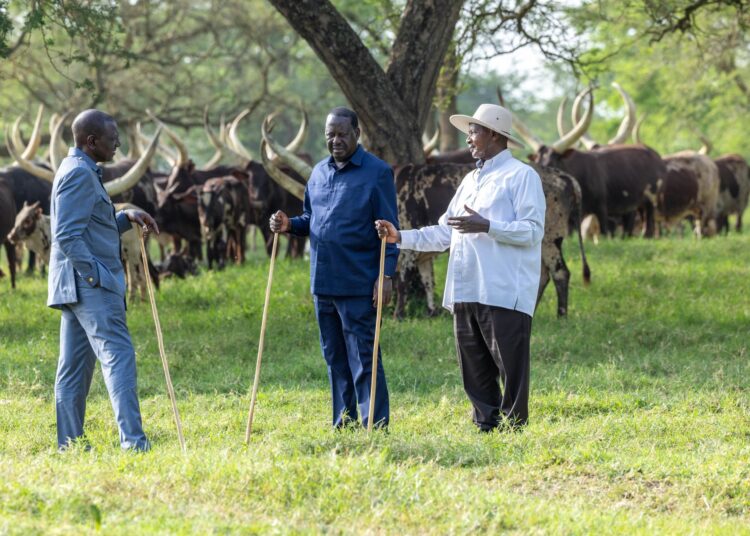
President William Ruto (Left) Former Prime Minister Raila Odinga (Center) And Uganda'S President Yoweri Museveni During Their Meeting In Uganda In February, 2024.
President William Ruto (left) Former Prime Minister Raila Odinga (center) and Uganda’s President Yoweri Museveni during their meeting in Uganda in February, 2024. photo/courtesy

Less well-known and less studied is the corrupt use of the ill-gotten proceeds and state funds to preserve or extend power of those in high office. It includes practices such as buying the support of individuals and businesses, capturing institutions of oversight and control, and using state resources to win elections.

This abuse of power can also be accompanied by violence, intimidation, threats and manipulation of elections.

The most detrimental impact of political corruption is that it destroys the power holders’ incentives to curb corruption. Political corruption persists because it serves a function beyond greed and personal enrichment. It keeps the regime together and afloat.

I am a political scientist focusing on democratic institutionalisation, political economy, political corruption and natural resources. My previous research on political corruption has covered several African countries, Palestine and Bangladesh. I draw my analysis from these and also the 2019 book Political Corruption in Africa, which I edited.

In my view, the mass protests against power abuse in Uganda and Kenya lately are good for two things: they shed light on the problem, and they put pressure on the power holders. The Kenyan president, for instance, has announced legal and administrative reforms to address charges of political corruption.

But this is rarely enough. Corrupt power holders have a strong tendency to fight back. They can even hijack the anti-corruption agenda and turn it into another tool for holding on to power.


Also Read: Gen Zs Announce Fresh Protests &Nane Nane & Unveil Line-up of Events


The anti-corruption trap

In the book that I edited, we outlined the two processes of political corruption – extractive and power preserving – in a number of African countries. The authors presented well documented cases, including:

  • vote-buying and clientelist tactics in Kenya
  • exceptions (leniency, pardon) given to corrupt people when joining the ruling party in Nigeria
  • military corruption integral to the survival of the political system in Uganda
  • both extractive and power preserving political corruption in Ghana
  • the “secret loans” affair that ravaged the economy in Mozambique
  • campaign financing and vote buying in Malawi
  • “state capture” in South Africa.

Africa is not unique. Political corruption is a widespread problem which has also driven people to the streets this year in Slovakia, Albania, Hungary, and Iraq.

At the same time, democracy in the world is in retreat.

World Bank data on the extent to which citizens in sub-Saharan Africa are able to participate in selecting their government, as well as freedom of expression, freedom of association, and a free media, have shown little improvement. This is a pointer to lower accountability to the public. Also, data on control of corruption, which captures perceptions of the extent to which public power is exercised for private gain, remains poor.

This is a strong indication that political corruption is holding back democratic development. In many African countries, extractive and power preserving political corruption go hand in hand.

The recent protests offer an opportunity to examine what the African anti-corruption movement is up against. Anti-corruption is politics. Illiberal leaders can use it to target political opponents and rivals as well as the media, civil society and activists. Anti-corruption can be used to bolster the legitimacy of corrupt leaders by “frying some small fish”, like the lower bureaucracy or certain socio-cultural groups.


Also Read: Museveni Accuses Foreign Forces of Funding Protests in Uganda


Anti-corruption has sometimes been redefined to focus on the business dealings of power holders’ rivals. Corrupt practices are tolerated when carried out by or serving the interests of the power holders. These include gift-giving, vote buying or handouts, special remuneration and advancement for loyal bureaucrats. The list also includes capital flight and secret contracting.

Anti-corruption institutions (like commissions) and the government institutions of oversight and control can also be politicised and disabled. Regime loyalists may be nominated to head them, or they can be starved of funding and competence. All of this protects corrupt power holders.

Then what?

Where corruption is politically embedded, anti-corruption efforts are resisted or made ineffective.

To avoid these risks, my co-researcher David Jackson and I have suggested a two-pronged approach. It involves direct anti-corruption interventions and indirect accountability and democracy reforms.

Direct anti-corruption is tailor-made for local conditions. Efforts should be made to counter both extractive and power preserving practices of the power holders as these are played out here and now. This requires a good analysis of the political economy of the regime: how does it get the money in, and how exactly is it reinvested in power?

Indirect anti-corruption sits within a broader framework of building accountability and democracy. Corruption is but one form of power abuse. Anti-corruption should therefore be seen as one – but important – element in the fight for democracy, equality and justice.The Conversation

Inge Amundsen, Senior Researcher, Chr. Michelsen Institute

This article is republished from The Conversation under a Creative Commons license. Read the original article.


Activists Boniface Mwangi (Left) And Hanifa Farsafi Participate In The Anti-Finance Bill Protests On June 25, 2024.
Activists Boniface Mwangi (left) and Hanifa Farsafi participate in the anti-Finance Bill protests on June 25, 2024. photo/TKT
The Conversation

The Conversation

The Conversation is an independent news organization that publishes evidence-based articles written by experts to help readers understand diverse topics. We cover a wide range of areas including arts, culture, education, health, politics, science, and more¹. Their content is characterized by in-depth analysis, research, news, and ideas from leading academics and researchers. The Conversation aims to provide academic rigor with journalistic flair.

Related Posts

Binge-Eating Among College Students With Abundant Junk Food, A Common Setting Linked To Binge-Eating Risks.

How Globalization and Food Insecurity Fuel Disordered Eating Behavior in Young Adults

October 14, 2026
From Knowledge To Impact: A New Era Of Kenya–Uk Science Diplomacy

From Knowledge Sharing to Innovation: A New Chapter in Kenya–UK Science Diplomacy

October 10, 2026
Kenyan Teaching And Teachers Received Awards For Outstanding Contributions On October 5, At The Kasarani Indoor Arena During National World Teachers’ Day.

What Would a Truly Professional Teaching Profession Look Like in Kenya?

October 7, 2026
Beyond Borders: Why Science Diplomacy Must Drive The Next Era Of Development

Why Science Diplomacy Must Drive the Next Era of Development

October 5, 2026
ADVERTISEMENT

The Kenya Times Facebook

LATEST NEWS

  • KCSE 2026 Timetable: Date and Time Each Paper Will Be Examined
  • Bobby Ogolla: How Gor Mahia’s ‘Six Million Dollar Man’ Made His Name
  • Motorist Jumps Out of Car, Recovers iPhone 15 Pro Max After Police Chase
  • Fastest Routes to Get From JKIA to Nairobi CBD
  • UDA Secretary General Hassan Omar Summoned
  • Safaricom Issues Response After Customers Report Unusual Phone Activity
  • Kenyan MP Wins Global Award
  • Profile of Esther Arunga, Former KTN Anchor Who Dropped Husband’s Surname After 16 Years
  • How Mamlaka Hill Chapel Grew From 80 Worshippers Under Bishop Ng’ang’a Before His Dismissal
  • Why SRC Asked 2 Senior Judges to Step Aside From High-Profile Car Allowance Case
  • India Issues Kenya Travel Advisory Over New Entry Requirement
  • Can You Drop Your Ex-Husband’s Name After Divorce in Kenya? What the Law Says
  • Dangote’s Lamu Refinery: Beyond Political Praise, Where Is the Business Case?
  • DCI Extends Same-Day Police Clearance Certificates to Diplomats and Foreign Nationals
  • Gachagua Hints at Fuel Price Increase Ahead of EPRA Review
ADVERTISEMENT

Company

About Us

Our Authors

Our Experts

Social Media

Policies

Privacy Policy

House Rules

Standards and Policies

Terms and Conditions

Subscription

My Account

Contact Us

Contact Us

Join Our Team

Advertise With Us

© Copyright 2026 | The Kenya Times | All Rights Reserved

Welcome Back!

Sign In with Facebook
Sign In with Google
Sign In with Linked In
OR

Login to your account below

Forgotten Password? Sign Up

Create New Account!

Sign Up with Facebook
Sign Up with Google
Sign Up with Linked In
OR

Fill the forms below to register

All fields are required. Log In

Retrieve your password

Please enter your username or email address to reset your password.

Log In
Your Privacy and Cookies
We use cookies on our website to give you the most relevant experience by remembering your preferences and repeat visits. By clicking “Accept”, you consent to the use of ALL the cookies.
Do not sell my personal information.
Cookie settingsACCEPT
Privacy & Cookies Policy

Privacy Overview

This website uses cookies to improve your experience while you navigate through the website. Out of these cookies, the cookies that are categorized as necessary are stored on your browser as they are essential for the working of basic functionalities of the website. We also use third-party cookies that help us analyze and understand how you use this website. These cookies will be stored in your browser only with your consent. You also have the option to opt-out of these cookies. But opting out of some of these cookies may have an effect on your browsing experience.
Necessary
Always Enabled
Necessary cookies are absolutely essential for the website to function properly. This category only includes cookies that ensures basic functionalities and security features of the website. These cookies do not store any personal information.
Functional
Functional cookies help to perform certain functionalities like sharing the content of the website on social media platforms, collect feedbacks, and other third-party features.
Performance
Performance cookies are used to understand and analyze the key performance indexes of the website which helps in delivering a better user experience for the visitors.
Analytics
Analytical cookies are used to understand how visitors interact with the website. These cookies help provide information on metrics the number of visitors, bounce rate, traffic source, etc.
Advertisement
Advertisement cookies are used to provide visitors with relevant ads and marketing campaigns. These cookies track visitors across websites and collect information to provide customized ads.
Others
Other uncategorized cookies are those that are being analyzed and have not been classified into a category as yet.
SAVE & ACCEPT
LOGIN | REGISTER
  • Login
  • Sign Up
  • Cart
No Result
View All Result
  • News
    • Latest News
    • Breaking News
    • Investigations
    • Explainers
    • Fact Check
  • Politics
    • Global Politics
    • Conflicts & Security
    • Elections
    • Diplomacy
    • Government & Policy
    • Political Analysis
  • Business
    • Global Economy
    • Markets
    • Technology
    • Startups
    • Energy
    • Finance
  • World News
    • Americas
    • Asia
    • Asia Pacific
    • Africa
    • Europe
    • Middle East
  • Africa
    • East Africa
    • West Africa
    • Southern Africa
    • Central Africa
  • Health
    • Global Health
    • Public Health
    • Health Policy
    • Medical Research
    • Diseases & Conditions
    • Mental Health
    • Nutrition
    • Climate & Health
    • Health Explainers
  • Sports
    • World Cup 2026
    • Athletics
    • Basketball
    • Boxing
    • Cricket
    • Football
    • Formula 1
    • Golf
    • Rugby
  • Weather
    • Climate Business
    • Climate Change
    • Climate Solutions
    • Living Green
  • Culture
    • Arts
    • Film & TV
    • Food and Recipes
    • Lifestyle
    • Music
    • People
    • Travel
  • Opinion
    • Editorials
    • Letters
  • Behind The Brand
  • Contact Us

Not enough quota to unlock this post
Unlock left : 0
Are you sure want to cancel subscription?