Voting is a way of exercising constitutional rights and the obvious fact of electing a preferred leader. However, how do Kenyans Vote? Does Tribalism influence the voting pattern in Kenya?
Do Kenyans vote based on tribal lines or policy interests? These are just a few questions asked while analyzing voting patterns in the country.
While it may be true that elections in Kenya are more than just ethnic census, it is only fair to admit that ethnic origins drive the voting pattern in the country.
Moreover, we live in a world where people have become selfish and individualistic. In that same cocoon, Kenyans have become biased over time regarding their tribes. People only want to help and uplift their tribe members because the good and value that comes from it bears the name of the tribe.
Kenyans have forgotten the importance of brotherhood ‘Undugu,’ fairness, and democracy. Tribalism has slowly consumed employment sectors and especially engulfed the country’s political climate.
For a long time, Kenyans have been voting along tribal lines because they believe it will benefit their community economically and development-wise. Besides, there is the need to identify with the ruling class as people tend to feel safe when they share either language or beliefs with the individuals in power.
Although ethnicity is key for Kenyan electoral behavior, it should not be the only significant marker in Kenyan politics. Some scholars argue that ethnicity serves more as an intermediate variable, influencing the fundamental rationales for electoral behavior, primarily economic variables. However, it is up to the Kenyan society to see that and act upon it.
Although there are Kenyans who have escaped demons of ethnicity, many still vote along tribal rather than policy lines. This explains why we hear phrases like ‘Raila Stronghold,’ ‘Ruto’s backyard,’ or ‘Odinga’s Bedroom,’ among others. Such phrases freely used even by media personnel usually refer to their regions of origin.
For instance, the Raila stronghold would be the Nyanza region, where most are Luo’s, whereas Rift valley constituting Kalenjins would be Ruto’s stronghold.
Nonetheless, this has not stopped various legislators from campaigning and holding rallies outside their ethnic strongholds. Moreover, candidates always try to win votes in areas dominated by their political rivals. Such steps may include forming alliances across the 40(+) tribes.
Forming alliances across tribes may seem like a step toward the right path. Unfortunately, it happens every election period and only worsens the existing political-ethnic divide.
What Is Ethnicity?
Different scholars have defined ethnicity differently. For some, ethnicity is an emotion-laden sense of belonging or attachment to a particular group (Horowitz, 1985; Shils, 1957).
Others see ethnicity as a social construct or a choice (Barth, 1969).
Some even call ethnicity a biological survival instinct based on nepotism (Van den Berghe, 1981).
A few consider it a mix of these different notions (Fearon & Laitin, 2000).
Nevertheless, all these definitions agree that ethnicity refers to aspects of relationships between groups that consider themselves and are regarded by others as being culturally distinctive. I believe ethnicity is a sense of belonging to a particular cultural group.
Tribalism In Colonial Era
Kenyan tribes lived peacefully in their distinct regions, freely practicing their culture. Different tribes had their own local set up of governance, and they lived free from each other until the coming of colonialists
Tribalism dates back to the colonial era, around 1920 to 1963, when Kenya was under British rule.
The British applied the divide and rule method of governance and played communities against each other.
The Agikuyu and Luo community fell victim to the divide and rule as they posed a threat to the colonizers due to their large population. It is then safe to say that the rivalry between the two communities has never been entirely put to bed even after independence.
The country, for a long time, was divided within tribal constraints. The ethnic groups from western Kenya, including Luo, Luhya, Kalenjin, Kisii, and Mount Kenya Region, commonly known as the GEMA community, include Kikuyu, Embu, and Meru.
Before colonialism, these two large groups had no contact with one another. Hence it can be deduced that tribalism is a product of colonialism, urbanization, and, consequently, the political culture that sprung up in independent Kenya.
The British magnified tribes’ differences, prompting clashes and fights between communities.
For instance, they spread negative tribal stereotypes to make one tribe feel superior to the other. The Kikuyu, for example, was made to believe that the Luo community was lazy, uncircumcised, and unreliable. In contrast, the Luhya were made to view the GEMA communities as schemers, liars, untrustworthy, and arrogant, among many more.
The sense of doubt progressed even after independence in 1963 when KADU (Kenya African Democratic Union) and KANU (Kenya African National Union) began fighting over power.
The Kikuyu and the Luo primarily dominated the KANU party. At the same time, KADU was a coalition of all the other small Kenyan tribes who feared being dominated by the Kikuyu/Luo alliance.
Nevertheless, KANU took over leadership, and Kenya adopted the unitary system of governance as opposed to “majimbo”- a federal system proposed by KADU.
Unfortunately, the unity between Luo’s and Kikuyu’s lasted a short while as Mzee Jomo Kenyatta, during his rule as president, favored his tribesmen- the Kikuyu, and sidelined Luo in his administration.
Kikuyus benefited from infrastructure, corruption benefits, and privileged access to government and parastatal jobs. On the other hand, while Luo’s held the Vice Presidency position, they experienced discrimination. Moreover, their complaints were met with intimidation and assassinations in some cases.
The tribal rift widened and solidified after the assassination of a Luo minister, Mr.Tom Mboya; blame was placed on Kikuyu personalities. Thence, it is needless to say a lot happened during this era to shape the current tribal divide in Kenya. Since then, Kenyan politics has essentially pitted Kikuyus against Luo, with each side attempting to attract other tribal groups to its side. However, the two communities have come together again in 2022, with Uhuru garnering votes for Odinga.
Unbroken Legacy
Tribalism still exists within us and around us. Kenyans have inherited the practice of voting along tribal lines, and unfortunately, I fear the 2022 general elections will go down the same path.
History proves that ethnic tensions have characterized Kenyan politics since independence. However, the demons of tribalism woke up strong in 2007 during the post-election violence when the presidential results were disputed. The violence saw thousands of Kenyans internally displaced while more than 1,000 people lost their lives.
While looking into the 2007 post-election violence, we realize the tribal divide in the nation majorly caused it. The 2007 presidential race between the late president Mwai Kibaki a Kikuyu and Raila Odinga a Luo did not go well. Kibaki emerged victorious, but his counterpart and political rival Raila disputed.
Moreover, Odinga mobilized political figures from most of the other tribes and formed the Orange Democratic Movement (ODM). Kibaki formed the Party of National Unity (PNU), which mainly comprised Kikuyu.
Therefore, the 2007 election was not based on policy interests, ideologies, or principles but on an avenue to vote out Kikuyu. In other words, it became a showdown between the Kikuyu- led PNU versus a coalition of other Kenyan tribes under the ODM umbrella.
As a result, violence broke out, and thousand lost their lives while many more were displaced when ODM said elections were rigged.
Politics and Tribalism Now
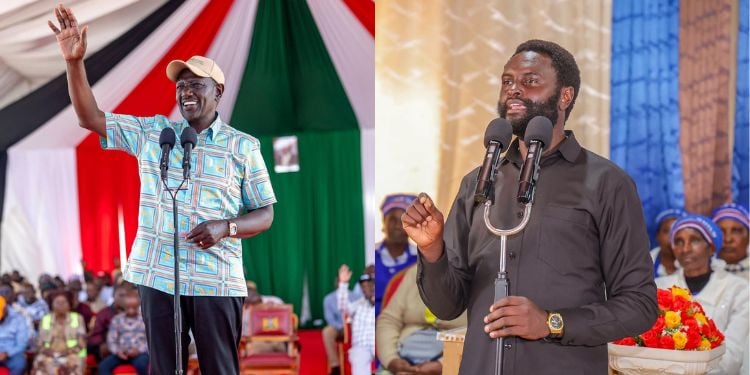
The two horses in the presidential race, Raila Odinga and William Ruto, are the most likely to be voted in candidates as per opinion polls. Raila has the support of Uhuru Kenyatta and further has Martha Karua as his running mate.
On the other hand, William Ruto has a mixture of the other tribes only this time, including Luhya leaders like Musalia Mudavadi and Moses Wetangula.
However, as they sell their manifestos and make promises to Kenyans, it is noticeable that during the campaigns, these politicians tend to lead with tribalism.
They talk of ‘watu wetu’ ‘waluhya’ ‘watu wa milima’ among many more. All these could be replaced by the larger Umbrella ‘Wakenya,’ but it seems as a country we are not there yet.
Moreover, in the current political sphere, leaders call on their tribe members when they want to support them.
Some politicians also use their tribes as leverage when they bargain for positions and favors in government. Take for instance, Kalonzo Musyoka’s case. The legislator has many supporters from the Ukambani region and did hesitate to use that to bargain for a slot in the Azimio government if the coalition wins the presidential bid.
Furthermore, tribalism has deeply cut into the voting patterns in the country, and as such, political figures try to form alliances with political big wigs from the ‘big five’ tribes. These tribes have a more significant influence on who is elected president due to their numerical benefits.
According to Kenya’s National Bureau of Statistics, as of 2019, the largest native ethnic groups are the Kikuyu (17.1%), the Luhya (14.3%), the Kalenjin (13.4%), and the Luo (10.7%), and the Kamba (9.8%).
Basing on the tribal divide, Kikuyus support President Uhuru Kenyatta, majority of Luo’s support Raila Odinga, the Kambas are behind Kalonzo Musyoka and the Kalenjins back William Ruto.
Nevertheless, the above statistics are why politicians are accused of playing the ethnic divide to get elected. Hence, elections are seldom based on issues, ideologies, or principles.
Effects of Voting Along Tribal Lines
Despite tribalism being a stumbling block to the entire democratic system, as well as the socio-economic development of the country, Kenyans still vote for their tribe members. There is undying loyalty to the tribe rather than the good of the country. Below are a few effects of tribal voting
- Underdevelopment
- Corruption
- Favoritism in Employment
- Rigging of elections and violence/civil war
- The exploitation of natural resources as well as underutilization of some
- Bad governance and lack of accountability as no one will criticize their tribesmen
- Erupting wrangles and chaos from opposing tribes
Changing The Tribal Narrative
Kenya has made attempts to end tribalism, especially after the 2007 violence. However, the dragon is yet to be slain. To put tribalism to bed, the government formed the Truth, Justice, and Reconciliation Commission in 2008.
The commission settled that ethnic conflicts majorly come from land inequality and regional imbalances. However, they never got to end tribalism.
Moreover, a second commission, the National Cohesion and Integration Commission, was formed to end the division between Kenyans.
The commission is responsible for promoting national identity and values, mitigating ethno-political competition and ethnically motivated violence, eliminating ethnic, racial, and religious discrimination, and promoting national reconciliation and healing.
Kenya seems stuck on the tribal path when it comes to presidential elections.
When you look at the current candidates and their outfits, Raila Odinga’s Azimio-La Umoja One Alliance has the support of big wigs from Kikuyu, Ukambani, and Luo.
On the other hand, Deputy president William Ruto’s Alliance is supported by Luhya community big wigs and Kalenjins.
Political coalitions are made along tribal lines and, as a result, will still shape the voting pattern in the country just like before.
Besides, everything has been ethnically politicized. Our politicians lack clear agendas during campaigns and focus on blame games and getting numbers. They may not directly play the tribal card, but it forms the basis of their plans to win the country’s top seat. They are relying on tribal arithmetic to gain control and get political mileage.
Also Read: Elections: Voting Rights And Wrongs
We are yet to see change; we are yet to see a country where people vote along policy lines rather than tribal bias. Similarly, it is about time we focus on policy interests, economic development, and our livelihood as opposed to the norm where we see tribe in leadership.