
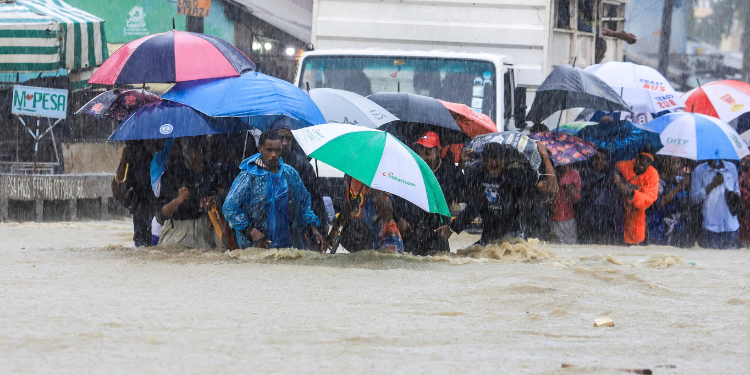
The Kenya Meteorological Service Authority (KMSA) has released its October-December 2026 rainfall outlook, detailing when the rains are expected to start and end in different parts of the country.
The forecast shows that several counties are likely to receive above-average rainfall during the season, with some areas expected to experience heavy rainfall events.
Mean temperatures are also expected to remain warmer than average across the country, with the highest probabilities of warmer conditions forecast over Kwale, Mombasa, Kilifi, Lamu and parts of Tana River, Taita Taveta and Garissa counties.
For October, above-average rainfall with higher probabilities is expected in Kwale, Mombasa, Kilifi, Lamu and Mandera, as well as parts of Taita Taveta, Tana River, Garissa and Wajir.
Above-average rainfall is also expected in Makueni, Kajiado, Machakos, Kitui, Nairobi, Kiambu, Murang’a, Kirinyaga, Embu, Tharaka-Nithi, Meru, Isiolo, Nyandarua and Nyeri.
The forecast also places parts of Taita Taveta, Tana River, Garissa, Wajir, Marsabit, Laikipia, Nakuru and Narok among areas likely to receive above-average rainfall in October.
Baringo, Bomet, Bungoma, Busia, Elgeyo Marakwet, Homa Bay, Kakamega, Kericho, Kisii, Kisumu, Migori, Nandi, Nyamira, Samburu, Siaya, Trans Nzoia, Turkana, Uasin Gishu, Vihiga and West Pokot are expected to record near-average to above-average rainfall.
Parts of Narok, Nakuru and Laikipia are also expected to experience near-average to above-average rainfall.
The Kenya Met has warned that heavy rainfall events are expected in several parts of the country during the month.
Kenya Met Forecasts Above-Normal Rains Across Counties in October-December
The onset of the October-December rainfall season will vary across the country.
In Nandi, Kakamega, Vihiga, Bungoma, Siaya, Busia, Baringo, Nakuru, Trans Nzoia, Uasin Gishu, Elgeyo-Marakwet, West Pokot, Kisii, Nyamira, Kericho, Bomet, Kisumu, Homa Bay, Migori and Narok, the rains are expected to continue from September into January.
The Kenya Met expects rainfall distribution in these areas to be fair to good.
In Nyandarua, Laikipia, Nyeri, Kirinyaga, Murang’a, Kiambu, Meru, Embu, Tharaka-Nithi and Nairobi, the rains are expected to begin in the second to third week of October and continue into January.
A similar timeline is expected in Machakos, Kitui, Makueni, Kajiado, Taita-Taveta and inland parts of Tana River County, where the rains are expected to begin in the second to third week of October and continue into January.
Also Read: Kenya Met Warns of Rain in 37 Counties This Week as El Niño Builds for October
The coastal counties of Mombasa, Kwale, Lamu and Kilifi, together with the Tana Delta, are expected to continue receiving rains that began in September. The season is expected to end between the first and second week of December in these areas.
In Turkana and Samburu, the onset is expected between the third and fourth week of October, with the rains likely to end in the first week of December. The distribution is expected to range from poor to fair.
Marsabit, Mandera, Wajir, Garissa and Isiolo are expected to receive the onset of the rains between the first and second week of October. The season is expected to continue until the first or second week of December, with fair to good distribution.
October Marks Start of Short Rains
October marks the transition from the cooler June-July-August period into the October-November-December short rains season.
Kenya Met says temperatures generally rise during October as the Intertropical Convergence Zone moves southwards across East Africa, bringing increased moisture and cloud cover.
Temperature conditions will vary depending on altitude, with the coolest areas expected in the highlands, where mean temperatures range between 15°C and 20°C.
The warmest conditions are expected in arid and semi-arid lowlands, where mean temperatures can exceed 28°C.
The month is also important for the onset of the short rains across much of Kenya.
Meru, Tharaka-Nithi, Murang’a, Embu and Busia are among the counties that typically receive more than 200mm of rainfall during October.
According to Kenya Met, several climate and weather systems influence the duration and intensity of October rainfall, including the Indian Ocean Dipole, El Niño Southern Oscillation, Madden-Julian Oscillation, tropical cyclones in the Indian Ocean, and subtropical high-pressure systems.
Also Read: Kenya Met Explains How 2026 El Niño Compares to 1997
Warmer Temperatures Expected
The OND forecast indicates that mean temperatures are expected to be warmer than average during the season.
The highest probabilities of warmer-than-average conditions are expected along the Coast, particularly in Kwale, Mombasa, Kilifi and Lamu, as well as parts of Tana River, Taita Taveta and Garissa.
Follow our WhatsApp Channel and X Account for real-time news updates.