The United Arab Emirates (UAE) has declared that it will fully support any United States‑led international operation to reopen and secure the Strait of Hormuz, amid rising regional tensions and continued disruption of global shipping routes.
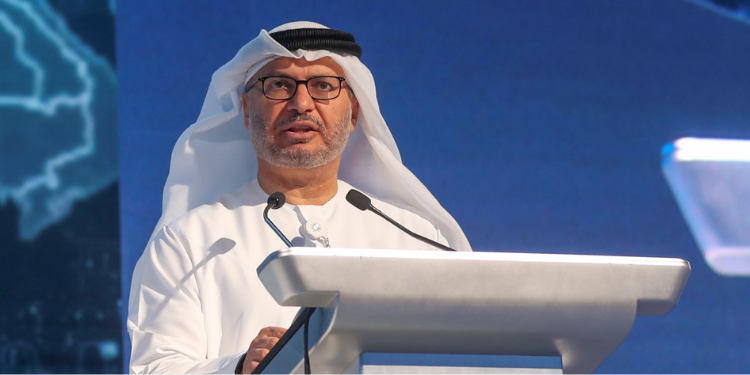
The pledge was made on April 5 by Anwar Gargash, diplomatic adviser to the UAE president, who said Abu Dhabi would participate in a coordinated international effort led by Washington but would not act alone as a maritime force.
“We are not ready to act as a maritime force on our own, but we will join any American‑led, international effort to secure navigation in the Strait of Hormuz,” Gargash said.
He added that the UAE is prepared to fulfill its role in guaranteeing free passage through the narrow waterway.
The statement marks one of the clearest signals yet from the UAE that it is prepared to support U.S. leadership in addressing the crisis surrounding the Strait of Hormuz, as shipping disruptions continue to raise global security and economic concerns.
UAE Positions Itself as Key Partner
Gargash stressed that the UAE sees Hormuz as an international issue, not a bilateral dispute. He said the waterway cannot be subject to pressure or control by any single country and must remain open as part of any broader effort to stabilize the region.
“For us, the Strait of Hormuz cannot be held hostage by one country,” he said, stressing the UAE’s view that free navigation must be guaranteed through collective action rather than unilateral military moves.
Despite failing to commit UAE forces independently, the comments position the country firmly within the U.S. diplomatic and strategic framework as Washington seeks partners to counter ongoing interference with shipping.
Also Read: UK Issues Middle East Operations Update Ahead of Anticipated Iran Bombing
The UAE hosts important U.S. military assets and has long served as a logistics and operations hub for allied forces operating in the Gulf.
The UAE’s measured language reflects an effort to balance support for security operations with caution against acting alone, a position consistent with its recent foreign policy approach of combining hard security cooperation with diplomatic restraint.
Abu Dhabi has joined UK-led diplomatic initiatives on the Strait of Hormuz and endorsed multinational planning aimed at restoring safe navigation, while keeping any military role tied to a broader coalition framework rather than a solo deployment.
Iran Factor Driving Escalation
Gargash’s remarks come amid increasing instability tied to Iran’s actions in and around the Gulf, including threats to shipping lanes and escalation across multiple fronts.
Also Read: Americans Nearly Lose Their Lives as Trump Makes Daring Move, Forcing US Plane to Escape Iran
These developments have increased the pressure on regional states to clarify their positions.
He warned that Iran’s strategy could have unintended consequences, particularly by strengthening the U.S. presence in the region rather than weakening it.
According to Gargash, ongoing pressure on maritime traffic would strengthen the U.S.’s role and could alter the security balance in the Gulf.
“The Iranian strategy will actually concretize the American role,” he said, adding that it would not reduce U.S. influence.
He also noted that such escalation could make Israeli involvement in Gulf security more visible, not less.
For the UAE, disruptions around the Strait of Hormuz carry direct economic and security risks.
The country is a key trade hub, and its ports, airlines, and logistics infrastructure rely on stable sea lanes.
Repeated threats to maritime traffic have already increased alert levels and forced regional governments to reassess security planning.