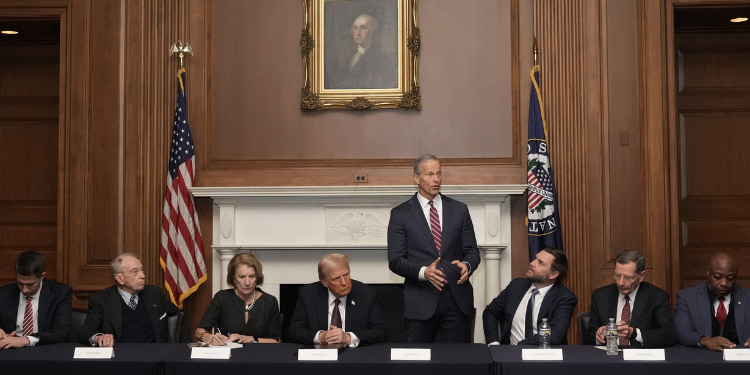
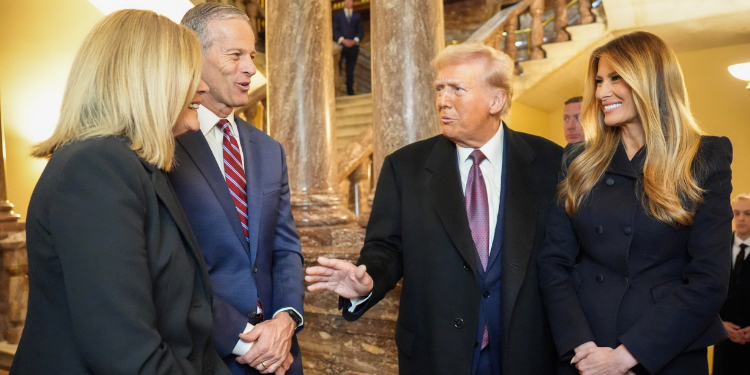
A proposal by U.S. Senate Majority Leader John Thune to consider passing the SAVE America Act through budget reconciliation has triggered sharp divisions within Republican ranks, with some lawmakers openly rejecting the strategy as unworkable.
Speaking to reporters on Tuesday, March 24, Senator Thune indicated that Republicans are considering a fallback option to advance the legislation through the Senate via reconciliation. This process would allow passage with a simple majority.
“We have two legislative vehicles, as you know, available to us so that we could tee one of those up, and that’s an option. And we’ll see if that’s what it takes to get some of these things across the finish line, and we can do it with simple majorities. We’ll take a hard look at that,” Thune said.
The Senator from South Dakota added that discussions among Republican senators showed “a lot of support for a budget reconciliation bill” and suggested the option could be used if necessary to advance the bill.
“I think that budget reconciliation, as I’ve said before, you have to have a reason to do it. And if we have reasons to do it, and we may, very well may, and I think there are a number of our colleagues in the Senate, we just came out of a luncheon where this was discussed, and I think there’s a lot of support for a budget reconciliation bill.”
Thune pressed on risks
During the exchange, Thune was directly challenged on whether relying on reconciliation — widely seen as procedurally difficult for policy-heavy legislation — risked backfiring politically.
He did not rule out the approach but stopped short of confirming it as a firm plan. Notably, the Senate Majority Leader also acknowledged that no concrete backup plan had been finalised, signalling leadership’s uncertainty about how to secure passage of the bill.
Also Read: Boost for Trump as Supreme Court Okays GOP-Favored Map Ahead of Midterms
The reconciliation proposal quickly drew criticism from within the GOP, with some lawmakers arguing the approach would fail under Senate rules.
Senator Mike Lee dismissed the idea outright, writing in a statement on social media, “There are many things the Senate could pass with a simple majority using the procedure known as ‘budget reconciliation.’ The SAVE America Act is *not* one of them.”
Lee insisted the legislation must continue through the standard legislative process, adding that “we need to keep debating it as we have been—until it passes.”
U.S. Representative for Florida’s 13th congressional district, Anna Paulina Luna, is also among the House members opposed to the plan.
In a statement, she criticized the reconciliation route as an attempt to avoid a direct vote on the bill’s voter ID provisions. Luna further accused Senate leadership of attempting to shift blame to procedural constraints.
“Under reconciliation, you can’t legislate policy, meaning you cannot include the Save America Act. I will be a NO on reconciliation. Stop sidestepping America, @LeaderJohnThune. They’re literally trying everything they can to get out of voting for Voter ID, and it is disgusting.”
SAVE America Act at center of Trump-backed push
The Safeguard American Voter Eligibility (SAVE) Act, often referred to as the SAVE America Act, has become a central legislative priority for Republicans aligned with President Donald Trump, who has pushed for stricter voter eligibility requirements ahead of the 2026 elections.
Newly sworn-in Department of Homeland Security (DHS) Secretary Markwayne Mullin on Tuesday reinforced that position during remarks at the White House, tying the bill to what he described as broad public backing.
Also Read: New DHS Chief Signals Hardline Shift on Voting, Claims 80% Support for SAVE America Act
The proposed legislation includes requirements for voter identification in federal elections and proof of citizenship during voter registration, measures Republican lawmakers argue are necessary to secure election integrity.
The reconciliation discussion is unfolding alongside a broader political fight over DHS funding. Senator Thune has repeatedly linked the SAVE America Act to negotiations over reopening DHS, which he said has been impacted by a prolonged funding standoff.
“Shamefully, we are on day 39 of the Democrat shutdown of the Department of Homeland Security. It is increasingly having effects across the country, as our airports and the TSA agents become more and more overrun. So it is time to end this. The time to end this is now,” Thune said earlier.
He added that Republicans plan to force votes on voter ID provisions, arguing there is widespread public support across political lines.
At the core of the GOP divide is whether the SAVE America Act meets the strict requirements for reconciliation, which is typically limited to budget-related measures.
Critics argue that major policy changes — such as voter ID mandates and citizenship verification — are unlikely to survive review by the Senate parliamentarian, who determines what provisions qualify under reconciliation rules.
This concern has been reinforced by previous legislative attempts where policy provisions were stripped from reconciliation packages.