
A federal judge has temporarily blocked the President Donald Trump administration from forcing universities to submit detailed admissions data intended to prove they are not considering race in student selection.
U.S. District Court for the District of Massachusetts judge Dennis Saylor IV on Friday, March 14, granted a temporary restraining order halting the policy.
Judge Saylor issued the order after 17 Democratic state attorneys general filed a lawsuit challenging the administration’s new reporting requirements.
The lawsuit argues the policy would force colleges to rapidly compile extensive data on applicants, admitted students, and enrolled students, including information on race and sex.
The requirements were introduced as part of annual federal surveys administered by the U.S. Department of Education.
Under the policy, universities would have been required to submit the data by March 18, including retroactive information covering the past seven years.
State officials said the timeline was unrealistic and could expose institutions to penalties or investigations if data were submitted inaccurately.
Massachusetts Attorney General Andrea Joy Campbell said the policy placed universities in an impossible position.
“This Administration’s unlawful and haphazard actions are threatening the well-being of Massachusetts students and the prosperity of our colleges and universities,” Campbell said.
“There is no way for institutions to reasonably deliver accurate data in the federal government’s rushed and arbitrary time frame.”
Trump administration argues transparency needed
The policy was introduced after President Trump raised concerns that universities might still be using indirect methods to consider race in admissions.
The administration argued that schools could be relying on essays or other personal statements to effectively bypass legal restrictions on race-based admissions.
In 2023, the Supreme Court of the United States ruled that colleges may not use affirmative action in admissions decisions.
However, the court said institutions may still consider how an applicant’s experiences with race have shaped their life if that information is shared in application essays.
Also Read: Trump Steps in to Free University Student Arrested by ICE After Mamdani Push
Officials in the Trump administration said the data-collection requirement was meant to ensure that universities complied with that ruling.
Education Department spokesperson Ellen Keast defended the effort.
“American taxpayers invest over $100 billion into higher education each year and deserve transparency on how their dollars are being spent,” Keast said.
She added that the expanded reporting requirements would help show how universities were handling admissions decisions following the Supreme Court’s ruling.
The administration’s policy directed Education Secretary Linda McMahon to expand data collection through the federal Integrated Postsecondary Education Data System (IPEDS).
The system gathers information from thousands of colleges and universities that receive federal student aid.
Under the directive, institutions would have been required to report detailed statistics, including the race, gender, academic records, and admission outcomes of applicants.
Failure to comply could trigger enforcement actions under Title IV of the Higher Education Act of 1965, which governs federal student financial aid.
Officials warned that non-compliant institutions could face penalties, including potential loss of federal funding.
States raise privacy concerns
Attorneys general behind the lawsuit also argued the new data requirements could jeopardize student privacy.
The coalition said collecting highly detailed admissions information could make it easier to identify individual students, especially in smaller institutions or specialized programs.
“Many institutions have data protection obligations to their students, which are placed at risk by the Administration’s new demands,” the lawsuit states.
The states also argued that the rushed timeline would yield unreliable data, potentially triggering unnecessary investigations.
Also Read: Republicans Unveil ‘Hybrid Filibuster’ Plan to Pass Trump Voter ID Bill
The administration’s push for expanded reporting also reflects agreements the federal government recently negotiated with several universities.
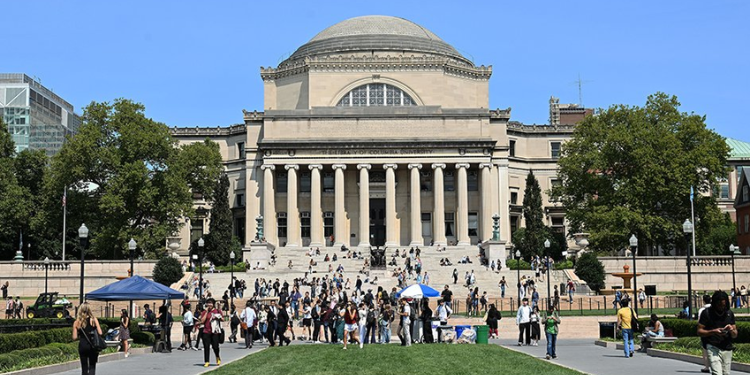
Institutions, including Brown University and Columbia University, agreed to provide detailed admissions statistics as part of settlements restoring federal research funding.
Those agreements required schools to share information on the race, grade-point averages, and standardized test scores of applicants and admitted students.
Under the new federal policy, similar data would be collected across thousands of institutions nationwide.
Judge Saylor’s ruling temporarily prevents the Education Department from enforcing the new reporting requirement while the lawsuit proceeds.
The decision does not resolve the underlying legal dispute but pauses the policy before the March reporting deadline.