
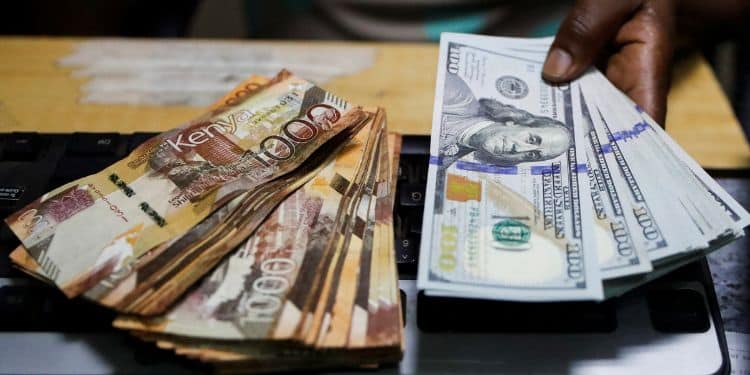
The Kenya shilling weakened against the US dollar for the second consecutive week, with the Central Bank of Kenya (CBK) quoting the currency at Ksh129.76 per dollar on October 2, up from KSh129.48 a week earlier.
The latest move puts the shilling within 24 cents of the Ksh130 mark, a level not seen since the currency’s recovery from the record lows in early 2024.
Kenya Shilling Weakens for Second Week
Even as the Kenya shilling weakened, Kenya’s foreign exchange reserves rose to $11.42 billion as of October 1 from $11.35 billion the previous week.
According to the CBK, the reserves were equivalent to 4.91 months of import cover, remaining above the statutory requirement of at least four months and providing an adequate buffer against short-term external shocks.
The Kenya shilling exchanged at Ksh129.71 per dollar on October 1 before weakening further to Ksh129.76 on October 2.
Also Read: Ruto’s Govt Conducts Business With Iran as 5,200 Containers Are Discharged at Lamu Port
Other major currencies also strengthened against the local unit, with the euro trading at Ksh146.40 and the British pound exchanging at Ksh171.62.
Remittances Continue Rising
Meanwhile, diaspora remittances remained strong, reaching $5.19 billion in the 12 months to August 2026, up from $4.99 billion recorded during a similar period in 2025.
Inflows in August alone stood at $468.5 million, a 12.2 percent increase from the same month last year.
The United States remained the largest source of remittances to Kenya, accounting for 53 percent of the total inflows during the review period.
At the Nairobi Securities Exchange, the NSE 20 Share Index closed at 2,986.60 points on October 1, up from 2,970.24 points a week earlier.
The 91-day Treasury bill averaged 7.94 percent, while the 182-day and 364-day papers averaged 8.48 percent and 9.99 percent, respectively.
Dollar Strengthens Globally
The US dollar recorded its second straight weekly gain as investors increased their demand for the currency amid weakness in other major economies.
The Dollar Index, which measures the dollar against six major currencies, rose about 1 per cent during the week to October 2.
It reached its highest level since April 2025, extending gains recorded in the previous week.
The euro remained under pressure against the dollar, with investors concerned about political and fiscal uncertainty in France.
The British pound also weakened, while the Japanese yen remained under pressure.
US Treasury yields also supported the dollar during the week as markets watched developments around US interest rates.
Higher yields can make dollar assets more attractive to investors seeking better returns.
Also Read: Safaricom Launches New System Deducting Money Automatically from M-PESA for Investment
The dollar remained firm even after US employment data released on October 2 showed that the economy added only 29,000 jobs in September, below the 90,000 expected. The unemployment rate also rose to 4.2 percent.
The weak jobs report increased expectations that the Federal Reserve could cut interest rates, limiting further dollar gains at the end of the week.
Impact on Import Costs
A stronger dollar can increase the cost of imported goods and services in Kenya because importers need more shillings to buy the same amount of dollars.
Fuel, vehicles, machinery, electronics, medicines, and industrial materials are priced in dollars.
Importers may pass higher costs to consumers through price increases.
Businesses that rely on imported raw materials can also face higher production costs. Kenyans paying in dollars for school fees, travel, medical care, and online services may similarly need more shillings.
However, exporters and Kenyans receiving dollar remittances can benefit because their dollar earnings convert into more shillings.
Follow our WhatsApp Channel and X Account for real-time news updates.