
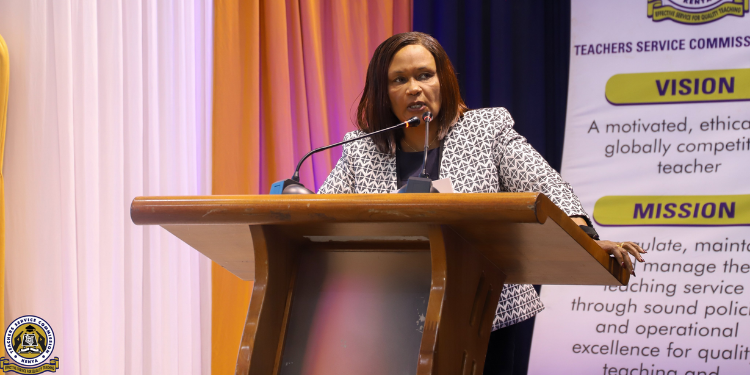
The Teachers Service Commission (TSC) is staring at a potential leadership crisis as the second and final acting tenure of Chief Executive Officer and Secretary Eveleen Mitei comes to an end on June 30, 2026, while a court case continues to block the recruitment of a substantive CEO.
By law, an acting office holder cannot serve beyond two consecutive six-month terms, meaning Mitei’s tenure will expire in exactly two weeks with no legal provision for a further extension.
TSC Faces Leadership Vacuum as Eveleen Mitei’s Final Acting Term Expires
Her departure threatens to leave the commission, which oversees more than 400,000 teachers across the country, without a substantive accounting officer at a time when major education reforms, including the implementation of the Competency-Based Curriculum (CBC) and secondary school transitions, require stable leadership.
The position is among the most powerful in the public service, controlling a wage bill running into hundreds of billions of shillings, and shaping key decisions on teacher recruitment, deployment, discipline and professional development.
The uncertainty follows the retirement of former CEO Nancy Macharia in June 2025 after a decade at the helm of the commission.
Mitei took over in an acting capacity in July 2025 before her appointment was extended for a final six months in January 2026.
Also Read: TSC Mulls Major Changes to Teacher Promotion Pathways: What It Entails
Efforts to recruit Macharia’s successor have, however, been repeatedly disrupted by court battles.
The recruitment process had briefly resumed earlier this year after a court lifted an injunction that had stalled the exercise since May 2025.
In a ruling delivered on January 29, the court dismissed a petition filed by Nyali-based petitioner Thomas Mosomi Oyugi, clearing the way for the Commission to proceed with the recruitment process it had temporarily suspended.
Oyugi had challenged the legality and constitutionality of Section 16(2) of the Teachers Service Commission Act, which requires candidates seeking appointment as CEO to hold a degree in education.
He argued that the provision was discriminatory and unfairly excluded qualified professionals from other fields, including finance, human resource management and public administration.
According to the petitioner, the requirements were “illogical and mischievously designed to favour one class of Kenyans (teachers and insiders in the Commission)” and violated constitutional principles on equality, non-discrimination, fair competition and merit-based appointments in public service.
Court Battle Derails TSC CEO Recruitment
However, the court found that the petitioner had failed to establish sufficient legal grounds to justify continued judicial intervention in the recruitment process for the head of the constitutional commission.
“Having found as I have herein above, that there hasn’t been a demonstration of a prima facie case in respect of the specific matters mentioned and that the Petitioner has not demonstrated the prejudice that he or the public would suffer if the conservatory order is not granted, I come to the inescapable conclusion that the instant application is for rejection. It is hereby rejected. The 1st Respondent is at liberty to proceed with the recruitment process, which was temporarily halted by order of this Court,” the judgment reads.
Also Read: TSC Proposes New Salary Rates and Job Grades for Teachers
The relief was short-lived. Just days after the recruitment exercise was cleared to proceed, the search for TSC‘s 10th CEO suffered another setback when the High Court issued fresh orders suspending the process.
In orders issued on February 3, the High Court in Kiambu halted the ongoing recruitment exercise, restraining the commission from implementing or continuing with the process pending the hearing and determination of a fresh application filed by Samuel Kariuki Kimata.
Justice Dorah Chepkwony certified the application as urgent and issued conservatory orders barring the commission from proceeding with the recruitment of the Secretary and Chief Executive Officer until the matter is heard and determined.
In her ruling, the judge ordered:
“That a conservatory order be and is hereby issued staying, suspending and restraining the 1st Respondent from implementing or continuing with the ongoing recruitment exercise of the Secretary/Chief Executive Officer of the 1st Respondent pending the inter-partes hearing of the application.”
Although the matter was heard inter-partes on March 5, 2026, and several mention dates have since followed, the conservatory orders remain in force, effectively freezing the recruitment exercise.
Leadership Vacuum Raises Stakes in TSC CEO Race
The ongoing legal impasse comes even as a newly constituted selection panel works to fill vacant commissioner positions at the commission.
With Mitei’s final day in office fast approaching and no substantive CEO in place, the TSC could soon find itself navigating an unprecedented leadership vacuum unless the courts clear the way for recruitment or an alternative legal solution is found.
Several high-profile names have been linked to the race, including former KNUT Secretary General Wilson Sossion, former Basic Education Principal Secretary Julius Jwan, and several senior TSC insiders.
Among them are Director of Staffing Antonina Lentoijoni, Finance Director Cheptumo Ayabei, Director of Quality Assurance and Standards Dr Reuben Nthamburi, and Head of Operations Gabriel Mathenge.
Why the TSC CEO Position Matters
The significance of the ongoing recruitment battle is underscored by the immense responsibilities attached to the office of the Secretary and Chief Executive Officer.
Under the Teachers Service Commission Act, the CEO serves as the head of the Secretariat, overseeing thousands of administrative staff at the commission’s headquarters and across all 47 counties.
The office holder is also the Accounting Officer, responsible for managing and accounting for a budget running into hundreds of billions of shillings, and is answerable to Parliament for the use of public funds.
In addition, the CEO acts as the custodian of records, safeguarding the professional profiles, disciplinary records and certification files of every registered teacher in the country.
The role further involves implementing the decisions of the commission, assigning duties to staff and ensuring compliance with public service values, ethics requirements and Chapter Six of the Constitution on leadership and integrity.
With the commission overseeing more than 400,000 teachers nationwide, the CEO plays a central role in shaping the welfare of millions of Kenyans who depend directly or indirectly on the teaching workforce.
The office also oversees teacher recruitment, deployment, promotion and discipline, manages the country’s massive teacher payroll and serves as the final authority on professional misconduct cases, making it one of the most influential positions in Kenya’s education sector.