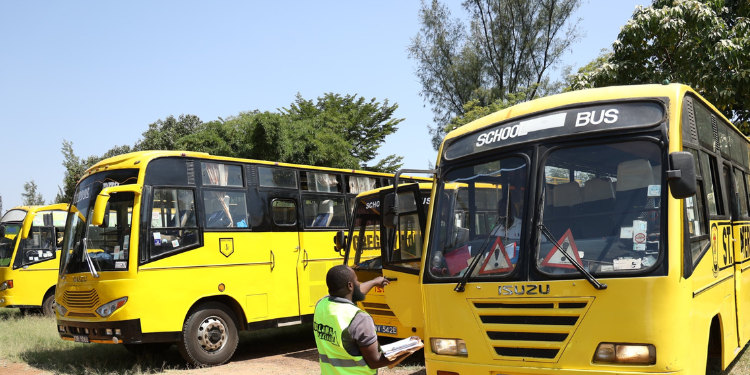
The National Transport and Safety Authority (NTSA) has issued safety measures directives to all schools that pick and drop students as schools reopen.
According to the NTSA, drivers involved in the school transportation should align with the NTSA set regulations for the student safety.
In coordination with the National Police Service (NPS), the safety authority will conduct mandatory compliance checks and inspections on all school buses and vans this week.
In a nationwide safety campaign, ‘Operation Watoto Wafike Salama’, the authority will focus on regulations to keep students safe as it intensifies the the countrywide safety crackdown.
Parents, school administrations, and school transport operators have been urged to prioritize the safety of students as the schools reopen.
In addition, all school transport operators have been requested to submit their fleets for inspection and confirmation of the safety of vehicles for children’s transportation.
“We call on parents, school administrations, and school transport operators to prioritize the safety of our children during this period. All school transport operators are expected to present their fleets for inspection to confirm that the vehicles are mechanically sound and safe for transporting children,” read a statement from the NTSA dated April 26.
Also Read: NTSA Sets Requirements for Starting a Driving School in Kenya
NTSA School Transport Operators Safety Checklist
Ahead of school reopening, the NTSA has issued a safety checklist to all school administrators and transport operators, which schools should ensure is fully complied with before using any vehicle for student transportation.
According to the safety authority, all school transport vehicles must be in good mechanical condition and have a valid inspection certificate, a Road Service License (RSL), and insurance.
School transport operators have been urged to visit the NTSA centers offering free vehicle inspection clinics.
In addition, all operational school buses and vans will be required to have safety features, including functional seat belts for all passengers, to reduce the risk of student injuries.
Further, the safety authority directed that all school vehicles be equipped with working speed limiters connected to the NTSA’s Intelligent Road Safety Management (IRSMS).
For easy identification of student vehicles, all school vehicles must be clearly marked as school transport on the front and, in some instances, on the rear.
Operational hours for all school transport, according to the authority, should not be before 6:00 a.m. or after 6:00 p.m. due to low-visibility risks.
Also Read: NTSA Rolls Out Stricter KD Plate Rules in New Crackdown on Misuse
Driver Compliance and Safety
For the safety of the students, all drivers operating school transportation must provide proof of the appropriate class of license.
In addition, the drivers must be medically fit, competent, and disciplined with no history of drug or alcohol abuse, with the authority regularly checking the drivers’ records for compliance.
Additionally, all school transport operators will stick to the approved NTSA routes, with no deviation during transportation.
Drivers will also be responsible for ensuring that no student hangs out of the windows while the vehicles are in motion and that all students remain seated with seat belts fastened before the vehicles start moving.
Proper supervision will be carried out by the vehicle operators during pick-up and drop-off at all times for safety.
Further, the operators are required to ensure that the vehicles they use are registered and fully licensed for school transport before use.
Schools’ administrations will be in charge of actively monitoring all the school drivers and transport operations.
Non-compliant vehicles and operators during the NTSA and NPS mandatory compliance check, starting the week of April 27, will not be allowed on the road.