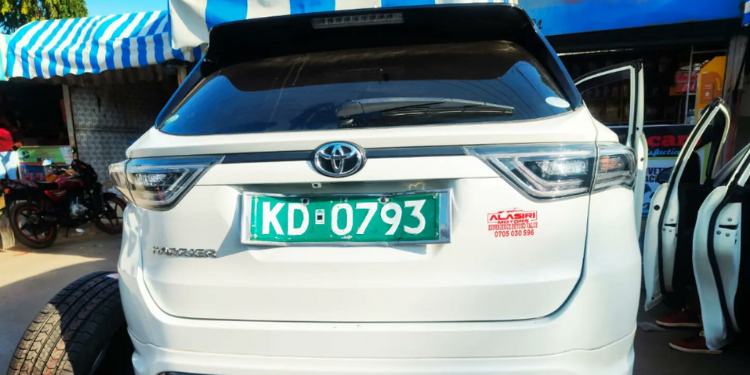
The National Transport and Safety Authority (NTSA) has moved to tighten controls on dealer registration plates, commonly known as KD plates
This move is aimed at curbing rising misuse and reinforcing compliance with road safety regulations.
Green KD plates are temporary plates issued by the NTSA to licensed motor vehicle dealers.
According to the NTSA, the updated measures are anchored in Section 24 of the Traffic Act (Cap 403), which governs the use of a dealer’s general license.
“The Authority, in undertaking its mandate, has implemented Section 24 of the Traffic Act that provides for the use of a dealer’s general licence,” said NTSA Director General Nashon Kondiwa.
NTSA notes that KD plates are increasingly being used outside their intended legal scope, prompting stricter enforcement and clear guidelines for motor vehicle dealers across the country.
Clear Limits on Use and Legal Purpose of KD Plates
NTSA Director General clarified that KD plates are not general-purpose registration plates and must be used only within strict legal limits, including vehicle testing and official transfers by licensed dealers.
Also Read: NTSA to Roll Out New Vehicle Inspection Rules: What They Mean for Motorists in Kenya
He clarified that KD plates cannot replace standard motor vehicle registration plates, even when dealers experience delays in obtaining official plates and its use is under the Kenyan law.
“A KD plate is not a substitute for a standard motor vehicle registration plate. Its use is strictly governed by the law,” Kondiwa stated.
Kondiwa stated that the law clearly defines both permitted and prohibited uses and that any misuse could incur penalties under traffic regulations.
Fees Revised as NTSA Reinforces Compliance Framework
Under the new framework, motor vehicle dealers will be required to comply with updated annual licensing fees.
New vehicle dealers will pay Sh9,600 annually, while second-hand dealers will pay KSh4,200. In addition, new KD plates will cost KSh18,500, with renewals set at KSh6,300.
NTSA director assured that adequate KD plates are available and can be applied via their accounts, dismissing concerns from some dealers who had warned that stricter enforcement could disrupt vehicle movement and operations in the sector.
Also Read: Court Suspends NTSA’s Instant Traffic Fines System
Crackdown on Illegal Plates and Insurance Compliance
NTSA also issued a warning against the use of improvised number plates, including paper and cardboard, stating that such practices have no legal basis under Kenyan traffic law.
The regulator further reiterated that all vehicles operating on public roads must have valid third-party insurance cover as required under the Insurance (Motor Vehicle Third Party Risks) Act.
“There is no provision for the use of printed papers, cardboard, or makeshift displays in the Traffic Act. The minimum legal requirement for all motor vehicles on public roads is Third Party Insurance. No vehicle can be used or permitted to be used on a road without a valid policy covering third-party risks.” added Kondiwa
NTSA states that the updated enforcement measures are part of efforts to streamline vehicle registration processes and improve compliance within the transport sector.
Legal Uses of KD Plates
According to the Traffic Act, Cap 403 KD plates may only be used under specific circumstances, ensuring that they are not misused for regular public transportation. The authorized uses of KD plates include:
- Inspection, examination, or test: Vehicles may use the KD plates when proceeding to or returning from any inspection, examination, or test. This ensures that vehicles undergoing mandatory checks can be moved within the framework of the law.
- Transporting vehicles for shipment: The plates are permitted for use when vehicles are being moved from a dealer’s premises to a railway station or wharf for shipment, or from a train or ship to the dealer’s premises.
- Post-construction tests: Dealers may use the plates for vehicles that are undergoing tests or trials during or after completion, construction, assembly, or repair. This is particularly relevant for vehicles that are still in the testing phase.
- Test drives for potential buyers: Dealers can also use the plates for test or trial runs by or on behalf of an intending purchaser, or for transporting the vehicle to the purchaser’s intended storage location.
- Weight measurement and registration: KD plates can be used when vehicles are taken to a public weighbridge to determine their weight, or when the vehicle is being registered.
- Movement between dealers or manufacturers: The plates are valid for transporting vehicles from one dealer’s premises to another dealer, manufacturer, or purchaser.
- Towing broken down vehicles: A dealer may use the KD plates to tow a vehicle that has broken down, transporting it to a repair or storage facility.
- Bodywork, painting, and repairs: The plates can be used for vehicles being taken to workshops for body fitting, painting, or repairs.
- Exhibitions: Vehicles may be moved to or from exhibitions of motor vehicles using the KD plates.