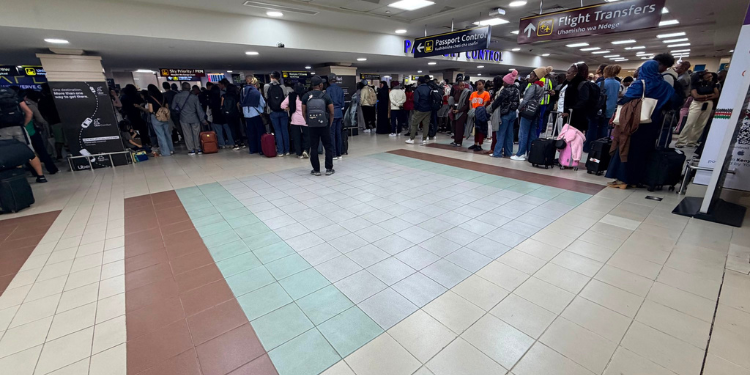
Kenya has tightened surveillance at Jomo Kenyatta International Airport (JKIA) after confirming the country’s first imported Ebola case.
Speaking on Wednesday, October 7, during a morning interview on NTV’s Fixing the Nation programme Health Cabinet Secretary Aden Duale said flights arriving from the Democratic Republic of Congo (DRC), Uganda, Tanzania, Rwanda, Burundi, Angola, Zambia, Ethiopia, South Sudan and the Central African Republic will be directed to a designated screening point at JKIA.
He said the aircraft will use Gate 16, where health screening facilities have been installed to assess passengers arriving from the affected countries.
“Any aircraft coming to JKIA from these countries will go to Gate 16 where our scanning health facilities have been placed,” he said.
Passengers will undergo mandatory health screening and complete health declaration forms before being allowed to proceed through the airport.
Duale warned travelers against providing false information on the forms, saying those who deliberately misrepresent their health information could face legal action.
“Declaration forms must be filled with all required truth. If you falsify it, in line with the Public Health Act, you are committing a crime,” he said.
Kenya Tracks 57 Ebola Contacts
The Ministry of Health has launched contact tracing following the arrival of the first confirmed Ebola case in Kenya.
Also Read: U.S. Issues Advisory Over Kenya’s Ebola Situation
According to the ministry, 57 people have been identified as contacts so far, and 10 have been placed in quarantine at different facilities.
The government has identified several facilities for isolation and treatment, including Kenyatta National Hospital, National Police Service Hospital and Moi Teaching and Referral Hospital.
Border facilities such as Malaba Health Centre, Kocholia Sub-County Hospital and Alupe Sub-County Referral Hospital in Busia are also being prepared to serve as temporary holding centres.
Public Health and Professional Standards Principal Secretary Mary Muthoni has said health officials across the country have been activated to respond to suspected cases.
In a statement on October 7, the PS said that the ministry is also working with county governments and faith-based health facilities to prepare for a possible increase in cases.
Muthoni said Kenya currently has no Ebola outbreak, describing the situation as an imported case under management.
“The country is not dealing with an outbreak, and we urge Kenyans to remain calm and vigilant and to rely on information from official Ministry of Health channels as we continue to monitor the situation,” stated the PS.
How Kenya’s First Ebola Case Was Detected
Duale confirmed Kenya’s first imported Ebola case on Tuesday, October 6.
The patient, a Kenyan citizen who had lived in the DRC for seven years, reportedly fell ill while in the country before traveling by road to Kampala and later taking a Jambojet flight to Nairobi.
He arrived at JKIA on October 3 and underwent routine screening at the Port Health facility before leaving the airport.
Also Read: How Kenyans Can Protect Themselves After First Ebola Case
He was later taken to Nairobi Hospital by a relative and a friend, where he was isolated before being transferred to an isolation facility.
Doctors suspected a viral infection after he developed symptoms including fever, chills, extreme fatigue, muscle pain, difficulty swallowing, and bleeding beneath the skin.
Laboratory tests conducted at the National Virology Reference Laboratory and Kenya Medical Research Institute (KEMRI) confirmed Ebola.
The patient died on Monday, October 5, at around 11:30 p.m. The Ministry of Health said preparations for his safe and dignified burial were underway under Ebola-safe burial protocols.
Govt Urges Kenyans to Avoid Gatherings, Hugs and Handshakes to Combat Ebola
Health Director General Patrick Amoth has urged Kenyans to avoid large gatherings, handshakes and hugs as the government steps up measures to contain the Ebola virus.
Amoth said large gatherings could increase physical contact and create opportunities for transmission, urging Kenyans to adopt alternative greetings such as waving.
“We are still in the response phase, and we really discourage large gatherings because they are a potential source of contact and therefore spread of the disease,” Amoth said.
He said the caution applies to political rallies, family events, church services, concerts and other large gatherings.
“Gatherings are potential hotspots for the spread of the disease, and they are discouraged, whether they are political or family gatherings. Any large gathering poses a risk,” he said.
Amoth also urged Kenyans to maintain basic infection prevention measures, including regular handwashing with soap and water, using hand rubs and seeking medical attention when symptoms develop.
The government has set aside an initial KSh2.6 billion for the Ebola response and is seeking additional funding from international partners. The funds will support surveillance, preparedness, contact tracing, and other emergency response measures.
He encouraged Kenyans to avoid handshakes and hugs and use alternative greetings as the country remains in the response phase.
Follow our WhatsApp Channel and X Account for real-time news updates