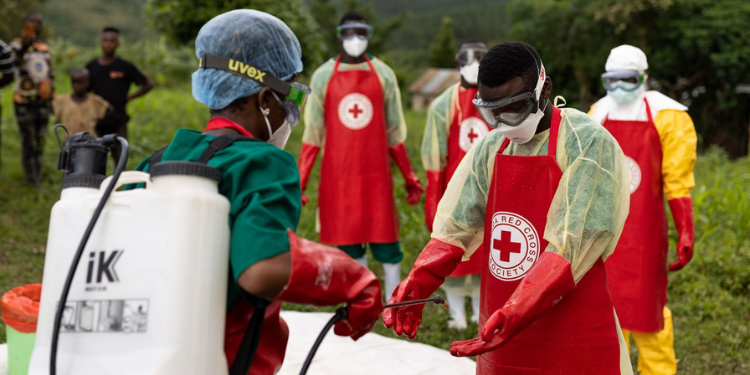
Kenya has turned to remdesivir, an antiviral drug used during the COVID-19 pandemic, in its response to the Bundibugyo strain of Ebola, which has nine confirmed cases as of October 21.
The government is introducing the medicine under a compassionate-use program as health officials explore treatment options for patients infected with the virus, which currently has no approved vaccine or specific treatment.
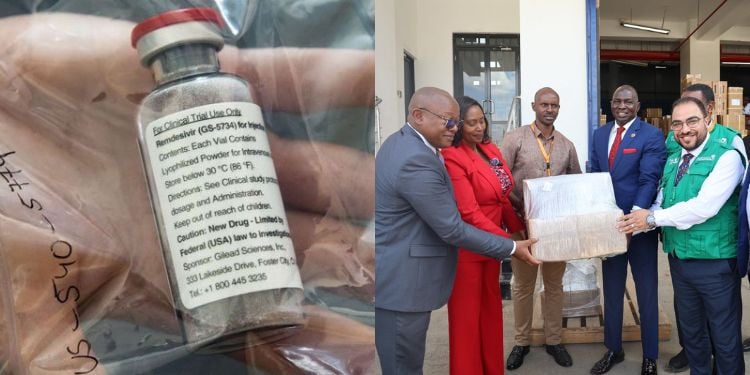
Kenya has received 500 doses of Remdesivir, a drug used during the COVID-19 pandemic, to support Kenya’s response to Bundibugyo virus disease.
In a statement on October 20, 2026, Africa CDC said the Government of Rwanda donated the antiviral drug to Kenya for compassionate use at the Kenyan government’s request.
Africa CDC facilitated the donation through bilateral coordination between Kenya and Rwanda. The doses were handed over to Mary Muthoni, Principal Secretary for Public Health and Professional Standards, in Nairobi.
“To support Kenya’s ongoing response to Bundibugyo virus disease, Africa CDC handed over 500 doses of Remdesivir to Mary Muthoni, Principal Secretary for Public Health and Professional Standards in Nairobi. The Government of Rwanda donated the antiviral therapeutic for compassionate use at the Government of Kenya’s request, following bilateral coordination facilitated by Africa CDC,” the statement read.
The agency also announced plans to support healthcare worker training and facilitate the deployment of medical experts from Uganda to strengthen clinical care in Kenya.
Why the Remdesivir Treatment in Kenya
Kenya is using remdesivir to treat patients infected with the Bundibugyo strain of Ebola, for which there are no approved vaccines or specific treatments.
The drug is being administered under a compassionate-use program to patients with limited treatment options.
Director-General for Health Dr Patrick Amoth said Kenya was cautiously assessing the treatment’s potential to relieve symptoms and improve patient outcomes.
“We are cautiously optimistic, given the results we are seeing from our Ebola treatment unit today,” Amoth said.
He confirmed that seven patients had received monoclonal antibodies under a compassionate-treatment program, with remdesivir planned as the next phase.
“Seven of those have received compassionate treatment in the form of monoclonal antibodies, and we hope to start the second part of the compassionate treatment using a medicine called Remdesivir tomorrow,” he said.
Remdesivir is an antiviral medicine that interferes with viral replication. It was used to treat some hospitalized patients during the COVID-19 pandemic, and Kenya is now evaluating its potential use against the Bundibugyo strain of Ebola.
DRC Ebola Treatment Trial
In the Democratic Republic of the Congo (DRC), patients infected with Bundibugyo virus disease receive supportive care, while eligible patients can participate in the World Health Organization (WHO)-backed PARTNERS trial.
Also Read: CS Duale Gazettes Strict New Ebola Rules and Penalties
The trial tests two treatments, MBP134, an experimental monoclonal antibody, and remdesivir, an antiviral drug previously used during the COVID-19 pandemic, to see whether they can improve survival.
“The PARTNERS (Platform Adaptive Randomized Trial for New and Repurposed Filovirus TreatmentS) trial will assess whether two antiviral therapies – a monoclonal antibody (MBP134) and remdesivir – can improve survival among people diagnosed with BVD.” WHO stated.
MBP134 is designed to help the immune system neutralize the virus, while researchers are testing remdesivir for potential activity against the Bundibugyo strain.
Neither treatment is an approved cure for the disease. Patients continue to receive supportive care, including fluids, oxygen where needed, symptom management and treatment for secondary infections.
Two Bundibugyo Ebola Vaccines Enter Human Trials as Research Advances
Vaccine research for Bundibugyo Ebola has reached the clinical-trial stage, but no vaccine has been proven effective against the strain in humans.
The Democratic Republic of the Congo (DRC) has received 70,000 doses of Ervebo, a vaccine licensed for the Zaire Ebola virus. However, its effectiveness against Bundibugyo Ebola in humans remains unknown.
Also Read: ‘No Ebola Here’: Uganda Hits Back After Nigeria Links Case to Kampala
The World Health Organization (WHO) recommended prioritizing Ervebo for testing in a randomized clinical trial during the ongoing outbreak in the DRC.
“On 7 August, the WHO Technical Advisory Group on candidate vaccine prioritization released a report regarding possible candidate vaccines for Bundibugyo virus disease. The members recommended that Ervebo, the only licensed Ebola vaccine (previously known as ebolavirus Zaire), be prioritized for inclusion in a randomized clinical trial in the context of the ongoing outbreak in the Democratic Republic of the Congo,” WHO stated.
WHO Director-General Tedros Adhanom Ghebreyesus also confirmed that two vaccines designed specifically against Bundibugyo virus have entered human trials.
“For the first time, two vaccines designed specifically against Bundibugyo virus have entered human trials. A separate vaccine has shown cross-protection in animal studies, and we are moving it toward a phase three trial,” he said.
The two vaccine candidates are the University of Oxford’s ChAdOx1 BDBV (also known as BD-Ebov), which is in a Phase 1 trial in the United Kingdom, and Moderna’s mRNA-1469, which is in a Phase 1 trial in Canada.
Follow our WhatsApp Channel and X Account for real-time news updates.