When Kenyans switch on a light bulb at home, few stop to think about the dangerous work that goes into ensuring electricity reaches their homes uninterrupted.
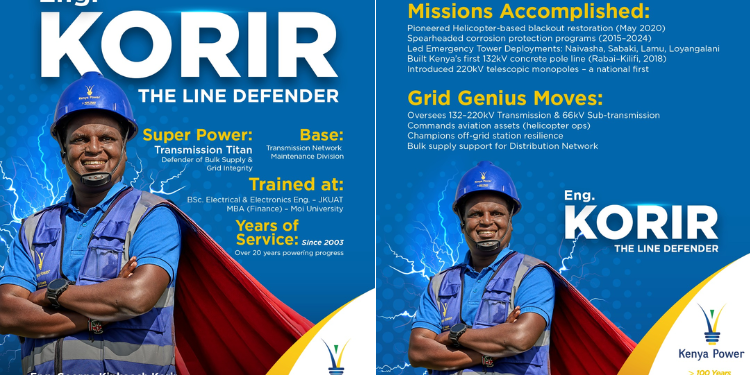
From helicopter-based restorations to building the country’s first 132kV concrete pole line, Eng. George Korir doesn’t just maintain the grid; he defends it.
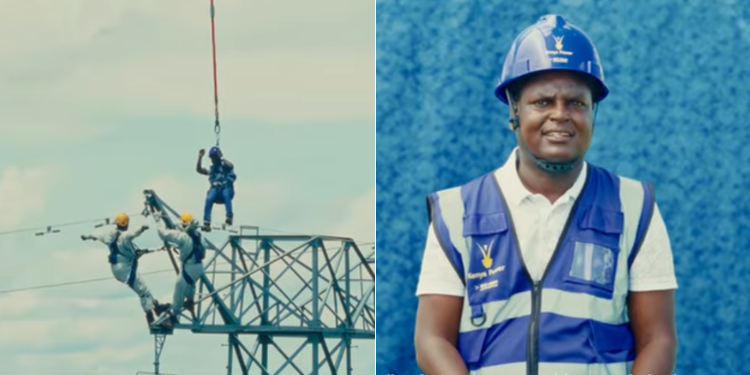
For Korir, keeping the country’s power flowing means working just inches away from live transmission lines carrying up to 500,000 volts of electricity—an environment where a single mistake could be fatal.
Speaking in a video highlighting behind-the-scenes work on how the Kenya Power team works around the clock to keep you powered, Korir explained the enormous infrastructure behind Kenya’s power network and the risks involved in maintaining it.
The Infrastructure That Keeps Kenya Powered
According to Kenya Power, the country’s electricity network stretches approximately 320,000 kilometres, a distance equivalent to circling the Earth about eight times.
Electricity generated at major power plants such as Olkaria is transmitted through high-voltage lines before being stepped down at substations and distribution transformers for use in homes and businesses.
Korir explained that the distribution transformers commonly seen in residential estates carry about 11,000 volts, while power transformers found at substations handle between 66,000 and 220,000 volts.
Transmission lines, however, carry between 220,000 and 500,000 volts, making them among the most dangerous parts of the electricity network.
He noted that substations are highly restricted areas where even trained engineers cannot enter without clearance from system controllers, who issue permits before any maintenance work begins.
According to Kenya Power, strict communication procedures are followed before engineers can access electrical equipment to minimize the risk of accidents.
Eng. George Korir Shares What It Takes to Work on Live 500,000-Volt Power Lines
The most dangerous part of his job involves climbing transmission towers to repair live power lines without interrupting electricity supply.
Unlike routine maintenance that requires power to be switched off, some transmission line repairs are carried out. In contrast, the lines remain energized to avoid widespread blackouts and major disruptions to homes, businesses and critical services.
While working high above the ground, Korir secures himself to the transmission tower before moving close to the live conductors.
He said the work demands complete concentration because any miscalculation could cost a life.
“My job is to work around live 500,000-volt transmission lines so that Kenyans continue to have electricity. People often ask me how I get up there,” he said.
” Once I’m in the air, I have to secure myself properly because one wrong step can be fatal.” “When I get up there, everything goes silent. It’s just me and the electricity. There is only a very thin line between life and death.”
Korir added that becoming a live-line maintenance engineer requires years of specialized training, professional certifications, examinations and continuous refresher courses.
“It took me years to reach this level. There was extensive training, professional certifications, examinations and even more training,” he said.
He described the profession as one that demands courage, physical strength, confidence and discipline.
Many people often ask why he chooses such a risky career, but his answer remains simple..”
“Whenever people ask me why I chose this career, I ask them, ‘Why not?’ Somebody has to do it. For them, for you,” he said, urging Kenyans to remember the sacrifices made by engineers every time they switch on a light at home.
Also Read: Who Runs Kenya Power? Full List of KPLC’s Top Leaders
Eng George Korir Mission
Korir has worked in Kenya’s electricity sector since 2003, rising through various engineering positions to lead transmission network operations.
His career has seen him oversee the maintenance of transmission lines ranging from 66kV to 220kV, support bulk electricity supply to the distribution network and coordinate helicopter-assisted operations for transmission line maintenance.
George Korir has led several key projects in Kenya’s electricity sector. They include pioneering helicopter-based blackout restoration in 2020, and leading corrosion protection programmes for transmission infrastructure.
He also oversaw the emergency transmission tower deployments in Naivasha, Sabaki, Lamu and Loiyangalani, helped build Kenya’s first 132kV concrete pole transmission line between Rabai and Kilifi, and introducing the country’s first 220kV telescopic monopoles.
Also Read: Full List of Kenya Power’s Top Shareholders and Their Ownership Stakes
Korir’s Career and Education
He currently serves as a Manager at Kenya Power, having taken up the role in October 2024. Before that, he was Manager – Electrical Plant between March 2024 and January 2026.
Before joining Kenya Power’s management team, Korir spent over 21 years at the Kenya Power and Lighting Company (KPLC), where he held several technical and leadership positions.
He served as Chief Engineer, Transmission Network Maintenance from 2017 to 2024, overseeing the maintenance of Kenya’s high-voltage transmission network.
He also served as Chief Engineer, Technical Services; Senior Transmission Engineer; Energy Transmission Engineer; Transmission Engineer; Power System Protection Engineer; Electrical Plant Workshop Engineer; Assistant Workshop Engineer; and Graduate Engineer, building extensive experience in operating and maintaining the national electricity grid.
Korir holds a Bachelor’s degree in Electrical Engineering from the Jomo Kenyatta University of Agriculture and Technology, where he studied between 1997 and 2001, and later earned a Master of Business Administration (MBA) from Moi University.
He completed his secondary education at Lenana School.
Follow our WhatsApp Channel and X Account for real-time news updates.