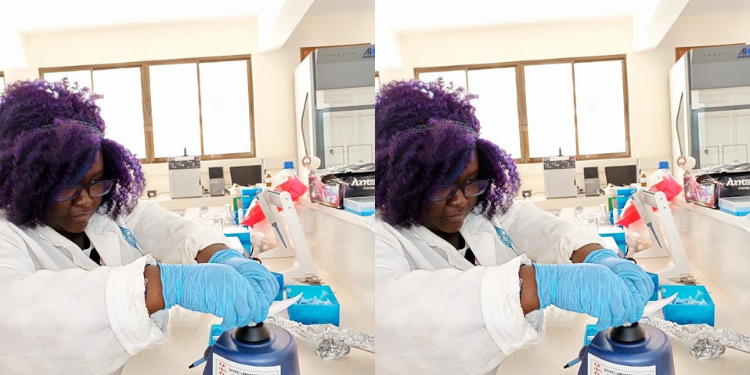
Teresia Nyambura Wacira is a Kenyan scientist and diver and is the first woman in the Kenya Marine and Fisheries Research Institute (KMFRI) Laboratory Department to earn a PhD.
Wacira’s journey from studying theology to pioneering marine biotechnology exemplifies resilience, determination, and academic excellence.
Despite financial and educational challenges, she advanced from secondary school setbacks to being the first person to earn a PhD in Biotechnology from the Technical University of Mombasa (TUM),
Teresia Nyambura’s Early Life and Education
Wacira was born in Nakuru County and began her education at Lanet Nursery School in 1989.
She continued at Nakuru East Primary School for classes 1 and 2, before moving to Kimbo Primary School in Nairobi in 1993.
Nyambura sat for her Kenya Certificate of Primary Education (KCPE), scoring 447 marks.
She joined Ruiru Girls High School, a day school, where she excelled academically, consistently ranking first in her class.
Also Read: Fiona Akoth: First Kenyan Woman to Become a United States Air Force Pilot
When she sat for the Kenya Certificate of Secondary Education (KCSE), she scored a B-, which fell short of the eligibility threshold for financial support from the Higher Education Loans Board (HELB).
While awaiting her results, Wacira worked at a salon in Githurai, braiding hair and offering makeup services, where she met the well-wishers.
With help from well-wishers who helped her to pay the school fees, Wacira repeated Form Four at Muruguru Girls Secondary School in Nyeri in 2005 and later scored a B+, qualifying for the Joint Admissions Board (JAB) and HELB funding.
Before joining the university, Wacira undertook a one-year discipleship training program at Camp Jabez in Gilgil, where she studied theology, youth ministry, and farm skills. On one mission to Samburu County, she preached the Gospel while enduring harsh conditions that tested her adaptability and perseverance.
In 2008, her name was published in a Kenyan newspaper as a JAB beneficiary, stating that she was to join Jomo Kenyatta University of Agriculture and Technology (JKUAT) to pursue a Bachelor of Science in Industrial Microbiology and Biotechnology.
Wacira then enrolled for a master’s degree in biotechnology from 2019 to 2022.
While studying for her master’s degree, she became a part-time lecturer at TUM. The same year, she earned her ISO 24801‑2 PADI Open Water Diver license.
In August 2022, Nyambura enrolled in a PhD in Biotechnology at TUM, completing it in October 2025, during which she specialized in mangroves, marine sponges, and their bioactive compounds.
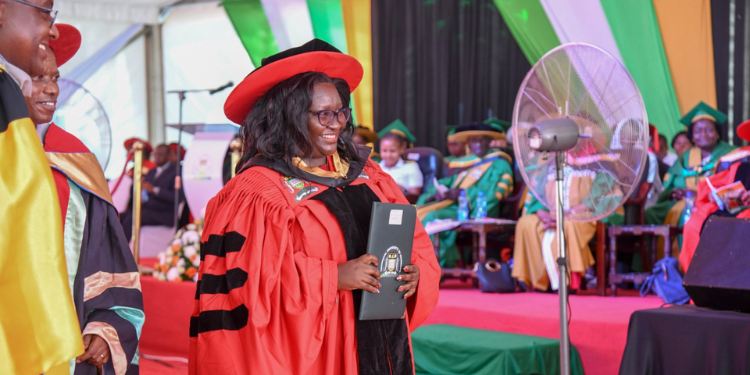
Nyambura’s doctoral work focused on molecular genetics and bioinformatics, and she graduated in November 2025 with four publications to her name as the first author.
Career Background
Wacira’s professional career began at KMFRI in 2013 as a volunteer intern.
In 2014, she was employed as a Laboratory Technologist and later served as Laboratory Unit Head of Microbiology for 7 years.
Currently, she serves as Head of Laboratory Services in the Freshwater Systems Directorate, overseeing stations in Kisumu, Turkana, Baringo, and Naivasha.
From 2016 to 2023, she served as a board member of Tabasuri DT Sacco. She held trade union leadership roles with UNRISK and COTU and attended international conferences sponsored by the Friedrich-Ebert-Stiftung (FES).
She also joined the FES Gender Justice Working Group and is a trainer at the Global Outlook Trade Union School (GOTUS) for the 2026 cohort.
Scientific and Leadership Achievements
She won the Number One logo design award at the Leibniz Centre for Tropical Marine Research (ZMT) Fish Barcoding workshop, establishing KMFRI’s first Molecular Genetics and Bioinformatics Laboratory at Kisumu, attracting major research funding in collaboration with Cornell University, ILRI, and USAID.
Also Read: Jacinta Mutwiwa: Kenyan Mathematician Who Earned Her PhD Before 30 and Scored 299 in KCPE
She also participated in key scientific conferences, including the African Scientific Conference on Advancing the Blue Economy, organized by UNESCO in 2025.
Her dedication has earned her the KMFRI Overall Best Performer trophy for two consecutive years (2022–2024), with her portrait displayed on the institute’s Wall of Fame.
From March 2016 to March 2023, she served as a Board Member of Tabasuri DT Sacco, overseeing credit department processes.
As a trade unionist with the Union of National Research Institutes of Kenya (UNRISK) under COTU, she joined the Global Outlook Trade Union School (GOTUS) at Tom Mboya Labor College in Kisumu in 2016, where she studied leadership, international labor laws, and global governance.
She later represented Kenya, sponsored by the Friedrich-Ebert-Stiftung (FES), at the Young African Activists Network (YAAN) conferences in Dar es Salaam (2016), Johannesburg (2017), and Gaborone (2018).
In 2024, she joined the FES Gender Justice Working Group and was recently appointed as a GOTUS trainer for the 2026 cohort.
She emerged as the position-one winner in logo design at the Leibniz Centre for Tropical Marine Research (ZMT) Fish Barcoding workshop. She established KMFRI’s first Molecular Genetics and Bioinformatics Laboratory at the Kisumu Centre, an achievement that attracted major research funding in collaboration with Cornell University, ILRI, and USAID.
She was also nominated to the Local Organizing Committee for the 2nd Aquatic Resources and Blue Economy Conference (ARBEC II) in 2024, before presenting in Mombasa at the African Scientific Conference on Advancing the Blue Economy, organized by UNESCO in 2025.
Her dedication has earned her recognition, including KMFRI’s Overall Best Performer trophy for two consecutive years (2022–2024), with her portrait displayed on the institute’s Wall of Fame.
Beyond her laboratory work, Teresia continues to inspire young women, proving that determination and perseverance can transform challenges into milestones with her affirmation, “Science gave me a voice, but resilience gave me the strength to use it.”