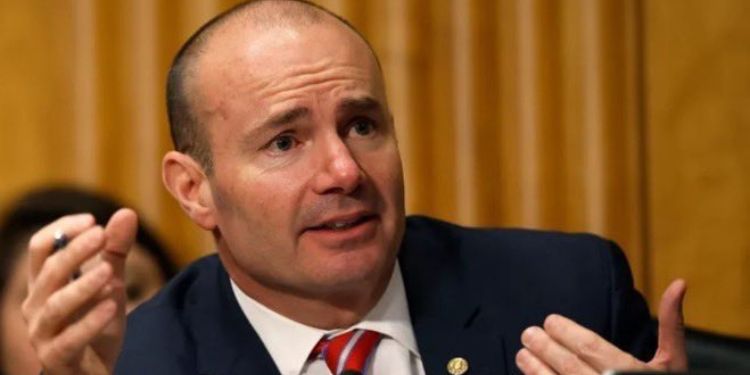
Senator Mike Lee has explained that Republicans will use the talking filibuster in the Senate to advance the SAVE America Act, a bill that requires documentary proof of U.S. citizenship for federal voter registration, thereby ensuring full debate and preventing procedural delays from blocking the legislation.
The bill, co-authored with Representative Chip Roy, seeks to implement voter ID requirements for federal voter registration.
Senator Mike Lee, in his statement, emphasised the use of the talking filibusters in the Senate, stating that procedural delays must involve active debate rather than “zombie filibusters.”
“Tell them we need to invoke the talking filibuster in the United States Senate,” he said in part of his statement.
Senator Mike Lee Calls for Support
In his explanation, Senator Mike Lee explained that after two years of preparation, the SAVE America Act will come to the floor of the United States Senate.
Lee urged citizens and lawmakers to support the bill and to encourage Senators to back its passage.
“I invite all, within the sound of my voice, who would like this bill to become law, to reach out to as many people as possible. Friends, neighbours, and especially United States Senators who might listen to you. Ask them, please, to get this passed. Tell them we need to invoke the talking filibuster in the United States Senate,” he said.
Also Read: Republicans Unveil ‘Hybrid Filibuster’ Plan to Pass Trump Voter ID Bill
The Senator stressed the need to remain focused on the bill until it becomes law, calling for full commitment and framing the legislation as vital to protecting the integrity of the Republic.
Filibusters and how they’re used to pass unpopular bills
Filibusters are a procedural tactic used in the United States Senate to delay or block a vote on a bill.
Senators can speak for extended periods or use other delaying measures to prevent legislation from advancing.
One of the most notable historical examples of a filibuster occurred in 1957, when Senator Strom Thurmond of South Carolina spoke continuously for 24 hours and 18 minutes to block the Civil Rights Act of 1957.
Also Read: GOP Revolt: Dozens of Republicans Ready to Block Senate Bills Over Voter ID Law
The extended speech aimed to delay the legislation designed to expand federal protections for voting rights, although the bill ultimately passed shortly after the filibuster ended.
Filibusters are often employed by the minority party to oppose bills they consider controversial or unpopular.
By prolonging debate, they can force negotiations, amendments, or even the withdrawal of legislation.
To overcome a filibuster, the majority can invoke a procedure called cloture, which requires a supermajority vote to end debate and move to a final vote on the bill.