


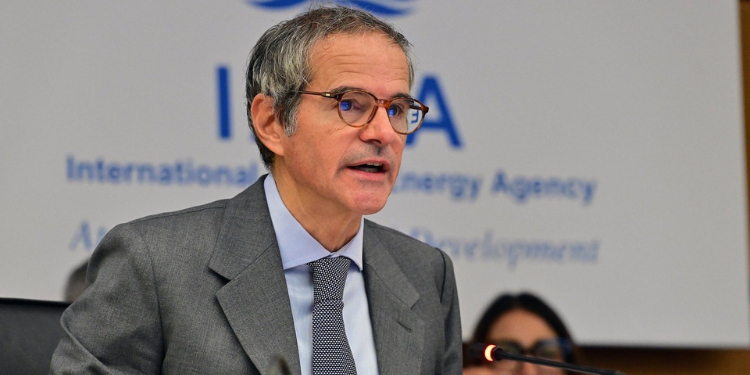
Director General of the International Atomic Energy Agency (IAEA), Rafael Grossi, has urged that any agreement between the United States and Iran include strict, detailed verification measures to monitor Tehran’s nuclear activities.
Speaking during a press briefing in Seoul, South Korea, on Wednesday, April 15, Grossi argued that Iran’s nuclear program is extensive and requires continuous monitoring by international inspectors.
“Iran has a very ambitious, wide nuclear program, so all of that will require the presence of IAEA inspectors,” said Rafael Grossi.
The director general said that without proper monitoring, any agreement would amount to what he called an “illusion of an agreement.”
Rafael Grossi Urges US–Iran Nuclear Deal to Include Strict Verification
He further stated that a workable nuclear accord must include very detailed verification mechanisms to ensure transparency and compliance from all parties.
Also Read: Confusion as Trump Tells Reporter Iran-U.S. War Has Ended
Grossi also said there was no real difference in the duration of the enrichment suspension if such options were under discussion between Washington and Tehran.
Additionally, Rafael Grossi noted that without the presence of IAEA inspectors, any potential deal would lack credibility.
He said Iran’s extensive nuclear program would require comprehensive monitoring of its facilities and nuclear material, adding that the agency expects to be called upon to provide the necessary safeguards and verification.
Rafael revealed that he was not involved in the talks and could not confirm the content of the meeting.
This comes shortly after US President Donald Trump hinted that the peace talks between the US and Iran could resume in Islamabad over the next two days, following an initial meeting in Pakistan that failed to produce an agreement.
Trump also praised Pakistan’s army chief, Field Marshal Asim Munir, saying he was doing a “great job” arranging the talks.
Rafael Grossi Issues a Warning to Korea on Nuclear
He also issued a warning over North Korea’s nuclear program, saying the IAEA continues to observe signs of expanding activity despite the expulsion of its inspectors from the North in 2009.
“In our periodic assessments, we have been able to confirm that there’s a rapid increase in the operations of (the 5-megawatt reactor at Yongbyon as well as) the operations of the reprocessing unit, operations of the light water reactor, and the activation of other facilities apart from Yongbyon,” he said.
Also Read: Iran, Russia, and China Challenge Western Powers in Letter to IAEA Over Nuclear Deal Dispute
Rafael Grossi added that the IAEA had also observed the construction of a new facility like the uranium enrichment plant at Yongbyon, suggesting a potentially significant increase in North Korea’s enrichment capacity.
On South Korea’s pursuit of nuclear-powered submarines, Grossi said it would require special arrangements with the agency to ensure that the nuclear material used for naval propulsion is not diverted for other purposes.


Very well detailed report on the efforts of IAEA efforts towards non-nuclear proliferation and disarmament.