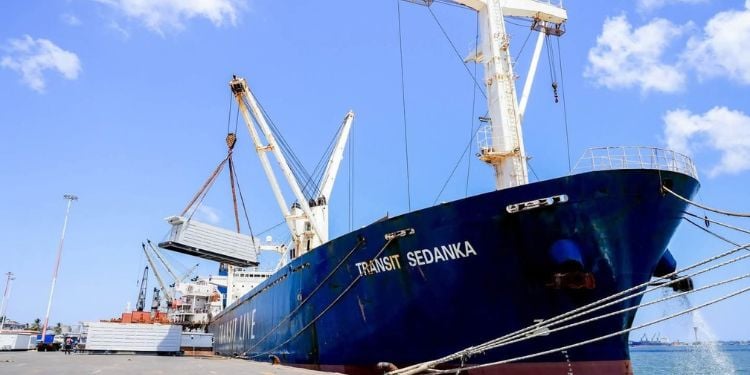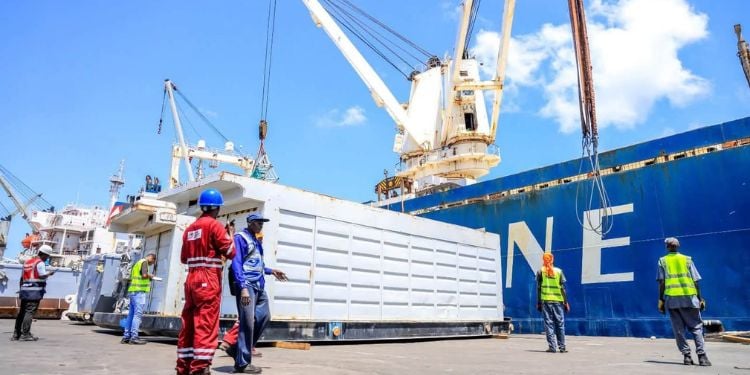
Mombasa Port has received a 2,152-metric-tonne consignment of onshore drilling equipment for the South Lokichar oil project in Turkana County, in preparation for Kenya’s planned commercial oil production.
The consignment arrived aboard the MV Transit Sedanka after sailing from Abu Dhabi via Duqm.
“The Port of Mombasa has received delivery of massive onshore drilling equipment for oil production in Lockchar in Turkana County, reaffirming the port’s status as the gateway for energy and infrastructure investment in the region. The 2,152-metric-tonne consignment came aboard the MV Transit Sedanka on Saturday, having sailed from Abu Dhabi via Duqm, according the a Kenya Ports Authority (KPA) statement dated September 27.
Among the heavy equipment being discharged is the GW70 Integrated Onshore Drilling Rig, a 1,500-horsepower unit valued at more than KSh2 billion.
Gulf Energy E&P BV from Great Wall Drilling Company (GWDC) of the United Arab Emirates leased the GW70 rig under a long-term arrangement.
The equipment’s arrival comes as Kenya prepares for the next phase of development of its largest onshore petroleum project, with the country targeting first oil production in December 2026.
According to the Energy and Petroleum Regulatory Authority (EPRA), the first crude exports through Mombasa are expected in the first quarter of 2027.
“The first oil date has been set for December 2026, and we expect, as per the field development plan, that the first export of crude out of Mombasa will happen in Quarter 1 2027,” EPRA Director of Petroleum and Gas Edward Kinyua explained.
Also Read: Turkana Oil Finally Breaks Through After 14-Year Wait
Turkana Oil Production Receiving Equipment from Mombasa Port
Kenya established a plan towards commercial oil production in Turkana after the discovery of oil at the Ngamia-1 exploration well in 2012 in the South Lokichar Basin.
The discovery was followed by further exploration and appraisal activities, with oil accumulations identified in several fields across the basin.
Currently, the development covers six fields, including Amosing, Ngamia, Twiga, Ekales, Agete and Etom, in Blocks T6 and T7.
Initially, the project was developed under Tullow Oil and its partners before Gulf Energy took over Tullow’s interests in Kenya.
Tullow announced in July 2025 that it had entered into an agreement with Auron Energy E&P, an affiliate of Gulf Energy, leading to the transfer of its entire working interest in Kenya.
The transaction was completed, and Gulf Energy took over development of the South Lokichar project.
Also Read: KPA Reveals What Happened in Mombasa Port Crane Incident
Investments and Recoverable Oil Target
The current Field Development Plan places the 2C resource base at approximately 326 million barrels, with the first phase focusing on Ngamia and Amosing.
Phase 1 involves 48 wells and is expected to deliver peak production of about 20,000 barrels of crude oil per day, and approximately 50,000 barrels per day in the second phase.
The South Lokichar development is expected to attract approximately US$6.1 billion in investment over 25 years, making it one of Kenya’s largest petroleum development projects.
Gulf Energy’s development plan is structured around two phases, with Phase One running from 2026 to 2031 and Phase Two expected to commence from 2032.
For transportation, crude from the South Lokichar fields will be transported by road or rail to Kenya Petroleum Refineries Limited (KPRL) before being exported via the Kipevu Oil Terminal II in Mombasa.
Follow our WhatsApp Channel and X Account for real-time news updates.