The National Police Service (NPS) is organized into three main units that operate under a unified command to maintain law and order across the country.
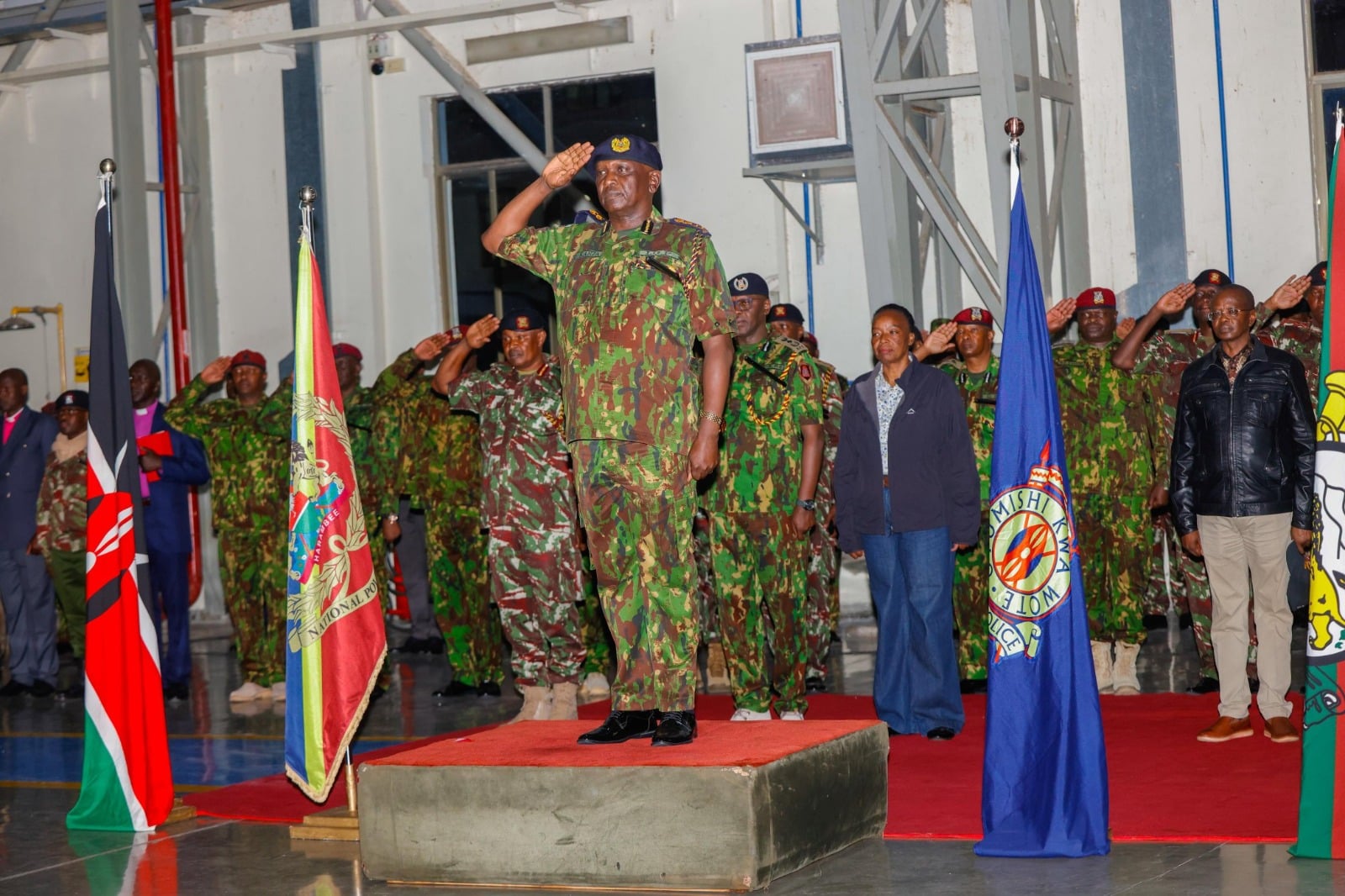
At the helm is the Inspector General of Police, Douglas Kanja, who provides overall leadership and strategic direction on national security matters.
Inside NPS Police Units and How They Operate in Kenya
The service comprises the Kenya Police Service, the Administration Police Service, and the Directorate of Criminal Investigations, each with distinct but complementary mandates.
Below the Inspector General, the command structure becomes more layered. The IG is deputized by two Deputy Inspector-Generals (DIGs), each responsible for a key arm of the service.
One DIG oversees the Administration Police Service, focusing on protective and border security functions. Gilbert Masengeli heads this docket.
The other DIG is in charge of the Kenya Police Service, which handles public safety and general policing, under Eliud K. Lagat, whose position has, in recent times, attracted public scrutiny.
Also Read: Murkomen Announces When New Nairobi Police Unit Will Be Operational
AP and DCI Organizational Structure
Within the Administration Police Service, the command structure cascades from regional, formation and unit AP commanders to county AP commanders and sub-county AP commanders, e
APS oversees a range of specialized units aligned to its mandate of securing government installations, managing border control, and supporting general policing operations.
These include the Rapid Deployment Unit (RDU), Border Police Unit (BPU), Anti-Stock Theft Unit (ASTU), Critical Infrastructure Protection Unit (CIPU), and the Security of Government Buildings (SGB) Unit.
The RDU is a highly trained rapid-response team deployed during emergencies and civil disturbances. The BPU secures Kenya’s borders and tackles cross-border crime, particularly in volatile regions.
ASTU focuses on curbing stock theft, a persistent challenge in pastoral areas. CIPU safeguards key national installations such as airports and government facilities, while SGB provides security for public buildings.
Meanwhile, within the Kenya Police Service, the DIG supervises a chain of command that cascades from regional commanders to county and sub-county police heads, down to officers commanding stations (OCs), police posts, and patrol bases.
Regional commanders coordinate security operations across regions, while county commanders oversee policing within counties and work closely with local security committees. Sub-county commanders manage day-to-day operations at the grassroots level, ensuring service delivery and coordination with local administrators.
Officers Commanding Stations (OCs) head police stations, oversee investigations, and serve as the primary link between the police and the public.
At the lowest level, police posts and patrol bases form the frontline of policing, responding to incidents, maintaining presence in communities, and working with local leaders to uphold order.
Also Read: Why Govt Regrets Increasing Kenya Police Salaries
The Directorate of Criminal Investigations, on the other hand, is headed by Director Mohamed Ibrahim Amin and supported by a structured investigative command system.
This includes the Regional Criminal Investigations Officer (RCIO), County Criminal Investigations Officer (CCIO), and Sub-county Criminal Investigations Officer (SCCIO), who oversee investigative work at their respective levels.
The RCIO supervises all DCI operations within a region; the CCIO manages investigations at the county level; and the SCCIO handles operations at the sub-county level, forming the most localized investigative command.
Across these levels, DCI officers are tasked with command and control, supervision, coordination, resource management, direct investigations, oversight, and community engagement.
The directorate also houses specialized units such as the Serious Crimes Unit, the Transnational Organized Crime Unit, the Economic and Commercial Crimes Unit, and the Cybercrime Unit, among others, which handle complex and high-level investigations.