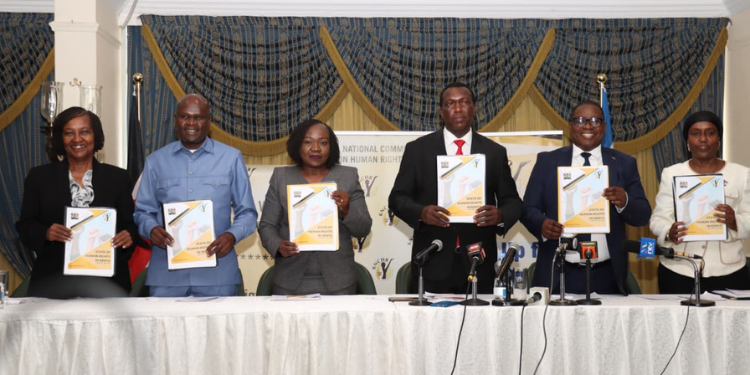
The Kenya National Commission on Human Rights (KNCHR) has invited victims of protests and demonstrations to submit applications for compensation as part of a national reparations process currently being developed.
In a press statement on March 13, the Commission announced that the victims are required to provide supporting documents, including P3 forms, medical reports, OB reports, post-mortem reports, and any other relevant evidence, for verification by Friday, April 3, 2026.
“The Kenya National Commission on Human Rights (KNCHR) wishes to inform the public, including victims and survivors of human rights violations, that a Framework for Compensation and Reparations to victims of human rights violations is ongoing,” read part of the statement.
Applications can be submitted through multiple channels:
- SMS: 22359
- Email: [email protected]
- Telephone: 020 3090000
- Mobile: 0726 610159
- Toll‑Free Line: 0800 720 627
Victims may also visit the Commission’s offices located across the country, including:
- Nairobi Office: CVS Plaza, Off Lenana Road
- North Rift Office (Kitale): AFC Building, Opposite Mega Plaza
- Western Region Office (Kisumu): 3rd Floor, Reinsurance Plaza, Oginga Odinga Street
- Coast Region Office (Mombasa): 10th Floor, Imara Building, Dedan Kimathi Avenue
- Central Region Office (Nyahururu): AFC Building, next to Nyahururu Law Courts
- Northeastern Region Office (Wajir): I‑Mall Building, Airport Road
- Kajiado Satellite Office: Huduma Center
- Isiolo Satellite Office: Ground Floor, Shune Suites, County Area
- Garissa Satellite Office: IPOA House, Off Kismayu Road
Also Read: Bungoma County Announces 364 Teaching Jobs and Other Vacancies: How to Apply
KNCHR Confirms Progress in Developing Reparations Framework
In the Friday statement, the Commission announced the progress in establishing a Framework for Compensation and Reparations for victims of human rights violations.
This work follows a landmark High Court judgment in two petitions which directed the Attorney General to establish a national compensation program under the Constitution and the Human Rights Commission Act, 2011.
The Commission stated that it has already begun a wide-ranging, multipronged engagement with victims, survivors, families, and key stakeholders, collecting data needed to support a credible and fair compensation system.
Through a call‑back mechanism, the Commission continues to receive new evidence daily from across the country.
“The Commission’s data collection process has, so far, successfully engaged victims, survivors, and their families in Nairobi and parts of the country,” noted KNCHR
Additionally, KNCHR is gathering information on violations, including:
- Torture
- Extrajudicial killings
- Enforced disappearances
- Unlawful imprisonment
- Death and bodily harm, including loss of limbs or organs
- Psychological torture and ill‑treatment
The Commission reported that it is also receiving input from state agencies, non-state organizations, and the judiciary, which are contributing sector-specific insights into the development of the reparations framework.
Also Read: Simple Steps for TSC Teachers to Submit Appraisals Online
Roadmap Toward a National Reparations Policy
According to the statement, the Commission has adopted a new, clear roadmap for developing a national Reparations Policy. This policy will guide government interventions to prevent future violations and ensure adequate redress for victims.
The process will be guided by Kenya’s national values, including public participation, transparency, and accountability. The Commission will announce all public engagements through:
- Public notices
- Its official website (www.knchr.org)
- Official social media platforms
- Community‑level and face‑to‑face forums
The Commission pledged to continue updating the public throughout the process and confirmed that it will submit the final Reparations Framework to the President, in line with Article 254(2) of the Constitution and Section 53(3) of the KNCHR Act, as required by gazette notice.
In addition, KNCHR urged Parliament and the National Treasury to release the funds necessary to carry out this critical national exercise.
It reaffirmed its commitment to the rule of law, the protection of human rights, and securing appropriate redress for victims and survivors in accordance with international human rights standards.
“The Commission urges Parliament and the National Treasury to urgently approve and disburse the requisite funds to enable the Commission to discharge this critical national function,” read the statement.