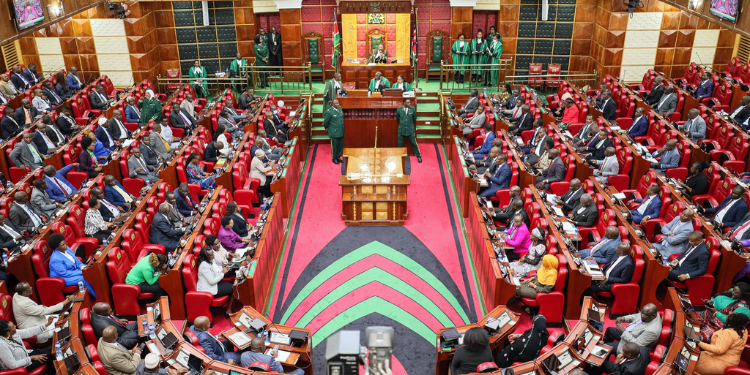
The Supreme Court has ruled that Parliament is duty‑bound to pass a law regulating local tribunals, and has warned courts against stepping into the legislative arena by supervising Parliament’s work.
In a judgment delivered on 31 March, the court partially allowed an appeal by Parliament and the Attorney General in a case filed by activist Okiya Omtata, challenging delays in passing a law governing local tribunals.
Supreme Court Backs Duty to Legislate
The dispute arose from Article 169 of the Constitution, which places local tribunals under the Judiciary as subordinate courts.
At issue was whether Parliament had failed in its constitutional duty by failing to enact a law setting out the powers, functions, and jurisdiction of these bodies.
The Supreme Court agreed with the High Court and the Court of Appeal that Parliament has a clear constitutional obligation under Article 169(2) to pass the necessary legislation.
The judges noted that by the time the case was filed, Parliament had been delayed for more than eight years, a lapse they said was unreasonable and harmful to the public.
Also Read: Court Issues Orders On Alleged Secret Barracks Construction in Karura Forest
The court held that prolonged legislative delay undermines the right of access to justice, which is protected by Article 48 of the Constitution, especially for people whose disputes are handled by tribunals.
Court Rejects Supervision of Parliament.
However, the Supreme Court took issue with the lower courts’ response to that delay.
It overturned orders requiring Parliament to report back to the courts on the progress of the proposed Tribunals Bill, ruling that such supervision went too far.
“The issuance of supervisory orders compelling Parliament to report on legislative progress was not appropriate,” the court said.
The judges explained that there was no proof that Parliament was refusing to act or deliberately ignoring its responsibility. They also noted that steps to introduce the legislation were already underway at the time.
The Supreme Court warned judges against interfering with Parliament’s internal processes, noting that courts must respect the separation of powers and that judicial review should not become a means of controlling how lawmakers carry out their mandate.
As part of its ruling, the Supreme Court also set aside a High Court declaration that had listed specific tribunals whose members were to be appointed by the Judicial Service Commission (JSC).
Also Read: Blow to Wamuthende as Court Orders Vote Recount
The judges found that the list was not supported by the pleadings before the High Court and that the lower courts had failed to properly examine each tribunal individually.
To guide future cases, the Supreme Court clarified that not everyone who is called to a tribunal automatically qualifies as a “local tribunal” under the Constitution.
For a body to fall into that category, the court said, it must:
- hear and decide disputes in a judicial or quasi‑judicial manner.
- be under the authority of the superior courts.
- follow a structured and adversarial process that leads to binding decisions.
- be established by an Act of Parliament, and
- not including judges of higher courts among its members.
Bodies that perform administrative, advisory, regulatory, or policy‑making roles do not meet this standard, even if the law refers to them as tribunals.
Despite setting aside supervisory and declaratory orders, the Supreme Court upheld the key conclusion reached by the lower courts: Parliament must enact the required law within a reasonable time.
The court emphasized that, where the Constitution does not set specific deadlines, lawmakers are still expected to act without undue delay, as prolonged inaction can itself constitute a constitutional violation.
In its final orders, the Supreme Court directed that each party bear its own costs, citing the public interest nature of the case.