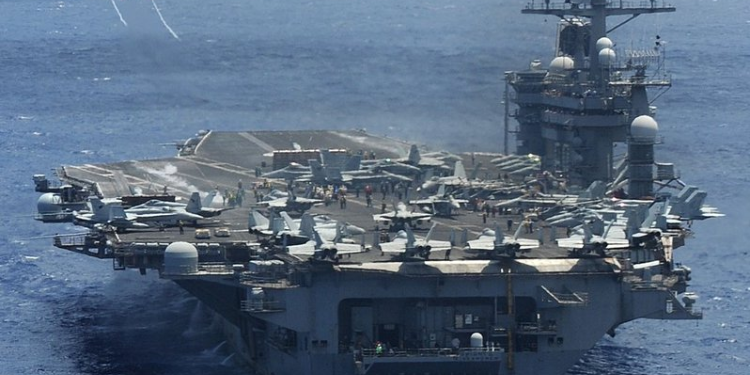
The United States has further expanded its military presence in the Middle East after the U.S. Navy’s largest aircraft carrier, USS Gerald R. Ford, reportedly returned to the region amid ongoing tensions with Iran.
Two U.S. defense officials told the Associated Press on Friday, April 17, that the carrier recently transited the Suez Canal alongside two guided-missile destroyers — the USS Mahan and the USS Winston S. Churchill — and is now operating in the Red Sea.
The redeployment comes after the carrier spent more than a month in the Mediterranean Sea undergoing repairs following a fire in a laundry space that forced it to return to port.
USS Gerald R. Ford joins another carrier
The arrival of the Ford makes it the second U.S. aircraft carrier currently positioned in the broader region, alongside the USS Abraham Lincoln, which is operating in the Arabian Sea.
A third carrier, the USS George H. W. Bush, is also en route after departing Naval Station Norfolk on March 31, according to U.S. officials cited in multiple reports. The strike group includes Carrier Air Wing 7 and more than 5,000 personnel.
If all three carriers are positioned for operations tied to the Iran conflict, it would mark a significant concentration of U.S. naval power across the Mediterranean and Middle East.
Also Read: Third U.S Supercarrier Crosses into Mediterranean as Operation Epic Fury Intensifies
The Ford’s return to the region follows a record-setting deployment. On April 16, the carrier surpassed the longest U.S. aircraft carrier deployment since the Vietnam War, reaching 295 consecutive days at sea.
The ship began its mission in June 2025 from Norfolk, Virginia, and has since operated across multiple theaters, including the Caribbean and the Middle East.
U.S. Senator Tim Kaine raised concerns about the toll on service members, saying the extended deployment has taken “a serious toll” on the mental health and well-being of the crew.
“They should be home with their loved ones, not sent around the world by a President who acts like the U.S. military is his palace guard,” Kaine said in a statement.
Pentagon officials have indicated the deployment could extend to around 11 months, potentially returning the carrier home in late May.
Iran war and military buildup
The deployment comes as the United States continues to increase its military footprint in the Middle East during the ongoing Iran conflict.
The U.S. Central Command (CENTCOM) this week said more than 10,000 U.S. personnel — including sailors, Marines, and airmen — are currently enforcing a blockade on Iranian ports and coastal areas, supported by aircraft and warships.
Also Read: Confusion as Iran Rejects Trump Claim It Agreed to Transfer Uranium to U.S
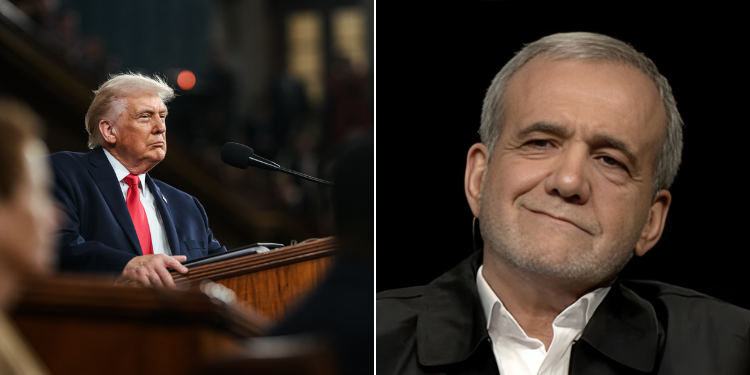
At the same time, President Donald Trump has said the war could conclude within “two to three weeks,” even as military preparations continue.
Washington is also pursuing renewed diplomatic engagement, with talks expected to resume in the coming days.
Earlier this week, the Russian Security Council warned that the United States and Israel could be preparing for a broader military operation.
According to Russian state media, the council said ongoing peace talks may be used as a cover for potential ground action against Iran.
“The U.S. and Israel may use peace talks to prepare for a ground operation against Iran, as the Pentagon continues to build up U.S. troop levels in the region,” the council said. It added that if negotiations fail, hostilities could intensify within weeks.
The military escalation comes alongside mixed signals on the diplomatic front.
U.S. officials have indicated progress in negotiations with Iran, while Iranian authorities have publicly disputed key claims made by Washington regarding potential agreements.