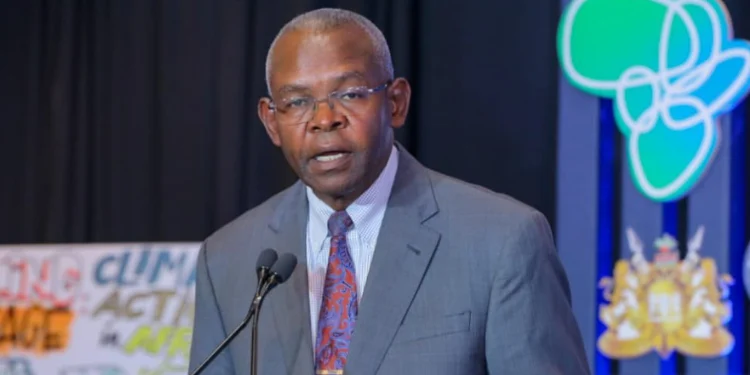
National Treasury Cabinet Secretary John Mbadi has revived debate on merging counties amid Kenya’s ballooning recurrent expenditure and debt burden.
Appearing before the National Assembly’s Public Debt and Privatization Committee, the CS noted that having 47 county governments and other governments at the national level is expensive to maintain.
He further cited that the country is under severe fiscal strain, with debt servicing projected to consume 915 of ordinary revenue in the financial year 2026/2027.
In addition, the CS argued that the consolidated funds service, including massive domestic interest and redemption, was rising to KSh 2.56 trillion.
“We have a very expensive Constitution, we have 47 county governments, and another government at the national level. It is high time that we discussed it.” National Treasury Cabinet Secretary John Mbadi explained.
To further his push on the need to merge the counties, the CS noted that with the 47 counties, there is mismanagement, stating that the development spending had dropped from 27% of ordinary revenue that was recorded in 2016 to 12.4% as of 2026.
In addition, the CS explained that the country, as well as the 47 counties, were heavily reliant on domestic borrowing and thus the economic deficit.
Mbadi County Merging Proposal
In 2025, Mbadi proposed that Kenya should have at least 14 counties.
In his suggestions, he argued that the country could go back to the 8-province structure to reduce wage bills and administrative costs while maintaining devolution.
According to Mbadi, management of devolved units in the counties had become unsustainable for the government.
In addition, the CS emphasized that the fewer counties there the, the easier it will be the devolve resources without heavily relying on the government.
Also Read: Mbadi Clears Air on Bread and Motor Vehicle Tax Fears
CBK Economic Downgrading
During the National Assembly’s Public Debt and Privatization Committee meeting, Central Bank Governor Dr. Kamau Thugge noted that Kenya’s 2026/2027 growth forecast had been downgraded.
According to the CBK governor, the downgrading of economic growth from 5.5% to 5% was due to the ongoing conflict in the Middle East.
Additionally, Thugge stated that, with the decline in the economic growth forecast to 5%, the net debt-to-GDP ratio, currently at 64%, had exceeded the 55% target.
Despite the downgrade of the Kenyan economy, the CBK governor noted that the agricultural and construction sectors had driven a recovery, serving as key economic stabilizers.
Also Read: Mbadi Reveals Why Govt Cannot Scrap Fuel Taxes
MPS on Deficit
During the meeting, members of the Committee raised questions about the government’s plan to finance a projected KSh 995.7 billion deficit through domestic borrowing.
Further, the chairperson of the Committee, Irene Mrembo, warned that the current domestic finance target could rise to nearly 1.8 trillion.
In response, Thugge defended the government on the shift from external to domestic borrowing, arguing that refinancing existing debt obligations shields the country from currency depreciation.
“By removing the risk of default or refinancing pressure, that has a positive impact on the exchange rate,” said the Governor.
To support the Governor, Treasury CS John Mbadi revealed that debt-servicing obligations are projected to consume 91 percent of ordinary government revenue in the 2026/2027 financial year.