
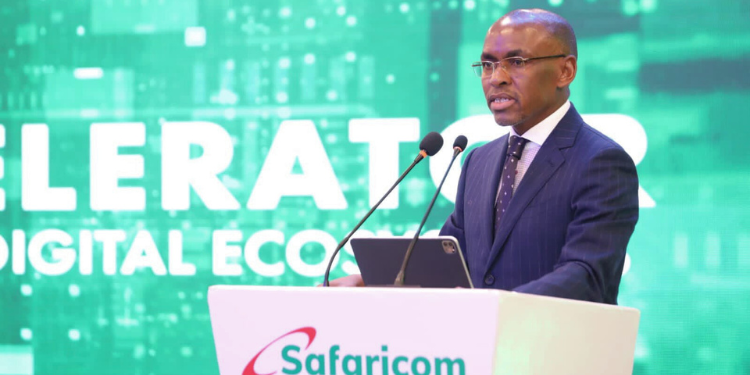
Safaricom has revealed plans for fixed broadband, Tokenized Wi-Fi, and prepaid fibre as the company seeks to expand internet access in Kenya’s digital economy.
Safaricom CEO Peter Ndegwa has outlined key strategies, including flexible pricing and new technologies, to unlock millions of new customers in Kenya and Ethiopia.
Safaricom’s Fixed Broadband and Tokenized Wi-Fi
According to the Telco provider, broadband represents its single largest opportunity for expansion, with the potential to grow the market by millions of users for the next five years.
Ndegwa said that only about 1.2 million Kenyans currently have access to fixed broadband, despite the country having a potential market of roughly four million users. He also said the company estimates that the fixed broadband market could grow by as much as 50 per cent annually for the next five years without exhausting demand.
Also Read: Safaricom Dealers Fear Job Cuts, Business Closures as Government Moves to Sell 15% Stake.
“Today, the market is only serving 1.2 million, so there’s still another 3 million to be served. So this area can grow 50 percent every year for the next five years without exhausting the opportunity,” said Ndegwa.
To achieve this, Safaricom plans to expand fibre infrastructure, deploy fixed wireless access using 5G technology, and introduce more affordable devices.
The company also plans to change how customers pay for the internet by introducing tokenized Wi-Fi and pay-as-you-go fibre.
“Instead of having plans that are monthly plans, you can have daily, hourly, weekly, or monthly. So we believe that by changing the way we go to market, by identifying locations based on the need of the customer, by tiering pricing, we can actually be able to deliver propositions that expand participation and that will also reduce cost to serve, so allow us to reach the extra 3 million,” added Ndegwa.
Enterprise Solutions for Small and Medium Businesses.
Another pillar of Safaricom’s strategy is enterprise for small and medium-sized businesses.
The company has already made progress in serving small businesses, but it plans to expand and accelerate growth by offering integrated, end-to-end solutions.
Ndegwa said Safaricom’s focus is on providing secure fixed connectivity combined with ICT, Internet of Things (IoT), and digital services that help businesses operate more efficiently.
“For small businesses also solutions that allow them to do business better, so we can provide tech solutions that allow them to do business better. But the most important is starting to integrate so that people or customers, whether they’re individuals or businesses, don’t see Safaricom as you’re buying specific products, but we integrate it so that you are buying value, you’re fulfilling a need a business need, or we are empowering businesses or actually meeting the needs of an individual across our ecosystem.” Added Ndegwa.
Also Read: Why Your Safaricom Data Bundles Drain Faster Than Expected and 6 Saving Tips
Public Sector Digitization and Regional Expansion
Safaricom also plans to deepen its role as the public sector’s digitization partner of choice by making government services more accessible through digital platforms across healthcare, agriculture, and financial services.
Ndegwa said Safaricom will leverage technologies already deployed in the private sector to improve public services, while also learning from government innovation.
He also highlighted digital identity as a long-term opportunity that could transform service delivery, since the digital IDs will enable the company provide services easily without inconveniences.
Follow our WhatsApp Channel and X Account for real-time news updates.