Tuesday, June 2, 2026
  • News
    • Latest News
    • Breaking News
    • Fact Check
    • Investigations
    • Explainers
  • Politics
    • Global Politics
    • Elections
    • Government & Policy
    • Diplomacy
    • Conflicts & Security
    • Political Analysis
  • Business
    • Global Economy
    • Markets
    • Technology
    • Startups
    • Energy
    • Finance
  • World News
    • Americas
    • Asia
    • Asia Pacific
    • Africa
    • Europe
    • Middle East
  • Africa
    • Central Africa
    • East Africa
    • West Africa
    • Southern Africa
  • Health
    • Global Health
    • Public Health
    • Health Policy
    • Medical Research
    • Diseases & Conditions
    • Mental Health
    • Nutrition
    • Climate & Health
    • Health Explainers
  • Sports
    • Athletics
    • Basketball
    • Boxing
    • Cricket
    • Football
    • Formula 1
    • Golf
    • Rugby
  • Weather
    • Climate Business
    • Climate Change
    • Climate Solutions
    • Living Green
  • Culture
    • Arts
    • Film & TV
    • Food
    • Music
    • Lifestyle
    • Travel
  • Opinion
    • Editorials
    • Letters
  • Behind The Brand
REGISTER
LOGIN
No Result
View All Result
The Kenya Times
  • News
    • Latest News
    • Breaking News
    • Fact Check
    • Investigations
    • Explainers
  • Politics
    • Global Politics
    • Elections
    • Government & Policy
    • Diplomacy
    • Conflicts & Security
    • Political Analysis
  • Business
    • Global Economy
    • Markets
    • Technology
    • Startups
    • Energy
    • Finance
  • World News
    • Americas
    • Asia
    • Asia Pacific
    • Africa
    • Europe
    • Middle East
  • Africa
    • Central Africa
    • East Africa
    • West Africa
    • Southern Africa
  • Health
    • Global Health
    • Public Health
    • Health Policy
    • Medical Research
    • Diseases & Conditions
    • Mental Health
    • Nutrition
    • Climate & Health
    • Health Explainers
  • Sports
    • Athletics
    • Basketball
    • Boxing
    • Cricket
    • Football
    • Formula 1
    • Golf
    • Rugby
  • Weather
    • Climate Business
    • Climate Change
    • Climate Solutions
    • Living Green
  • Culture
    • Arts
    • Film & TV
    • Food
    • Music
    • Lifestyle
    • Travel
  • Opinion
    • Editorials
    • Letters
  • Behind The Brand
  • News
    • Latest News
    • Breaking News
    • Fact Check
    • Investigations
    • Explainers
  • Politics
    • Global Politics
    • Elections
    • Government & Policy
    • Diplomacy
    • Conflicts & Security
    • Political Analysis
  • Business
    • Global Economy
    • Markets
    • Technology
    • Startups
    • Energy
    • Finance
  • World News
    • Americas
    • Asia
    • Asia Pacific
    • Africa
    • Europe
    • Middle East
  • Africa
    • Central Africa
    • East Africa
    • West Africa
    • Southern Africa
  • Health
    • Global Health
    • Public Health
    • Health Policy
    • Medical Research
    • Diseases & Conditions
    • Mental Health
    • Nutrition
    • Climate & Health
    • Health Explainers
  • Sports
    • Athletics
    • Basketball
    • Boxing
    • Cricket
    • Football
    • Formula 1
    • Golf
    • Rugby
  • Weather
    • Climate Business
    • Climate Change
    • Climate Solutions
    • Living Green
  • Culture
    • Arts
    • Film & TV
    • Food
    • Music
    • Lifestyle
    • Travel
  • Opinion
    • Editorials
    • Letters
  • Behind The Brand
No Result
View All Result
The Kenya Times ~ Trending, Breaking News and Videos
No Result
View All Result
ADVERTISEMENT

Decades of Underfunding, Blockade have Weakened Gaza’s Health System

- The siege has pushed it into abject crisis

Yara M. AsibyYara M. Asi
October 18, 2023
Reading Time: 11 mins read
A Health Service On Its Knees. Palestine.

A health service on its knees. Abed Zagout/Anadolu via Getty Images

FacebookTwitterLinkedInRedditWhatsApp
Advertisement

For the wounded, injured and sick in Gaza, there is seemingly no escape. On Oct. 17, 2023, news broke that at least 500 patients, staff and people seeking shelter from Israeli bombs had been killed in an explosion at a hospital, according to health authorities in the Hamas-run enclave.

It amounts to a devastating loss of life during a campaign of bombing that has not spared the frail or sick. Just days earlier, the World Health Organization said in a stark assessment that an order to evacuate from hospital beds and head south amounts to a “death sentence.”

By that time, four hospitals had already ceased functioning in Gaza’s north because of damage from Israeli bombs.

Beyond the sheer immediate devastation of the current conflict – in which thousands of Israelis and Palestinians have been killed – there will be significant and undoubtedly long-lasting implications for the Gaza Strip’s health system.

As a Palestinian expert in global health who has worked with medical professionals from Gaza, I know that even before this latest escalation of violence, health services in Gaza were in a poor shape. Insufficiently and poorly resourced for decades, doctors and hospitals also had to contend with the devastating effects of a 16-year blockade imposed by Israel, in part with coordination with Egypt.

A system completely overwhelmed

ADVERTISEMENT

The immediate concern in Gaza is for those seeking assistance due to the bombing campaign that Israel ordered after an attack on its people by Hamas fighters.

An expected ground offensive will only further risk more civilian casualties. Hospitals in Gaza are completely overwhelmed.


Also Read: Gareth Evans: The Case for Recognizing Palestine


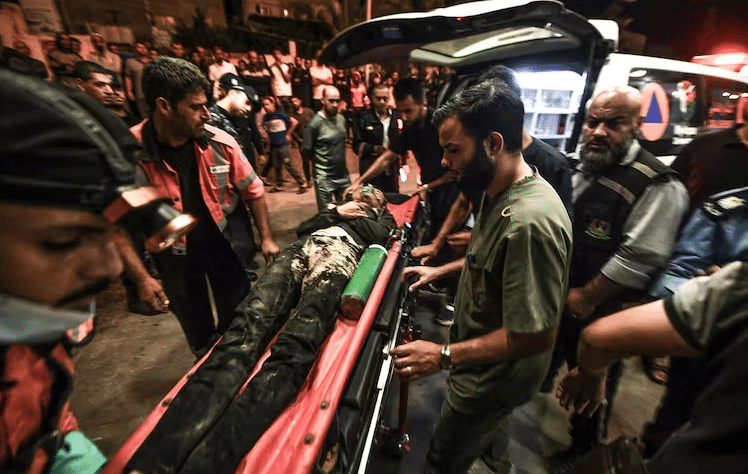
They are seeing around 1,000 new patients per day, in a health system with only 2,500 hospital beds for a population of over 2 million people. It has forced hospitals to tend to patients in corridors and nearby streets.

People maimed in the bombing are being treated for horrific injuries without basics such as gauze dressings, antiseptic, IV bags and painkillers. Those experiencing traumatic injuries are unable to receive sufficient care, increasing rates of infection and amputation.
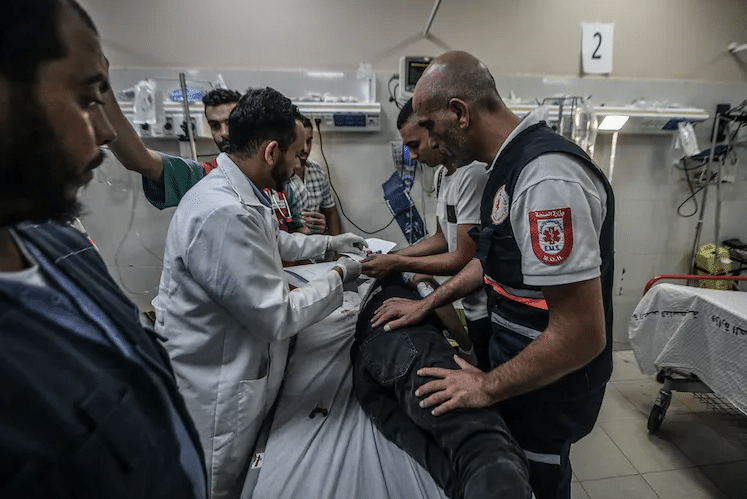
A Citizen Receives First Aid At A Hospital In Khan Yunis, Gaza, On Oct. 16, 2023. Abed Zagout
A citizen receives first aid at a hospital in Khan Yunis, Gaza, on Oct. 16, 2023. Abed Zagout/Anadolu via Getty Images

And things may soon get worse.

ADVERTISEMENT

According to the United Nations’ Office for the Coordination of Humanitarian Affairs, Gaza’s hospitals have been forced to work without electricity, using fuel to run generators to ensure life-saving equipment remains functioning. The U.N. estimates this fuel will run out any day due to a complete siege placed on Gaza by Israel.

Such conditions have led to concerns that alongside the massive number of bombing victims, Gaza health services will soon have to contend with the outbreak of disease.

Patients with immediate health needs, like dialysis or chemotherapy, are among those being ordered to leave and head for greater safety in Gaza’s south, although evacuation routes have also been bombed.

A century of underfunding

The current devastation to Gaza’s health system is obvious. But Gaza’s health care system was already under stress before the latest bombardment. In fact, policies that stretch back decades have left it unable to meet even the basic health needs of Gaza’s residents, let alone respond to the ongoing humanitarian catastrophe.

Where is the Gaza Strip: The Gaza Strip is a small, roughly rectangular piece of land bordered by Israel, Egypt and the Mediterranean Sea.
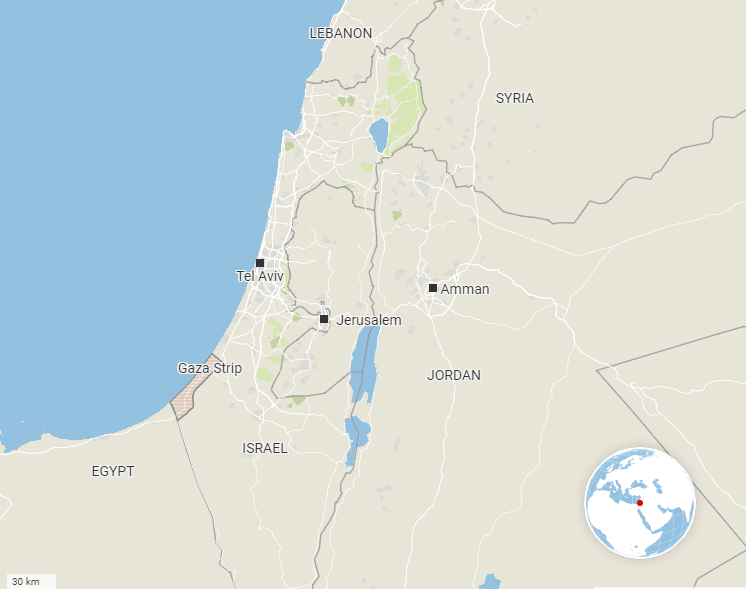
The Gaza Strip Is A Small, Roughly Rectangular Piece Of Land Bordered By Israel, Egypt And The Mediterranean Sea.
The Gaza Strip | Photo Courtesy

In just over a century, the health system in Gaza has been administered by six authorities: the Ottomans until the end of World War I, the British during the mandate period from 1917 to 1947, Egypt from 1949 to 1967, Israel under occupation starting in 1967, and then a Ministry of Health led first by the Palestinian Authority from 1995-2006 and since then by Hamas.

What each have had in common is that, from my perspective as a global health expert, they invested little in Palestinian health. For periods of the 20th century, the health priorities of successive governing bodies appeared focused more on reducing the spread of communicable disease to protect foreigners interacting with the native Palestinian population.


Also Read: US President Joe Biden Flies to Israel Amid War


There was seemingly far less attention paid to building health infrastructure, adequately training health personnel, promoting preventive care and other long-term initiatives that make up a sustainable health system.

Under Israeli occupation from 1967, several Palestinian hospitals were turned into detention centers or military offices, while others were closed, and new ones were prohibited from opening. Palestinian physicians working in the occupied territories earned one-third the salary of their Israeli counterparts.

As a result of this neglect, health indicators throughout what are now called the occupied territories – the West Bank and Gaza Strip – have been poor.

Maternal and infant mortality – typical indicators of health system functioning – tends to be high. For example, in the mid-1980s, infant mortality was over 30 per 1,000 live births for Palestinians, compared with just under 10 per 1,000 among the Jewish population of Israel.

And infant mortality has remained stubbornly high in Gaza.

Meanwhile, a lack of a reliable drinkable water infrastructure and overall unsanitary conditions resulted in the spread of parasitic and other infectious diseases, like rotavirus, cholera and salmonella – which remain leading causes of death in Gaza’s children.

Dying before they can leave

Most residents of Gaza fled there in 1948 after being displaced from their homes in what became the state of Israel. They were classified as refugees, many receiving limited services from the United Nations Relief and Works Agency for Palestine Refugees in the Near East that was established in 1949.

Since then, chronic underfunding of public hospitals has meant that Palestinians in Gaza have remained reliant on outside money and nongovernmental organizations for essential health services.

This started a trend of humanitarian dependence that continues to this day, with many of Gaza’s health facilities funded by the United Nations, humanitarian agencies like Doctors Without Borders and religious organizations.

During the passage of the Oslo Accords in the mid-1990s, the Palestinian Authority was established to administer services in the occupied territories. The accords called for health responsibilities to be transferred to the newly formed Palestinian Ministry of Health as preparation for a sovereign Palestinian state, which the accords called for within a five-year period.

The Palestinian Authority received a significant influx of humanitarian aid as it took on civil responsibilities, including health.

As a result, health indicators for Palestinians, including life expectancy and immunization rates, started to improve in the late 1990s.

But as it became increasingly clear that the overarching goal of the Oslo Accords for Palestinians – statehood – would not materialize, disillusion with the Palestinian Authority led to victory for Hamas in 2006 elections held in Gaza. Since then, Hamas has been considered the de facto governing body in Gaza, while the Palestinian Authority operates in the West Bank.


Also Read: After a Shocking Hamas Assault on Israel, Both Sides Brace for the Devastating Fallout


The rise of Hamas, which the U.S., Israel and others designate as a terrorist group, saw Gaza become isolated from the international community. It also coincided with Israel imposing a full land, sea and air blockade of Gaza.

There is no doubt that the blockade has rapidly accelerated the deterioration of the health system in Gaza and directly impacted the mortality rate.

Gazans who need advanced care, whether for cancer or other chronic illnesses, traumatic injuries and other life-threatening ailments, often can only access needed services in Israeli hospitals and require a permit to cross the border from Gaza. Some die before the permit process is complete.

Gaza health services after the siege

This vulnerable health system is now facing unprecedented challenges, staffed by health professionals who have committed to stay with their patients even under hospital evacuation orders and at risk of death.

It is uncertain what the health system of Gaza will look like in the future.

In years past, international aid would help repair and rebuild some, but not all, of the infrastructure damaged in airstrikes, especially schools and hospitals.


Also Read: How Hamas Weaponized Palestinians’ Despair


But Israeli Prime Minister Benjamin Netanyahu has promised a “long and difficult war.” And with the level of destruction seen in just a few days, it remains unclear just what will be left in the aftermath.

Already at least 28 doctors and other health workers have been killed in Gaza, with ambulances and a number of hospitals rendered useless by the bombs.

Replacing this human capital and vital infrastructure could take years, if not generations – and that is without the limits of a punishing blockade and continued bombardment.

This article was updated on Oct. 17, 2023 to add news of an explosion at a Gazan hospital.The Conversation

Yara M. Asi, Assistant Professor of Global Health Management and Informatics, University of Central Florida

This article is republished from The Conversation under a Creative Commons license. Read the original article.


Tags: GazaGlobal HealthHamasHumanitarian AidIsraelIsraeli-Palestinian Conflict Israel-Hamas Conflict 2023PalestinePalestinians
Yara M. Asi

Yara M. Asi

Yara M. Asi, PhD, is an Assistant Professor at the University of Central Florida, where she has taught in the School of Global Health Management and Informatics for more than 6 years. She is a 2020-2021 Fulbright US Scholar to the West Bank and a Non-resident Fellow at the Arab Center Washington DC. Her research agenda focuses on global health and development in fragile and conflict-affected populations. Along with working at one of the first accountable care organizations in the United States, she has also worked with Amnesty International USA, the Palestinian American Research Center, and the Al-Shabaka Policy Network on policy and outreach issues. She has presented at multiple national and international conferences on topics related to global health, food security, health informatics, and women in healthcare, and has published extensively on health and well-being in fragile and conflict-affected populations in journal articles, book chapters, and other outlets. Dr. Asi has a book forthcoming with Johns Hopkins University Press about the threats war and conflict pose to public health and human security.

Related Posts

Moe Has Vowed To Take Action Against Utumishi Girls School Principal Over School Fire That Killed 16 Learners.

Opinion | How Kenya Failed the Girls of Utumishi Academy

June 2, 2026
Is Kenya Losing Its Morals? Rising Deviant Behavior And Rampant Crime

Opinion | The Mother Who Hates Her Own Children: Kenya’s Moral Collapse

June 2, 2026
Treasury Invites Applications For Board Recruitment Across 39 State-Owned Enterprises

Opinion | How New Taxes on Bank Card Transactions Charges Will Raise the Costs for Ordinary Kenyans if Adopted by Parliament

June 1, 2026
The Kenya National Examinations Council (Knec) Has Announced The Dates For The 2026/2027 Business And Technical Examination.

Opinion | AI Mistakes That Could Destroy Kenya’s Future — Global Lessons Every Leader, Business and Citizen Must See Now

May 31, 2026
ADVERTISEMENT

The Kenya Times Facebook

LATEST ARTICLES

  • Raila Odinga Junior Unveils His Late Father’s Restored Hummer
  • COFEK Turns Up Pressure on Commission in Bid to Remove Education PS Julius Bitok
  • UoN the Only Kenyan University Ranked Among the World’s Top 2,000 Universities
  • Details of US Travel Advisory to Its Citizens Amid Controversy Over Ebola
  • Marco Rubio Confesses Secret on Iran Talks as He Hints at Rare Breakthrough
  • From Seminary Expulsion to the Cabinet: The Story of Rt. Major General Kahinda Otafiire
  • High Court Rejects Bia Tosha Bid to Halt KSh297 Billion EABL Stake Sale to Asahi Group
  • Who Is Bill Pulte? Meet the 38-Year-Old Trump Pick Replacing Tulsi Gabbard as Acting DNI
  • Florentius Koech: Neurosurgeon and Founder of Tophill Brain and Spine Hospital
  • In Iran War’s Shadow, Israel’s Renewed Lebanon Campaign Risks Repeating Failed Lessons and Occupations of the Past
  • Meet the Ismaili Family Behind Nairobi’s 4-Star Best Western Plus Meridian Hotel
  • Kenya on Alert as Experts Issue Warning on Severe Weather Conditions Ahead
  • KNEC Announces 2026/2027 TVET Examination Registration Dates
  • PS Oluga Clarifies Nationality of 37 People Quarantined After Returning from Congo
  • How to Send Money Internationally: Cheapest Methods in 2026
ADVERTISEMENT

Company

About Us

Our Authors

Our Experts

Social Media

Policies

Privacy Policy

House Rules

Standards and Policies

Terms and Conditions

Subscription

My Account

Contact Us

Contact Us

Join Our Team

Advertise With Us

© Copyright 2026 | The Kenya Times | All Rights Reserved

Welcome Back!

Sign In with Facebook
Sign In with Google
Sign In with Linked In
OR

Login to your account below

Forgotten Password? Sign Up

Create New Account!

Sign Up with Facebook
Sign Up with Google
Sign Up with Linked In
OR

Fill the forms below to register

All fields are required. Log In

Retrieve your password

Please enter your username or email address to reset your password.

Log In
Your Privacy and Cookies
We use cookies on our website to give you the most relevant experience by remembering your preferences and repeat visits. By clicking “Accept”, you consent to the use of ALL the cookies.
Do not sell my personal information.
Cookie settingsACCEPT
Privacy & Cookies Policy

Privacy Overview

This website uses cookies to improve your experience while you navigate through the website. Out of these cookies, the cookies that are categorized as necessary are stored on your browser as they are essential for the working of basic functionalities of the website. We also use third-party cookies that help us analyze and understand how you use this website. These cookies will be stored in your browser only with your consent. You also have the option to opt-out of these cookies. But opting out of some of these cookies may have an effect on your browsing experience.
Necessary
Always Enabled
Necessary cookies are absolutely essential for the website to function properly. This category only includes cookies that ensures basic functionalities and security features of the website. These cookies do not store any personal information.
Functional
Functional cookies help to perform certain functionalities like sharing the content of the website on social media platforms, collect feedbacks, and other third-party features.
Performance
Performance cookies are used to understand and analyze the key performance indexes of the website which helps in delivering a better user experience for the visitors.
Analytics
Analytical cookies are used to understand how visitors interact with the website. These cookies help provide information on metrics the number of visitors, bounce rate, traffic source, etc.
Advertisement
Advertisement cookies are used to provide visitors with relevant ads and marketing campaigns. These cookies track visitors across websites and collect information to provide customized ads.
Others
Other uncategorized cookies are those that are being analyzed and have not been classified into a category as yet.
SAVE & ACCEPT
LOGIN | REGISTER
  • Login
  • Sign Up
  • Cart
No Result
View All Result
  • News
    • Latest News
    • Breaking News
    • Investigations
    • Explainers
    • Fact Check
  • Politics
    • Global Politics
    • Conflicts & Security
    • Elections
    • Diplomacy
    • Government & Policy
    • Political Analysis
  • Business
    • Global Economy
    • Markets
    • Technology
    • Startups
    • Energy
    • Finance
  • World News
    • Americas
    • Asia
    • Asia Pacific
    • Africa
    • Europe
    • Middle East
  • Africa
    • East Africa
    • West Africa
    • Southern Africa
    • Central Africa
  • Health
    • Global Health
    • Public Health
    • Health Policy
    • Medical Research
    • Diseases & Conditions
    • Mental Health
    • Nutrition
    • Climate & Health
    • Health Explainers
  • Sports
    • Athletics
    • Basketball
    • Boxing
    • Cricket
    • Football
    • Formula 1
    • Golf
    • Rugby
  • Weather
    • Climate Business
    • Climate Change
    • Climate Solutions
    • Living Green
  • Culture
    • Arts
    • Film & TV
    • Food
    • Lifestyle
    • Music
    • Travel
  • Opinion
    • Editorials
    • Letters
  • Behind The Brand
  • Contact Us

Not enough quota to unlock this post
Unlock left : 0
Are you sure want to cancel subscription?