Saturday, September 26, 2026
  • News
    • Latest News
    • Breaking News
    • Fact Check
    • Investigations
    • Explainers
  • Politics
    • Global Politics
    • Elections
    • Government & Policy
    • Diplomacy
    • Conflicts & Security
    • Political Analysis
  • Business
    • Global Economy
    • Markets
    • Technology
    • Startups
    • Energy
    • Finance
  • World News
    • Americas
    • Asia
    • Asia Pacific
    • Africa
    • Europe
    • Middle East
  • Africa
    • Central Africa
    • East Africa
    • West Africa
    • Southern Africa
  • Health
    • Global Health
    • Public Health
    • Health Policy
    • Medical Research
    • Diseases & Conditions
    • Mental Health
    • Nutrition
    • Climate & Health
    • Health Explainers
  • Sports
    • World Cup 2026
    • Athletics
    • Basketball
    • Boxing
    • Cricket
    • Football
    • Formula 1
    • Golf
    • Rugby
  • Weather
    • Climate Business
    • Climate Change
    • Climate Solutions
    • Living Green
  • Culture
    • Arts
    • Film & TV
    • Food and Recipes
    • Music
    • Lifestyle
    • People
    • Travel
  • Opinion
    • Editorials
    • Letters
  • Behind The Brand
REGISTER
LOGIN
No Result
View All Result
The Kenya Times
  • News
    • Latest News
    • Breaking News
    • Fact Check
    • Investigations
    • Explainers
  • Politics
    • Global Politics
    • Elections
    • Government & Policy
    • Diplomacy
    • Conflicts & Security
    • Political Analysis
  • Business
    • Global Economy
    • Markets
    • Technology
    • Startups
    • Energy
    • Finance
  • World News
    • Americas
    • Asia
    • Asia Pacific
    • Africa
    • Europe
    • Middle East
  • Africa
    • Central Africa
    • East Africa
    • West Africa
    • Southern Africa
  • Health
    • Global Health
    • Public Health
    • Health Policy
    • Medical Research
    • Diseases & Conditions
    • Mental Health
    • Nutrition
    • Climate & Health
    • Health Explainers
  • Sports
    • World Cup 2026
    • Athletics
    • Basketball
    • Boxing
    • Cricket
    • Football
    • Formula 1
    • Golf
    • Rugby
  • Weather
    • Climate Business
    • Climate Change
    • Climate Solutions
    • Living Green
  • Culture
    • Arts
    • Film & TV
    • Food and Recipes
    • Music
    • Lifestyle
    • People
    • Travel
  • Opinion
    • Editorials
    • Letters
  • Behind The Brand
  • News
    • Latest News
    • Breaking News
    • Fact Check
    • Investigations
    • Explainers
  • Politics
    • Global Politics
    • Elections
    • Government & Policy
    • Diplomacy
    • Conflicts & Security
    • Political Analysis
  • Business
    • Global Economy
    • Markets
    • Technology
    • Startups
    • Energy
    • Finance
  • World News
    • Americas
    • Asia
    • Asia Pacific
    • Africa
    • Europe
    • Middle East
  • Africa
    • Central Africa
    • East Africa
    • West Africa
    • Southern Africa
  • Health
    • Global Health
    • Public Health
    • Health Policy
    • Medical Research
    • Diseases & Conditions
    • Mental Health
    • Nutrition
    • Climate & Health
    • Health Explainers
  • Sports
    • World Cup 2026
    • Athletics
    • Basketball
    • Boxing
    • Cricket
    • Football
    • Formula 1
    • Golf
    • Rugby
  • Weather
    • Climate Business
    • Climate Change
    • Climate Solutions
    • Living Green
  • Culture
    • Arts
    • Film & TV
    • Food and Recipes
    • Music
    • Lifestyle
    • People
    • Travel
  • Opinion
    • Editorials
    • Letters
  • Behind The Brand
No Result
View All Result
The Kenya Times ~ Trending, Breaking News and Videos
No Result
View All Result
ADVERTISEMENT

After Chernobyl and Fukushima: Is Nuclear Power Actually Safe in 2026?

Geoffrey MoturibyGeoffrey Moturi
September 26, 2026
Reading Time: 12 mins read
Chernobyl, Fukushima, And Kenya: Can Nuclear Power Be Made Safe?

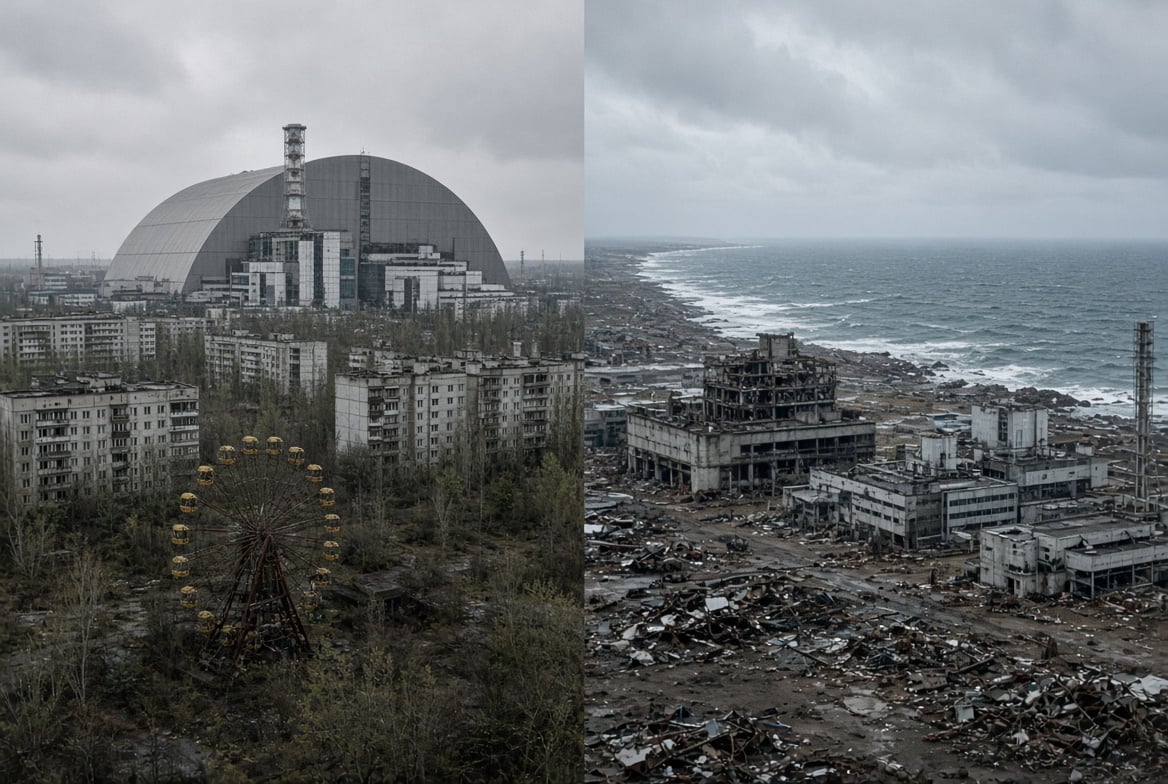
Chernobyl and Fukushima: Abandoned Pripyat and the New Safe Confinement (left) beside Fukushima Daiichi’s damaged reactors on the coast (right). PHOTO/Grok.

FacebookTwitterLinkedInRedditWhatsApp
Advertisement

Fear of nuclear energy often runs deeper than the facts. But when we look beyond the disasters that dominate public memory, the picture is more complicated: and, in many respects, more reassuring.

Ask Mama Wanjiku why she is suspicious of a microwave oven, and she may give a simple answer: It emits radiation.

Never mind that her phone communicates using electromagnetic waves. Never mind that sunlight itself is a form of electromagnetic radiation. The word radiation carries a particular fear.

For many people, that fear is shaped by images from Chernobyl and Fukushima.

It is not an irrational fear. Nuclear accidents can have serious consequences.

But fear alone does not tell the whole story.

ADVERTISEMENT

As Kenya explores nuclear power as part of its long-term energy future, Kenyans deserve a clear and honest answer to a basic question:

Is nuclear power actually safe?

The short answer is that modern nuclear power can be operated safely, but safety is never automatic. It depends on technology, regulation, competent operators, strong institutions and a culture that refuses to compromise on safety.

The Two Accidents That Shaped Public Opinion

When people think about nuclear power, two names usually come to mind.

Chernobyl.

And Fukushima.

ADVERTISEMENT

Chernobyl, 1986

In April 1986, Reactor Number Four at the Chernobyl Nuclear Power Plant in what is now Ukraine suffered a catastrophic accident during a poorly managed safety test.

A combination of design weaknesses and serious operational failures led to an uncontrolled power surge, explosions and a major release of radioactive material.

Emergency workers and plant personnel died as a direct result of the accident, while the long-term health consequences have been the subject of extensive scientific research and debate.

The accident also contaminated large areas and forced the relocation of thousands of people.

Chernobyl was unquestionably a catastrophe.

But it is important to understand that the reactor involved was a specific Soviet-era RBMK design, operating under a system with serious design and safety weaknesses that are not representative of modern nuclear reactor designs.

Fukushima, 2011

In March 2011, Japan experienced one of the most powerful earthquakes ever recorded.

The earthquake was followed by a devastating tsunami.

The tsunami overwhelmed the Fukushima Daiichi Nuclear Power Plant’s protective systems and disrupted electrical power and cooling systems at several reactors.

Three reactor cores suffered severe damage.


Also Read: Can Kenya Protect a Nuclear Power Plant from Terrorism, Theft and Sabotage?


More than 100,000 people were evacuated from surrounding areas, causing significant social, economic and psychological disruption.

The disaster fundamentally changed the global conversation about nuclear safety.

Fukushima demonstrated an important lesson: even technologically advanced countries must prepare for events beyond what engineers initially expect.

It also forced the nuclear industry to re-examine how plants are designed to withstand extreme natural disasters.

The Matatu Analogy

Consider Kenya’s matatu industry.

In the 1990s and early 2000s, public transport vehicles were associated with serious safety concerns.

Overloading, reckless driving, poorly maintained vehicles and weak enforcement contributed to a high number of road accidents.

The response was not to abandon public transport.

Instead, regulations were strengthened.

Speed governors were introduced. Seat belts became mandatory. Licensing and enforcement systems were tightened.

The system did not become perfect.

Matatus are still involved in accidents.

But the lesson is important: technology becomes safer when design, regulation and human behaviour improve.

Nuclear power has followed a similar path.

The nuclear industry has learned from accidents.

Each major accident has led to changes in reactor design, emergency planning, regulation and international cooperation.

The question, therefore, is not whether nuclear technology has ever failed.

It has.

The more relevant question is whether the lessons from those failures have been incorporated into modern systems.

How Modern Nuclear Reactors Are Different

Modern nuclear reactor designs incorporate multiple layers of safety.

Many newer Generation III and Generation III+ designs include what engineers call passive safety systems.

In simple terms, these systems are designed to use natural forces such as gravity, pressure differences and natural circulation to help maintain safety during certain emergencies.

This reduces reliance on pumps, external electricity and immediate human intervention.

However, passive safety does not mean a reactor cannot experience an accident.

No complex industrial technology is completely risk-free.

Instead, modern reactor safety is based on a principle known as defence in depth.

This means several layers of protection are designed to work together.

These can include:

  • Strong fuel design
  • Multiple physical barriers containing radioactive materials
  • Backup cooling systems
  • Emergency power supplies
  • Containment structures
  • Passive safety systems
  • Independent regulatory oversight
  • Emergency preparedness and response plans

The objective is simple: if one system fails, another system should provide protection.

The Number That Often Surprises People

One of the most interesting ways of comparing energy technologies is to look at deaths associated with the amount of electricity produced.

When researchers compare major energy sources by deaths per unit of electricity generated, nuclear power generally ranks among the safest sources.

Coal and oil cause substantial health impacts, largely because of air pollution.

Natural gas also contributes to air pollution and can be associated with industrial accidents.

Hydropower has historically experienced rare but sometimes catastrophic dam failures.

Solar and wind have comparatively low mortality rates, although construction and maintenance activities can involve occupational risks.

Nuclear power also has a relatively low estimated mortality rate per unit of electricity generated.

The exact figures vary depending on the methodology used and whether researchers include accidents, air pollution and projected long-term health impacts.

That distinction matters.

But the broader conclusion from major comparative studies remains consistent:

Nuclear power has one of the lowest death rates per unit of electricity produced among major energy sources.

Why, then, does it often feel more dangerous?

Because nuclear accidents are dramatic.

They dominate headlines.

Their names become part of global history.

Meanwhile, the health effects of fossil-fuel air pollution are often gradual and less visible.

A single major nuclear accident can remain in public memory for decades.

Millions of cases of pollution-related illness do not receive the same attention.

Our perception of risk is often influenced more by what is memorable than by what is statistically common.

What About Kenya’s Safety Framework?

Kenya is not expected to develop nuclear power without a regulatory framework.

The country has established institutions responsible for different parts of the nuclear programme.

The Nuclear Power and Energy Agency (NuPEA) is responsible for supporting the development of the nuclear power programme.


Also Read: Will Nuclear Power Actually Lower KPLC Bills for Kenyans to Enjoy Cheaper Tokens?


The Kenya Nuclear Regulatory Authority (KNRA) regulates nuclear and radiation safety.

The separation between the organisation promoting nuclear development and the organisation regulating safety is important.

A regulator must be able to make safety decisions independently.

It must be able to delay, reject or stop activities that do not meet safety requirements.

That independence cannot exist only on paper.

It must exist in practice.

The Real Test for Kenya

Here is the honest part of the conversation.

Kenya’s nuclear institutions are still developing.

That is not necessarily a weakness. Every country entering nuclear power begins by building institutions, expertise and regulatory capacity.

But nuclear safety requires more than laws and agencies.

It requires highly trained scientists and engineers.

It requires experienced inspectors.

It requires independent regulators.

It requires transparent decision-making.

It requires emergency preparedness.

And, perhaps most importantly, it requires a culture in which safety concerns can be raised without political interference or institutional pressure.

A nuclear reactor can be built with advanced technology.

But no technology can replace good governance.

The Bottom Line

Mama Wanjiku’s concerns about radiation should not be dismissed or mocked.

People are right to ask questions about nuclear safety.

The history of Chernobyl and Fukushima shows that serious nuclear accidents can happen.

But those accidents also led to major changes in technology, regulation and international safety practices.

Modern nuclear power is not risk-free.

Neither are coal, oil, natural gas, hydropower, solar power or any other major energy technology.

The evidence from comparative studies suggests, however, that nuclear power has one of the lowest mortality rates per unit of electricity generated.

For Kenya, the question is therefore bigger than whether nuclear technology can be made safe.

It can.

The harder question is whether Kenya can build and maintain the institutions required to ensure safety standards are never compromised.

That is not ultimately a question about uranium.

It is a question about governance.

And that may be the most important safety system of all.

Follow our WhatsApp Channel and X Account for real-time news updates.

Tags: Kenya Nuclear EnergySiaya Nuclear Plant
Geoffrey Moturi

Geoffrey Moturi

Eng. Geoffrey Moturi, aka Kawangware Finest, is a Digital Public Affairs Strategist, New Media Expert, and AI Learner with a background in Electrical & Electronics Engineering and Nuclear Science. Certified in Digital Journalism (REUTERS/Meta) and Digital Marketing (Google), he focuses on politics, tech, green energy, and trends. Geoffrey leverages social media to deliver verified, unbiased news and craft innovative digital strategies for brands and individuals. "Opinion is free, but facts are sacred"

Related Posts

Climate Change Agenda In Africa: Crucial Role Of Climate Financing

Women’s Higher Education in Africa: Progress, Gaps, and What Works

September 25, 2026
Former Cj Maraga Says That Govt Has Withdrawn His Security

When the Judge Who Cancelled an Election Runs for President

September 24, 2026
How Orengo Is Betting Kenya’s Energy Future On Nuclear Power In Siaya

How Orengo Is Betting Kenya’s Energy Future on Nuclear Power in Siaya

September 22, 2026
Iebc Chairperson Erastus Edung During Vetting At The Parliament Photo/Parliament

Who Will Be in Charge When an IEBC System Fails in 2027?

September 21, 2026

Leave a Reply Cancel reply

Your email address will not be published. Required fields are marked *

ADVERTISEMENT

The Kenya Times Facebook

LATEST NEWS

  • After Chernobyl and Fukushima: Is Nuclear Power Actually Safe in 2026?
  • Margaret Kenyatta Nursing Scholarships: Requirements, Eligibility and How Students Can Apply
  • Fresh Twist in Raphael Tuju’s Court Fight Over Multi-Billion-Shilling Loan Dispute
  • Weatherman Lists 25 Counties to Receive Rain as Temperatures Drop to 6°C
  • US Govt Boosts DCI with Expertise to Crack Complex Crimes
  • Home AFCON Draws Closer as Kenya Opens New Qualifying Campaign Against Eritrea
  • Asian Billionaire Throws Lecture at Ruto Over UNGA Investment Pitch
  • KAA Recruits Dutch Flood Experts to Spare JKIA Another National Shame
  • Headache for Sifuna as UDP Sets Rules for Party Takeover
  • What Uhuru Kenyatta Studied Before Building His Business Empire
  • Women’s Higher Education in Africa: Progress, Gaps, and What Works
  • Kenya Moves Closer to First Oil as Key Equipment Arrives in Mombasa
  • Kindiki Hailed as Today’s Kibaki, Steps Up Mt Kenya Takeover
  • State House Official Resigns with Immediate Effect
  • Kenyans Locked Out of NTSA Services as Portal Stops Working
ADVERTISEMENT

Company

About Us

Our Authors

Our Experts

Social Media

Policies

Privacy Policy

House Rules

Standards and Policies

Terms and Conditions

Subscription

My Account

Contact Us

Contact Us

Join Our Team

Advertise With Us

© Copyright 2026 | The Kenya Times | All Rights Reserved

Welcome Back!

Sign In with Facebook
Sign In with Google
Sign In with Linked In
OR

Login to your account below

Forgotten Password? Sign Up

Create New Account!

Sign Up with Facebook
Sign Up with Google
Sign Up with Linked In
OR

Fill the forms below to register

All fields are required. Log In

Retrieve your password

Please enter your username or email address to reset your password.

Log In
Your Privacy and Cookies
We use cookies on our website to give you the most relevant experience by remembering your preferences and repeat visits. By clicking “Accept”, you consent to the use of ALL the cookies.
Do not sell my personal information.
Cookie settingsACCEPT
Privacy & Cookies Policy

Privacy Overview

This website uses cookies to improve your experience while you navigate through the website. Out of these cookies, the cookies that are categorized as necessary are stored on your browser as they are essential for the working of basic functionalities of the website. We also use third-party cookies that help us analyze and understand how you use this website. These cookies will be stored in your browser only with your consent. You also have the option to opt-out of these cookies. But opting out of some of these cookies may have an effect on your browsing experience.
Necessary
Always Enabled
Necessary cookies are absolutely essential for the website to function properly. This category only includes cookies that ensures basic functionalities and security features of the website. These cookies do not store any personal information.
Functional
Functional cookies help to perform certain functionalities like sharing the content of the website on social media platforms, collect feedbacks, and other third-party features.
Performance
Performance cookies are used to understand and analyze the key performance indexes of the website which helps in delivering a better user experience for the visitors.
Analytics
Analytical cookies are used to understand how visitors interact with the website. These cookies help provide information on metrics the number of visitors, bounce rate, traffic source, etc.
Advertisement
Advertisement cookies are used to provide visitors with relevant ads and marketing campaigns. These cookies track visitors across websites and collect information to provide customized ads.
Others
Other uncategorized cookies are those that are being analyzed and have not been classified into a category as yet.
SAVE & ACCEPT
LOGIN | REGISTER
  • Login
  • Sign Up
  • Cart
No Result
View All Result
  • News
    • Latest News
    • Breaking News
    • Investigations
    • Explainers
    • Fact Check
  • Politics
    • Global Politics
    • Conflicts & Security
    • Elections
    • Diplomacy
    • Government & Policy
    • Political Analysis
  • Business
    • Global Economy
    • Markets
    • Technology
    • Startups
    • Energy
    • Finance
  • World News
    • Americas
    • Asia
    • Asia Pacific
    • Africa
    • Europe
    • Middle East
  • Africa
    • East Africa
    • West Africa
    • Southern Africa
    • Central Africa
  • Health
    • Global Health
    • Public Health
    • Health Policy
    • Medical Research
    • Diseases & Conditions
    • Mental Health
    • Nutrition
    • Climate & Health
    • Health Explainers
  • Sports
    • World Cup 2026
    • Athletics
    • Basketball
    • Boxing
    • Cricket
    • Football
    • Formula 1
    • Golf
    • Rugby
  • Weather
    • Climate Business
    • Climate Change
    • Climate Solutions
    • Living Green
  • Culture
    • Arts
    • Film & TV
    • Food and Recipes
    • Lifestyle
    • Music
    • People
    • Travel
  • Opinion
    • Editorials
    • Letters
  • Behind The Brand
  • Contact Us

Not enough quota to unlock this post
Unlock left : 0
Are you sure want to cancel subscription?