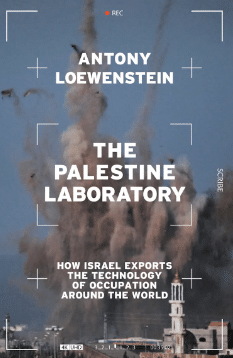
In The Palestine Laboratory: How Israel Exports the Technology of Occupation Around the World, Antony Loewenstein details how Israel’s military-industrial complex has grown from a minor industry into a dominant economic and social force at home and abroad.
He traces how, since 1967, the Occupied Territories and their people have furnished Israel with a living laboratory for their application and development of border security and surveillance systems, phone-hacking spyware, tracking and targeting technologies, as well as more traditional weapons systems. Tried and tested in the field, these systems are then packaged and sold for export.
In the wake of the September 11 terrorist attacks and the wave of anxiety they engendered, demand for Israeli hardware and know-how exploded. Israel is now one of the world’s top-ten weapons dealing nations. Its defense enterprises market everything from small arms to killer drones, from spyware to surface-to-air missiles. If it flies, watches, listens or goes bang, Israeli companies make and will sell it to (just about) anybody.
The Israeli economy, one critic noted, has “abandoned oranges for hand grenades”. Perhaps. But, as Loewenstein notes, everybody wants hand grenades nowadays.
Loewenstein’s analysis of Israeli arms dealing offers a sobering roll-call of the past half-century’s standout despots and pariah
nations, ranging from apartheid-era South Africa to Saudi Arabia’s bonesaw authoritarians. Their clients have included, among others, Suharto-era Indonesia, Ceausescu’s Romania, Pinochet’s Chile, the Shah’s Iran, the Duvaliers’ – père et fils – Haiti, Stroessner’s Paraguay, and Rios Montt’s genocidal tyranny in Guatemala, where Israeli-made Galil rifles were used to massacre indigenous communities.
Also Read: Israeli forces shoot and kill Palestinian in occupied West Bank
Through its commercial relationships and the diplomacy into which they so often shade, Israel has consistently pursued international acceptance of, or acquiescence to, its occupation of pre-1967 Palestinian territories. Israel will trade with any state whose backing will help stifle criticism or stave off sanctions, as well as just about anybody else who can pay. As a result, not only has Israel surrendered its once-prized status as “a light unto nations”, its export policies have ensured that millions laboring under autocratic rule remain locked in darkness.
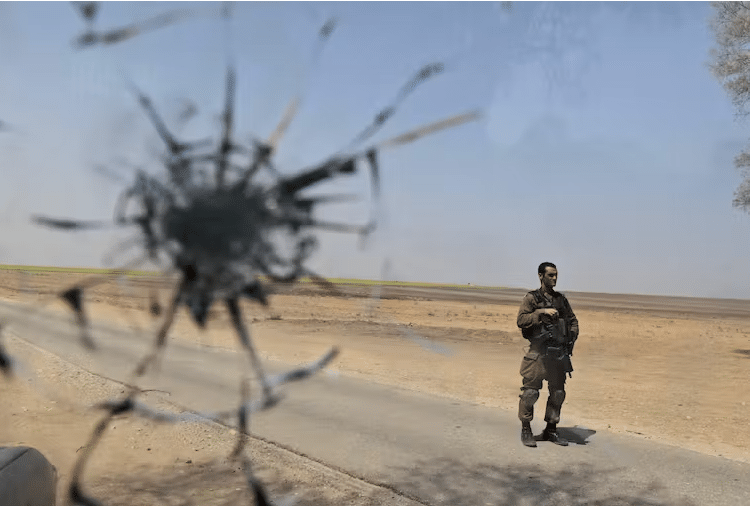
Despite the massive investments of manpower, materiel and infrastructure, Israel’s occupation of East Jerusalem and the West Bank, and the containment of Gaza, has been a boon to the state, not a financial burden. The high operational tempo of its military means that those marketing Israeli defense materiel can point to the performance of their technologies in Gaza, Jenin, and across the Occupied Territories, as well as in Lebanon and Syria.
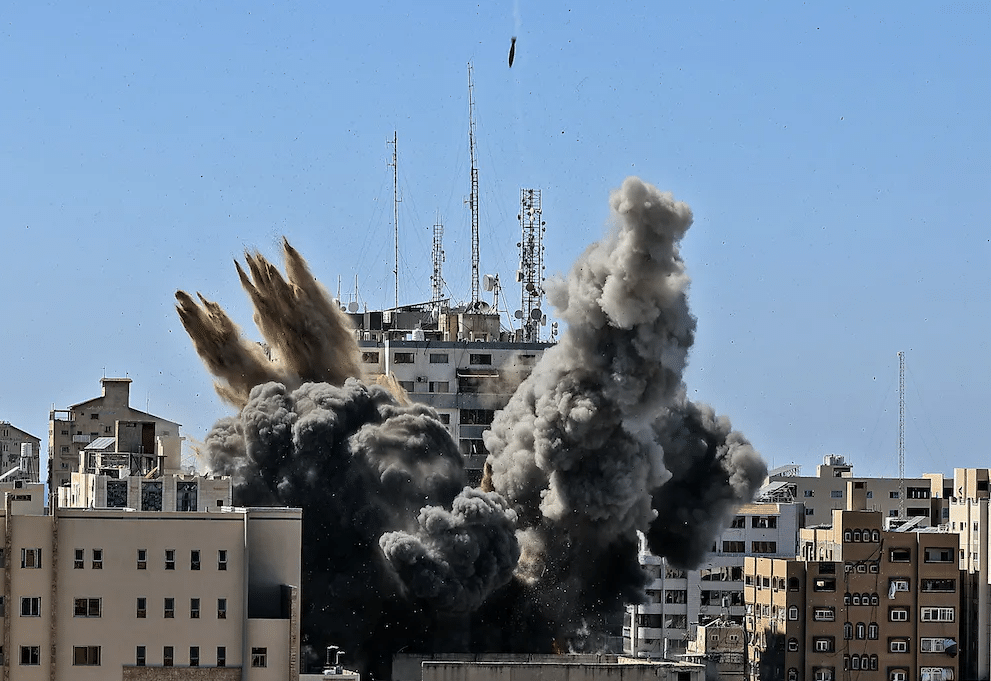
Do you need to know what your enemies are planning? Listen to these recordings of their conversations and messages sourced via the latest spyware. Do you want to see where your enemies are and interdict them before they can do you any harm? See how this drone locates, tracks and then detonates the car in which the militant commander is travelling. Looking for a surgical strike option? Watch this missile demolish the tower block where enemy intelligence has occupied offices, leaving the surrounding real estate mostly intact.
Export industry
The September 11 attacks on New York and Washington turbocharged Israel’s defence sector. Spooked by the fear of hostile foreigners and enemies within, governments from around the world queued up to learn from “the Harvard of anti-terrorism” and buy its technology.
As of 2021, Israeli arms sales had increased by more than 55% over the preceding two years, to a total of US$11.3 billion. Its more recent clients include India, Turkey, the United Arab Emirates and Azerbaijan. In each of these countries, Israeli arms have exacerbated existing conflicts. Indeed, Israel rarely meets a client with whom it will not do business. Its government has approved every defense deal brought to it since 2007.
Despite this, the US National Security Agency (NSA) has continued to transfer data-mining and analytical software to the Israelis, who have increasingly passed it on to private companies. Using its operations in the occupied territories as incubator, accelerator and test bed, and drawing on the expertise of Unit 8200 – the Israeli Defense Force’s equivalent of the NSA – the Israeli state has facilitated and funded numerous private start-ups.
Yet the appearance of a thriving defense private sector is illusory, as the government oversees ownership and directs the operations of the key players in the market. NSO, the surveillance company responsible for the phone-hacking spyware Pegasus, is under the “almost complete control” of Israel’s Ministry of Defense, which “controls ownership and rights and has a veto on shareholders, owners and operators. The tech, patent and IP is also controlled.”
All foreign sales are overseen by the Ministry of Defense. A dedicated department of the Director of Security of the Defense Establishment is tasked to ensure that classified information about the defense industry is not inadvertently revealed through any of these deals. Israel thus retains its best and sharpest innovations for its own use.
Commercial sales
The commercial sale of technologies ordinarily reserved for state purposes, and their subsequent misuse, often by states themselves, has disturbed senior intelligence officials in the “five eyes” intelligence community and strained ties with Tel Aviv.
The first major customer for NSO’s Pegasus spyware, in 2011, was the Mexican government, which at the time was locked in a bloody struggle against drug cartels. The capacity to listen in to the narco-traffickers’ conversations and read their text exchanges gave Mexican authorities a crucial if temporary edge. Pegasus, they later claimed, had played a key role in the 2016 arrest of the head of the Sinaloa drug cartel, “El Chapo”.
However, it wasn’t long before state officials made the information garnered by Pegasus, and the technology itself, available to the cartels. While the drug traffickers targeted their rivals and their critics in the media, leading to a massive upsurge in the killing of reporters, the government used the technology to spy on critics of its other policies, notably proponents of a sugar tax on the country’s soft-drinks industry, giving the lie to its assurance that it would be used solely to track perpetrators of major crimes.
Also Read: Israeli ‘air and ground troops’ launch offensive on Gaza Strip, army says
Jeremy Fleming, former director of Britain’s intelligence, security and cyber agency Government Communications Headquarters (GCHQ), described NSO’s practices as “beyond the pale” and argued that “countries or companies that promulgate [technology] in an unconstrained way like that are damaging and should not be tolerated”.
How are the Israelis able to behave like this? Why doesn’t the United States rein them in?
Loewenstein argues that after the US failed to protect it from Iraqi Scud missiles during the first Gulf War, Israel exercised greater autonomy in the production, deployment and trade in its military technology. It is not an entirely convincing argument. It overlooks the fact that the Scuds that landed on Tel Aviv and Haifa in January 1991 were targeted as much at the Arab and Muslim-majority members of the international coalition that the US had assembled against Iraq’s invasion of Kuwait as they were at the Israelis.
The missile attacks were intended to provoke a response from Israel, which was not a member of the US-led coalition, in the belief this would bring about the withdrawal of Egypt, Syria, Saudi Arabia, the UAE, Turkey and others, and so precipitate the collapse of the anti-Iraqi alliance.
Israel has acted with greater independence from the US because, over the past 20 years, it has become less economically dependent. Until Russia’s invasion of Ukraine, Israel was perennially the largest recipient of US aid, which in 1981 was roughly equivalent to 10% of Israel’s economy. As its economy grew, the size and significance of the US subvention diminished. By 2020, the US’s $4 billion of financial assistance amounted to only 1% of the economy, thus freeing Israel to act, at home and abroad, with less regard for the political interests or moral sensitivities of the US.
The border industrial complex
Before we retreat behind the smug assumption that the unethical sell only to the unprincipled, Loewenstein reminds us that in 2021 the major destination for Israeli arms exports was Europe.
As the immediate threat of terrorism has faded since the defeat of Islamic State, Israeli defense technology has played a central role in helping the European Union and its constituent states to monitor and hold back the flow of refugees making their way to the European mainland.
The EU’s border agency, Frontex, uses unmanned aerial vehicles (UAVs) – Israeli Heron and Hermes drones – to monitor movements on its maritime and land borders. Tested over the occupied territories, the Heron can remain in the air for up to 24 hours. Its equipment includes high-resolution and thermal-imaging cameras, artificial intelligence to detect moving targets, and mobile telephone location technology.
While these drones can locate and track migrants on land or the water, in daylight or darkness, providing the Frontex control center in Warsaw with a visual live feed, they cannot rescue anybody. If the Frontex operator sees an armed vessel or a suspicious-looking boat, he can alert a patrol boat to intercept and investigate. If all he sees is a leaky boat full of refugees, there may not be quite as much hurry. As one analyst noted, the technology gives Frontex “the option to let refugees drown”.
Frontex’s budget grew from €6 million in 2006 to €460 million in 2020. The EU is now pledged to spend €34.9 billion on border and migration management between 2021 and 2027, transforming it from “a coordination mechanism to a fully fledged multinational security force”.
Israel supplies this “border industrial complex” with, among other things, digital barriers, steel fences, observation towers, ground sensors, thermal imaging, virtual border-guard interview machines, and lie-detector machines powered by AI.
The size of the Frontex budget, and the inhuman equipment it furnishes, lays bare just how badly the multicultural project in Europe is struggling. The backlash against immigration has long been a feature of European Union politics, energized by the global financial crisis, and lethally sharpened after the influx of Syrian refugees in 2015. Ethno-nationalists, Brexiteers and other tinpot populists have ridden to power by stoking public fears of the outsider and championing an increasingly narrow vision of national identity and its approved expression.
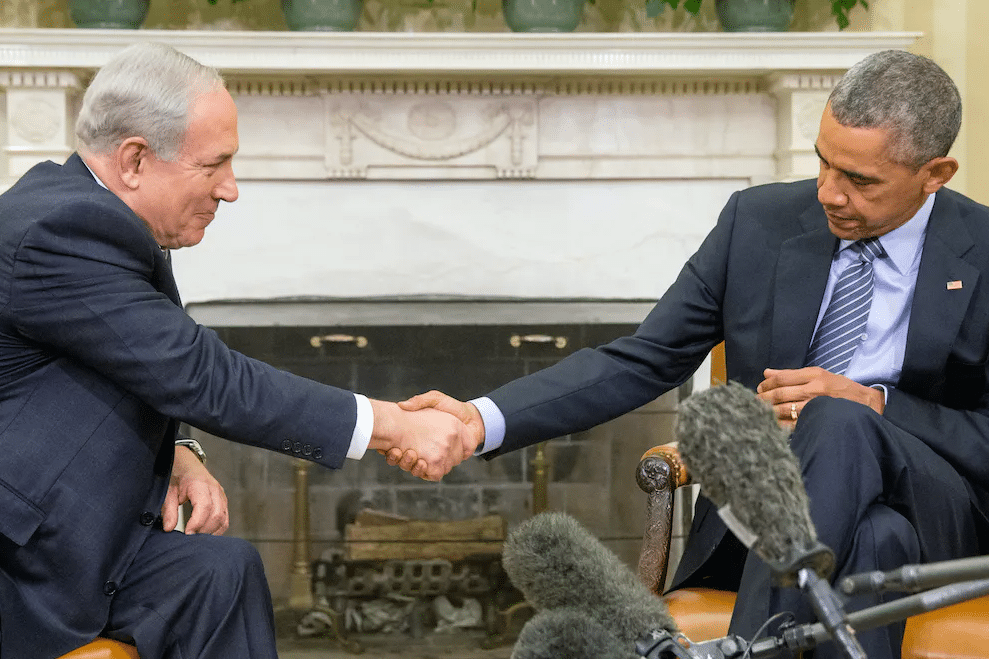
Benjamin Netanyahu’s Israel, Loewenstein argues, has been at the forefront in articulating and embedding the policies and practices of this new ethno-nationalism. For a long time, Israel and its policies in the Occupied Territories looked like an outlier. The then US President Barack Obama, in one of his many spats with Netanyahu, argued that the arc of history was bending away from colonialism and racism, and that the Israelis would have to come to a settlement with the Palestinians, as in the 21st century it was no longer sustainable to occupy another land and oppress its people.
Netanyahu disagreed, arguing, as Peter Beinart put it, that
the future belonged not to liberalism as Obama defined it – tolerance, equal rights and the rule of law – but to authoritarian capitalism: governments that combined aggressive nationalism with economic and technological might. The future, Netanyahu implied, would produce leaders who resembled not Obama, but him.
As the retreat from liberalism plays out across the world, in the US, India, Hong Kong, Hungary, Poland and multiple African states, Netanyahu looks less like a has-been and more like a portent, the “rough beast, its hour come round at last / Slouch[ing] towards Bethlehem”.
In The Palestine Laboratory, Loewenstein does not merely indict Israel for its failure to live up to the promise of its founding principles and its leading role in the supply, sustainment and normalization of a border-industrial complex. He also condemns Europe, the US, Australia and the West for their politicization of fear of the outsider, their receptiveness to divisive demagoguery, and their moral complicity in the immiseration of millions who live under occupation and oppression, and the millions more who roam the Earth in search of safe harbor. Israel may have lost its way, but once-civilized nations seem to be following it into the darkness.
Kevin Foster, Associate Professor, School of Languages, Literatures, Cultures and Linguistics, Monash University
This article is republished from The Conversation under a Creative Commons license. Read the original article.