Thursday, September 3, 2026
  • News
    • Latest News
    • Breaking News
    • Fact Check
    • Investigations
    • Explainers
  • Politics
    • Global Politics
    • Elections
    • Government & Policy
    • Diplomacy
    • Conflicts & Security
    • Political Analysis
  • Business
    • Global Economy
    • Markets
    • Technology
    • Startups
    • Energy
    • Finance
  • World News
    • Americas
    • Asia
    • Asia Pacific
    • Africa
    • Europe
    • Middle East
  • Africa
    • Central Africa
    • East Africa
    • West Africa
    • Southern Africa
  • Health
    • Global Health
    • Public Health
    • Health Policy
    • Medical Research
    • Diseases & Conditions
    • Mental Health
    • Nutrition
    • Climate & Health
    • Health Explainers
  • Sports
    • World Cup 2026
    • Athletics
    • Basketball
    • Boxing
    • Cricket
    • Football
    • Formula 1
    • Golf
    • Rugby
  • Weather
    • Climate Business
    • Climate Change
    • Climate Solutions
    • Living Green
  • Culture
    • Arts
    • Film & TV
    • Food and Recipes
    • Music
    • Lifestyle
    • Travel
  • Opinion
    • Editorials
    • Letters
  • Behind The Brand
REGISTER
LOGIN
No Result
View All Result
The Kenya Times
  • News
    • Latest News
    • Breaking News
    • Fact Check
    • Investigations
    • Explainers
  • Politics
    • Global Politics
    • Elections
    • Government & Policy
    • Diplomacy
    • Conflicts & Security
    • Political Analysis
  • Business
    • Global Economy
    • Markets
    • Technology
    • Startups
    • Energy
    • Finance
  • World News
    • Americas
    • Asia
    • Asia Pacific
    • Africa
    • Europe
    • Middle East
  • Africa
    • Central Africa
    • East Africa
    • West Africa
    • Southern Africa
  • Health
    • Global Health
    • Public Health
    • Health Policy
    • Medical Research
    • Diseases & Conditions
    • Mental Health
    • Nutrition
    • Climate & Health
    • Health Explainers
  • Sports
    • World Cup 2026
    • Athletics
    • Basketball
    • Boxing
    • Cricket
    • Football
    • Formula 1
    • Golf
    • Rugby
  • Weather
    • Climate Business
    • Climate Change
    • Climate Solutions
    • Living Green
  • Culture
    • Arts
    • Film & TV
    • Food and Recipes
    • Music
    • Lifestyle
    • Travel
  • Opinion
    • Editorials
    • Letters
  • Behind The Brand
  • News
    • Latest News
    • Breaking News
    • Fact Check
    • Investigations
    • Explainers
  • Politics
    • Global Politics
    • Elections
    • Government & Policy
    • Diplomacy
    • Conflicts & Security
    • Political Analysis
  • Business
    • Global Economy
    • Markets
    • Technology
    • Startups
    • Energy
    • Finance
  • World News
    • Americas
    • Asia
    • Asia Pacific
    • Africa
    • Europe
    • Middle East
  • Africa
    • Central Africa
    • East Africa
    • West Africa
    • Southern Africa
  • Health
    • Global Health
    • Public Health
    • Health Policy
    • Medical Research
    • Diseases & Conditions
    • Mental Health
    • Nutrition
    • Climate & Health
    • Health Explainers
  • Sports
    • World Cup 2026
    • Athletics
    • Basketball
    • Boxing
    • Cricket
    • Football
    • Formula 1
    • Golf
    • Rugby
  • Weather
    • Climate Business
    • Climate Change
    • Climate Solutions
    • Living Green
  • Culture
    • Arts
    • Film & TV
    • Food and Recipes
    • Music
    • Lifestyle
    • Travel
  • Opinion
    • Editorials
    • Letters
  • Behind The Brand
No Result
View All Result
The Kenya Times ~ Trending, Breaking News and Videos
No Result
View All Result
ADVERTISEMENT

Opinion | Why Wage Increases Won’t Fix What’s Broken in Kenya’s Economy

The Kenya Times - Opinion DeskbyThe Kenya Times - Opinion Desk
May 29, 2026
Reading Time: 6 mins read
Low Wages Squeeze Kenyans As As Computer Misuse And Cybercrimes Act Establishes Penalties For Unauthorized Access To Computer Systems, As Well The Legal Cybersecurity Practices.

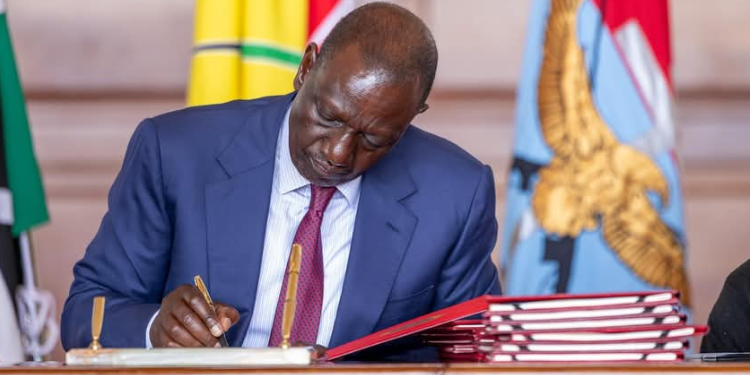
President William Ruto. PHOTO/PCS

FacebookTwitterLinkedInRedditWhatsApp
Advertisement

A 12 percent wage increase sounds like relief. In a moment when the cost of living continues to strain households, it feels like something has finally shifted in favour of workers. But relief is not the same as progress.

When government signals higher wages across the economy, the assumption is simple: workers earn more, and therefore live better. The reality is less straightforward. Wages do not exist in isolation. They sit inside a system shaped by productivity, costs, taxes, and incentives. Change one part without addressing the rest, and the outcome rarely matches the intention.

Employers do not operate in a vacuum. When wage bills rise suddenly, businesses adjust. Some reduce hiring. Others slow expansion. Many quietly begin to withdraw the very benefits that make employment tolerable. Overtime is cut. Training budgets shrink. Staff meals, transport allowances, and small welfare provisions disappear. Bonuses become irregular or vanish altogether.

The worker who was meant to benefit from a wage increase often finds that the total value of their employment has not improved. In some cases, it declines.

This is not because employers are indifferent. It is because they are responding to pressure. A business must balance what it pays with what it produces. If output does not rise in tandem with wages, something else gives.

That is the first problem with top-down wage adjustments. They assume that income can be raised without first strengthening the underlying capacity that sustains it.

ADVERTISEMENT

Wages and rising tax burden

The second problem is less visible but more consequential. Even where wages increase, the gains are quickly eroded by the structure of taxation and statutory deductions. A worker may see a higher gross salary, but by the time PAYE, levies, and contributions are applied, the net improvement is marginal.

Matatu Protests Force Schools To Close Nationwide As Fuel Crisis Escalates 
Matatus at Kakamega-Eldoret bus stage in Kakamega town PHOTO/MAK-X

In Kenya today, that erosion is significant. Housing levies, health contributions, and shifting tax brackets mean that part of any wage increase flows back to the government. What appears to be relief on paper becomes a recycling mechanism in practice.

The result is a cycle that feels familiar. Workers are told they are earning more. Employers are paying more. Yet neither side feels meaningfully better off.

This is where the conversation needs to shift.

Limited opportunities

Kenya’s central economic challenge is not simply low wages. It is the limited capacity of the economy to absorb labour at scale. Too many people are able and willing to work, but too few opportunities exist that can sustain them productively.

Raising wages in that environment does not solve the problem. It makes it worse.

ADVERTISEMENT

Also Read: Ruto Confirms Plan to Scrap PAYE for Kenyans Earning Below Ksh30,000


When the cost of labour rises without a corresponding increase in productivity, firms become more cautious. Hiring slows and entry-level opportunities shrink, or informal arrangements expand. In the long run, this weakens the very workforce the policy is meant to protect.

If the goal is to improve the welfare of workers, the more durable path lies elsewhere. It begins with investment.

An economy that attracts large-scale, sustained investment creates demand for labour. As firms expand, they compete for workers. That competition naturally pushes wages upward, without the need for directive adjustments. More importantly, it does so in a way that is tied to productivity, making those wages sustainable. This is how strong labour markets are built.

Need for an enabling business environment

For that to happen, government policy must focus on enabling conditions rather than direct outcomes. Investors respond to clarity, predictability, and cost structures. They look for affordable and reliable energy, efficient logistics, access to finance, and a regulatory environment that does not shift unpredictably. Where those conditions exist, capital flows. Where capital flows, jobs follow.

There is also a fiscal dimension that cannot be ignored. A broader employment base expands the tax base. More people working productively means more revenue without the need to increase tax rates. As revenues stabilize, the pressure to rely on borrowing reduces. Debt servicing costs begin to ease, freeing up public resources.

Those resources can then be redirected into infrastructure, healthcare, education, water and other enablers that reinforce growth. The system begins to support itself. That is the loop Kenya needs to close.

At present, however, the sequence is reversed. Wage increases are announced before the underlying conditions for productivity and investment have been strengthened. Taxes remain high because the base is narrow. Businesses face rising costs. Workers face limited opportunities. The system strains under its own contradictions.


Also Read: Salaries Kenyan Workers Will Earn After Ruto Raises Wages


None of this suggests that workers do not deserve better pay. They do, but better pay that is not anchored in productivity and supported by a conducive economic environment is difficult to sustain.

Momentary relief

Short-term measures can create an impression of action. They can generate goodwill. But they do not address the structural constraints that shape outcomes over time.

The harder work is less visible. It involves building an economy that can carry higher wages without breaking under them. That means focusing less on announcing increases and more on enabling growth. It means asking not just how much workers earn today, but how many people can earn tomorrow, and under what conditions.

Until that shift happens, wage increases will continue to offer momentary relief while leaving the deeper problems intact.

Kenya does not need louder announcements. It needs a more coherent economic strategy, one that begins with job creation, expands opportunity, and allows wages to rise as a result of a stronger, more productive system. That is the path to lasting improvement.

This article was written by George Nyongesa, a lecturer of philosophy and logic at the University of Nairobi and Chuka University.

Follow our WhatsApp Channel and X Account for real-time news updates.

Ruto Proposes Scrapping Paye For Millions Of Low-Income Workers Low Wages Squeeze Kenyans As
National Treasury officials led by Cabinet Secretary John Mbadi during a past press briefing. PHOTO/Nati
Tags: CS John MbadiFinance Bill 2026Minimum Wage Bill
The Kenya Times - Opinion Desk

The Kenya Times - Opinion Desk

The Kenya Times Opinion Desk publishes independent commentary and analysis from contributors and invited voices. Views expressed are those of the authors and do not represent the newsroom’s reporting or editorial positions.

Related Posts

Gtc Office Tower Nairobi: Leasing Costs, Security Features And Businesses Inside The Landmark Building

How Nairobi’s Expansion is Tearing Families Apart, Book Finds

September 3, 2026
President William Ruto Has Vowed To Transform Kenya Into Singapore Through Transformative Leadership.

Ruto’s Singapore Dream: The Math That Never Added Up

September 2, 2026
Parliament Has Allocated Ksh175.5 Billion To Health, Including Ksh19.1 Billion For The Primary Healthcare Fund And Ksh4.0 Billion For Emergencies.

More Revenue for Health Will Not Be Enough Without Budget Credibility

August 31, 2026
A Collage Of Kenya'S Former Deputy President Rigathi Gachagua And Health Cs Aden Duale. Photo/Courtesy

When Political Insults Become Attacks on Entire Communities

August 31, 2026

Comments 1

  1. Gulilat says:
    3 months ago

    As an individual , I’ve learned something from the article. The advice sounds workable. But the writer didn’t mention political willingness 4 creating a sound atmosphere in the economic system.

ADVERTISEMENT

The Kenya Times Facebook

LATEST NEWS

  • African Tech Founders Get New Path to Investors, Deals and Mentorship
  • Tata Chemicals Magadi: Owners of Over 100-Year-Old Company Ruto Ordered Out of Kenya
  • From Dusty Pitches to Champions League: Jereko Joins Nekesa in Kenyan Football History
  • CS Ogamba Issues New Directive on University and TVET Funding for First-Year Students
  • Ruto Reveals Why He Kicked Multimillion-Shilling Company Out of Kenya
  • Jomo Kenyatta Boys High School Closed Again
  • How Nairobi’s Expansion is Tearing Families Apart, Book Finds
  • World Meteorological Organization Issues Major El Niño Warning as New Weather Threat Emerges
  • University Faces Protest Over Expansion to Satellite Campuses
  • Migori County Announces 118 Jobs in New Recruitment Drive: How to Apply
  • Sakaja Reveals One Nairobi Problem Residents Can Blame Him For
  • Kenya Among 5 Nations Set to Receive Japan’s New Military Gear
  • Ndindi Nyoro Breaks Silence on His Bitter Split With President Ruto
  • Akoko Val: How Cooking Videos Became Her Ticket to Social Media Fame and a Luxury Lifestyle
  • Story of Ken Wa Maria, How He Rose from Gikomba Trader to Kamba Music Star
ADVERTISEMENT

Company

About Us

Our Authors

Our Experts

Social Media

Policies

Privacy Policy

House Rules

Standards and Policies

Terms and Conditions

Subscription

My Account

Contact Us

Contact Us

Join Our Team

Advertise With Us

© Copyright 2026 | The Kenya Times | All Rights Reserved

Welcome Back!

Sign In with Facebook
Sign In with Google
Sign In with Linked In
OR

Login to your account below

Forgotten Password? Sign Up

Create New Account!

Sign Up with Facebook
Sign Up with Google
Sign Up with Linked In
OR

Fill the forms below to register

All fields are required. Log In

Retrieve your password

Please enter your username or email address to reset your password.

Log In
Your Privacy and Cookies
We use cookies on our website to give you the most relevant experience by remembering your preferences and repeat visits. By clicking “Accept”, you consent to the use of ALL the cookies.
Do not sell my personal information.
Cookie settingsACCEPT
Privacy & Cookies Policy

Privacy Overview

This website uses cookies to improve your experience while you navigate through the website. Out of these cookies, the cookies that are categorized as necessary are stored on your browser as they are essential for the working of basic functionalities of the website. We also use third-party cookies that help us analyze and understand how you use this website. These cookies will be stored in your browser only with your consent. You also have the option to opt-out of these cookies. But opting out of some of these cookies may have an effect on your browsing experience.
Necessary
Always Enabled
Necessary cookies are absolutely essential for the website to function properly. This category only includes cookies that ensures basic functionalities and security features of the website. These cookies do not store any personal information.
Functional
Functional cookies help to perform certain functionalities like sharing the content of the website on social media platforms, collect feedbacks, and other third-party features.
Performance
Performance cookies are used to understand and analyze the key performance indexes of the website which helps in delivering a better user experience for the visitors.
Analytics
Analytical cookies are used to understand how visitors interact with the website. These cookies help provide information on metrics the number of visitors, bounce rate, traffic source, etc.
Advertisement
Advertisement cookies are used to provide visitors with relevant ads and marketing campaigns. These cookies track visitors across websites and collect information to provide customized ads.
Others
Other uncategorized cookies are those that are being analyzed and have not been classified into a category as yet.
SAVE & ACCEPT
LOGIN | REGISTER
  • Login
  • Sign Up
  • Cart
No Result
View All Result
  • News
    • Latest News
    • Breaking News
    • Investigations
    • Explainers
    • Fact Check
  • Politics
    • Global Politics
    • Conflicts & Security
    • Elections
    • Diplomacy
    • Government & Policy
    • Political Analysis
  • Business
    • Global Economy
    • Markets
    • Technology
    • Startups
    • Energy
    • Finance
  • World News
    • Americas
    • Asia
    • Asia Pacific
    • Africa
    • Europe
    • Middle East
  • Africa
    • East Africa
    • West Africa
    • Southern Africa
    • Central Africa
  • Health
    • Global Health
    • Public Health
    • Health Policy
    • Medical Research
    • Diseases & Conditions
    • Mental Health
    • Nutrition
    • Climate & Health
    • Health Explainers
  • Sports
    • World Cup 2026
    • Athletics
    • Basketball
    • Boxing
    • Cricket
    • Football
    • Formula 1
    • Golf
    • Rugby
  • Weather
    • Climate Business
    • Climate Change
    • Climate Solutions
    • Living Green
  • Culture
    • Arts
    • Film & TV
    • Food and Recipes
    • Lifestyle
    • Music
    • Travel
  • Opinion
    • Editorials
    • Letters
  • Behind The Brand
  • Contact Us

Not enough quota to unlock this post
Unlock left : 0
Are you sure want to cancel subscription?