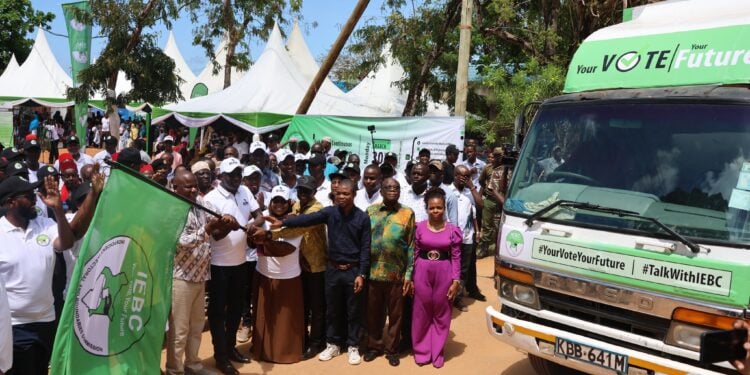
The Independent Electoral and Boundaries Commission (IEBC) began mass voter registration on March 30, an exercise that will take 30 days.
The audit firm KMPG conducted an audit of the registers of voters prior to the 2022 general elections. According to the audit report, there are duplicate records totaling 481,711, and voters said to have registered with identity cards that do not belong to them, totaling 226,143. A total of 246,465 records of deceased voters were also picked. Another 164,269 registrations were linked to invalid registration documents (IDs and Passports).
The report unearthed 14 mysterious Returning Officers (ROs) running the system. The report indicated that the mysterious Returning Officers were able to “transfer, delete, insert, trigger, truncate, and update the voters register at will,” and “one user, Postgress, had superuser access privileges.”
IEBC Audit report findings
According to the report, KPMG also discovered that the 14 Returning Officers were not gazetted but had worked alongside 290 IEBC officers in charge of the constituencies in previous elections. The audit also revealed that the ‘digital’ ROs were backed by 513 generic accounts in the IDMS, compared with 9 genuine accounts, and had access to the voters’ register in the Integrated Database Management System (IDMS). The officers had the elevated privileges in IEBC IDMs to transfer, change voter particulars, and deactivate deceased voters and the constituency
KMPG report showed that the digital voters register had over 2 million mysterious voters. These voters registered using duplicate or fake documents, while other people registered twice in previous elections. Auditors also found that during the cleaning of the voters’ register, new voters were mysteriously re-registered.
Also Read: List of IEBC Voter Registration Centres in Nairobi County
KPMG also noted that the IDMS database was not configured to delete inactive accounts after 90 days, as required by IEBC policy, which made it easier for those who had left the IEBC to gain access to the system.
The total number of records in the Smartmatic register of voters provided to KPMG on May 5, 2022, was 21,970,597, including all biographic and biometric details. Smartmatic duplicated the 2,184,472 records against the 21,970,597 records to generate a fully deduplicated register containing 21,710,728 voters, which was given to KPMG on May 18,2022.
What should be done ahead of the elections?
1. The Independent Electoral and Boundaries Commission (IEBC) must unconditionally and immediately cancel the opaque, secretive, and tainted contract extension to Smartmatic for election technology management. This scrupulous company has a terrible record of credibility across the world in electronic voting, voter registration, and results transmission.
2. IEBC must issue a fresh tender without issue for the acquisition of the Integrated Election Management Technology. The procurement must meet the constitutional and procurement transparency threshold, including the involvement of all stakeholders. We will not accept any time-buying tactics.
3. No voter biometrics registration should be done with the KIEMS kits provided by Smartmatic. Smartmatic has supplied the IEBC with critical election technology, including biometric voter registration systems, KIEMS kits for voter identification, and results transmission infrastructure. The kits and technology must be discarded, and new kits must be acquired afresh.
4. All voter registration must be polling station-based. Each polling station must have a special code. Voters’ data safety and security at each polling station must be guaranteed. The voters’ identification kits must be foolproof to prevent data sharing.
5. IEBC must develop and provide a time-bound roadmap and milestones on election preparedness. Each milestone must be specific about what ought to have been done and report on the status.
Also Read: How IEBC Will Rename Constituencies After 2027 General Election
6. The Parliamentary Legal and Justice Committee must immediately summon IEBC to provide details of the election preparations, any electoral reforms needed, and the governance structure of the Commission, including its secretariat staff recruitment status
7. IEBC must ensure that, as per the Constitution, the High Court and Court of Appeal, the final presidential election results shall be announced at the constituency by the returning officer after collating the final polling station results. There shall be no Bomas or other such centers to purport to announce presidential results.
8. IEBC must issue regulations to grant the media full access to the final results announced at both polling stations and the Constituency tallying center in real time, including the right to project the winners of those centers. This is in exercise of principles of participation, transparency and accountability
9. IEBC must gazette and disclose all polling stations with their special codes. Further, the Commission must provide clear timelines for voters’ identification and for the public scrutiny of voters’ registers at each polling station.
10. A comprehensive register of voters audit must be done. In addition, the IEBC, the National Civil Registration Bureau, and Immigration services must work together to confirm the details of all registered voters and their valid documentation. All old voters’ registers must be transparently audited.
11. The process for procuring electoral materials must be made public and involve all stakeholders. Voting materials at each polling station must have a special code.
12. Finally, all documentation on proceedings, resolutions, and meeting records of the Commission and its various committees on any matter touching on electoral and election management must be made public.
This article was written by Ndung’u Wainaina, a Human Rights Defender.