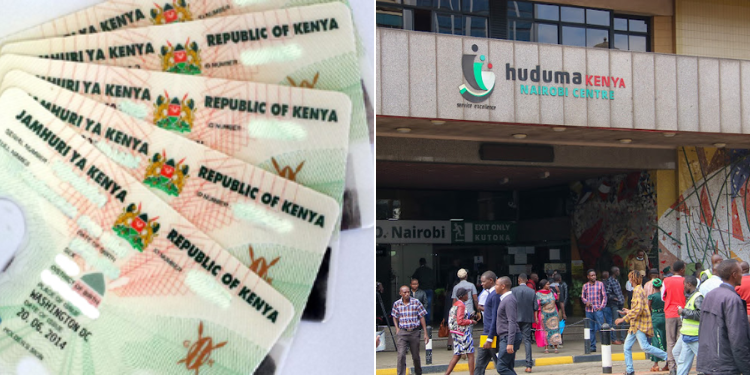

The government has launched a mass national identification registration drive targeting thousands of Kenyans.
The ongoing national ID registration exercise is underway in parts of Nairobi and Western Kenya.
A phased rollout, which will gradually extend across the country, is designed to ensure that every Kenyan turning 18 can access identification quickly, affordably, and locally.
This represents a deliberate shift toward citizen-centred service delivery, ensuring that registration services are brought closer to where people live, rather than requiring them to overcome distance, cost, or other structural barriers.
Measures such as the waiver of ID application fees are intended to enhance inclusion by eliminating financial barriers and enabling all eligible citizens to benefit from opportunities linked to legal identification.
Why ID Registration Is Important
For many young Kenyans, identity represents the difference between waiting and starting life.
In a shared testimony, a Kisumu resident said obtaining a new ID would enable her to access enterprise opportunities, including youth and entrepreneurship funds, to start her own business.
Others noted that without a national ID, accessing loans or purchasing land can be difficult, if not impossible.
As such, the ID is more than just a document; it is a gateway to adulthood, economic opportunity, and full participation in society.
Community members have emphasized the importance of mobile registration and Huduma Mashinani-style outreach, noting that bringing services directly to local communities helps ensure no one is left behind.
Also Read: Murkomen Introduces New Machine to Speed ID Registration Issuance
The Role of Identity in a Country
Identity is one of the most powerful foundations of a functioning society.
At its most basic level, it is recognition, meaning, acknowledgement that a person exists, belongs, and has a place within the national system.
Across Kenya and globally, identification is not simply an administrative requirement.
It is the gateway to citizenship in its most practical, lived form.
Also Read: Murkomen Gazettes Waiver of KSh1,000 ID Replacement Fee
In Kenya, the National Identity Card is often the first and most important document a citizen holds because it connects them directly to the state’s services, protections, opportunities, and civic responsibilities.
Without legal identity, citizens can become invisible to the systems designed to serve them. Rights may exist in law, but they cannot be exercised in daily life.
When opportunity becomes uncertain, participation becomes limited, and dignity is compromised.
From accessing services at Huduma Centres to registering for government programmes, identity is the starting point of participation in national life.
According to the World Bank, in Kenya and worldwide, official proof of identity is essential for participating in economic, social, and political life, as well as for exercising fundamental rights.
Without an ID, people can find it difficult or impossible to access social assistance, healthcare, or education, open a bank account, activate a SIM card, or participate in the digital economy.
Beyond service access, identity functions as economic infrastructure. With official identification, citizens can open bank accounts, register businesses, access credit to start small enterprises, secure casual employment, and participate fully in the formal economy.
Follow our WhatsApp Channel and X Account for real-time news updates.