Monday, June 8, 2026
  • News
    • Latest News
    • Breaking News
    • Fact Check
    • Investigations
    • Explainers
  • Politics
    • Global Politics
    • Elections
    • Government & Policy
    • Diplomacy
    • Conflicts & Security
    • Political Analysis
  • Business
    • Global Economy
    • Markets
    • Technology
    • Startups
    • Energy
    • Finance
  • World News
    • Americas
    • Asia
    • Asia Pacific
    • Africa
    • Europe
    • Middle East
  • Africa
    • Central Africa
    • East Africa
    • West Africa
    • Southern Africa
  • Health
    • Global Health
    • Public Health
    • Health Policy
    • Medical Research
    • Diseases & Conditions
    • Mental Health
    • Nutrition
    • Climate & Health
    • Health Explainers
  • Sports
    • Athletics
    • Basketball
    • Boxing
    • Cricket
    • Football
    • Formula 1
    • Golf
    • Rugby
  • Weather
    • Climate Business
    • Climate Change
    • Climate Solutions
    • Living Green
  • Culture
    • Arts
    • Film & TV
    • Food
    • Music
    • Lifestyle
    • Travel
  • Opinion
    • Editorials
    • Letters
  • Behind The Brand
REGISTER
LOGIN
No Result
View All Result
The Kenya Times
  • News
    • Latest News
    • Breaking News
    • Fact Check
    • Investigations
    • Explainers
  • Politics
    • Global Politics
    • Elections
    • Government & Policy
    • Diplomacy
    • Conflicts & Security
    • Political Analysis
  • Business
    • Global Economy
    • Markets
    • Technology
    • Startups
    • Energy
    • Finance
  • World News
    • Americas
    • Asia
    • Asia Pacific
    • Africa
    • Europe
    • Middle East
  • Africa
    • Central Africa
    • East Africa
    • West Africa
    • Southern Africa
  • Health
    • Global Health
    • Public Health
    • Health Policy
    • Medical Research
    • Diseases & Conditions
    • Mental Health
    • Nutrition
    • Climate & Health
    • Health Explainers
  • Sports
    • Athletics
    • Basketball
    • Boxing
    • Cricket
    • Football
    • Formula 1
    • Golf
    • Rugby
  • Weather
    • Climate Business
    • Climate Change
    • Climate Solutions
    • Living Green
  • Culture
    • Arts
    • Film & TV
    • Food
    • Music
    • Lifestyle
    • Travel
  • Opinion
    • Editorials
    • Letters
  • Behind The Brand
  • News
    • Latest News
    • Breaking News
    • Fact Check
    • Investigations
    • Explainers
  • Politics
    • Global Politics
    • Elections
    • Government & Policy
    • Diplomacy
    • Conflicts & Security
    • Political Analysis
  • Business
    • Global Economy
    • Markets
    • Technology
    • Startups
    • Energy
    • Finance
  • World News
    • Americas
    • Asia
    • Asia Pacific
    • Africa
    • Europe
    • Middle East
  • Africa
    • Central Africa
    • East Africa
    • West Africa
    • Southern Africa
  • Health
    • Global Health
    • Public Health
    • Health Policy
    • Medical Research
    • Diseases & Conditions
    • Mental Health
    • Nutrition
    • Climate & Health
    • Health Explainers
  • Sports
    • Athletics
    • Basketball
    • Boxing
    • Cricket
    • Football
    • Formula 1
    • Golf
    • Rugby
  • Weather
    • Climate Business
    • Climate Change
    • Climate Solutions
    • Living Green
  • Culture
    • Arts
    • Film & TV
    • Food
    • Music
    • Lifestyle
    • Travel
  • Opinion
    • Editorials
    • Letters
  • Behind The Brand
No Result
View All Result
The Kenya Times ~ Trending, Breaking News and Videos
No Result
View All Result
ADVERTISEMENT

About Half of Young Americans Can’t Name a Single Holocaust Site, Repeating a Pattern of Ignorance Seen in Postwar Germany

The ConversationbyThe Conversation
April 18, 2026
Reading Time: 9 mins read
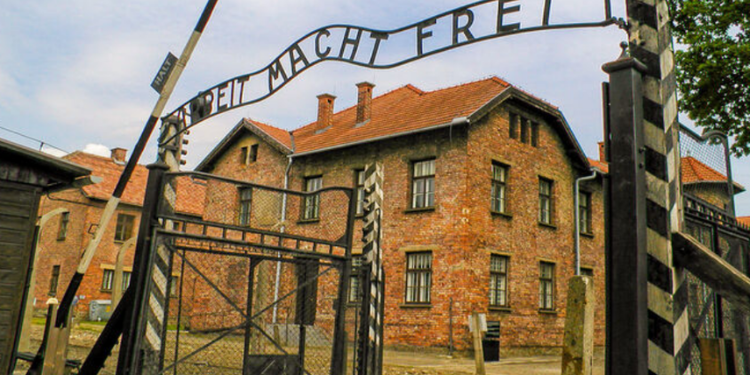
The Entrance Gate At Auschwitz Photo/Rick Stevens

The entrance gate at Auschwitz PHOTO/Rick Stevens

FacebookTwitterLinkedInRedditWhatsApp
Advertisement

In 2025, 48% of Americans ages 18-29 could not name a single concentration or death camp, according to a survey by the nonprofit Conference on Jewish Material Claims Against Germany, which works to secure compensation and restitution for Holocaust survivors.

Another 53% of surveyed Americans said that they had encountered Holocaust “denial or distortion while on social media”. Given their ages, approximately 70% of living Holocaust survivors will likely die by 2035.

As they do, more and more people will never hear firsthand experiences about the atrocities Nazis perpetuated during the genocide of European Jews.

My research shows that Holocaust education and awareness, though, doesn’t always follow a linear path.

Teaching a Dark Chapter

In my 2024 book, “Teaching a Dark Chapter: History Books and the Holocaust in Italy and the Germanys”, I study how Holocaust education evolved in East Germany, West Germany and Italy from the 1940s through the 1980s.

In particular, I focus on the content of history textbooks that schools used for middle school students.

ADVERTISEMENT

I also explore how two antisemitic incidents, one in 1959-60 and then another in 1977, revealed West German students’ lack of Holocaust knowledge.

Both times, international and domestic West German news outlets expressed alarm about students’ ignorance.

These antisemitic incidents also led to a series of educational reforms, in which educational leaders affirmed the need for Holocaust education and specified how educators should teach about the Holocaust.

The ‘Swastika Epidemic’

All of the synagogues in Cologne, Germany, were either destroyed or badly damaged during the Nazi pogroms of 1938, sometimes called Kristallnacht, or the “Night of the Broken Glass.”

The prominent, historic Roonstrasse synagogue was among the badly damaged Jewish houses of worship and was one of the few synagogues in West Germany to be rebuilt following World War II. In September 1959, West German Chancellor Konrad Adenauer attended a high-profile ceremony when the synagogue’s reconstruction was complete.

But then on Christmas Day of that year, Roonstrasse was defaced with antisemitic graffiti.

ADVERTISEMENT

Two 25-year-old men were arrested for the vandalism. They testified during their 1960 trial that they never learned about Nazism in school.

At the time, West Germany had vague guidelines on how to teach students about the Nazis and the Holocaust.

Historian James Loeffler has challenged whether these arrested men were actually responsible for the vandalism.

He argues that the Soviet KGB actually drew the swastikas in order to discredit West Germany.

Regardless, following the Roonstrasse defacement, a wave of additional antisemitic vandalism spread throughout West Germany and other places, including the United States. The press called this trend the “swastika epidemic.”

Many people attributed the rise in antisemitic activity to a lack of education about the Nazi period. They questioned what West German students were learning about their country’s recent past.

New Guidelines on How to Teach Nazism

The swastika epidemic wasn’t happening in isolation.

In April 1959, the TV documentary “Blick auf unsere Jugend,” meaning “Focus on Our Youth”, focused on a class of West German high school students. Very few of them knew how many Jews were killed by the Nazis.

The negative media coverage coincided with representatives of German and international Jewish organizations meeting with the West German federal president, Theodor Heuss, regarding the antisemitic vandalism and the failures of the West German education system to teach about Nazism.

A committee of West German state cultural representatives called the Kultusministerkonferenz, or KMK, began issuing new guidelines in 1960 and again in 1962 about how to teach about Nazism in schools.

The West German federal states were instructed to examine how Nazism and what we now know as the Holocaust – the term was not used at the time – was depicted in school textbooks. Feedback was then provided to the textbook publishers.

How Books Were Revised

I analyzed many versions of the same middle school history textbook called “Kletts geschichtliches Unterrichtswerk Ausgabe B,” which translates into “Klett’s Historical Instructional Materials Version B.”

Between 1959 and 1960, the textbook authors completely revised a subsection on “Terror and Crimes,” which examined how the Nazis murdered disabled people, as well as how the Nazis persecuted and murdered Jews.

The subsection tripled in size between the 1959 and 1960 textbook editions. The new version also included important new information, such as that the Nazis murdered an estimated 6 million Jews.

Previous editions had used generalizations like “many million,” without providing actual numbers.


Also Read: New Trick Scammers Are Using to Sweep Clean Americans; Bank Accounts, How to Protect Your Money


 A Second Controversy

Seventeen years later, in 1977, a West German teacher named Dieter Bossmann published a widely publicized study that offered more detail on the widespread ignorance among West German students, at every level.

Some students admitted to knowing almost nothing about Hitler. Some said relatively positive things about Hitler. One student thought that the Nazis had killed tens of thousands of Jews. Another thought that 16 million Jews had been killed.

The West German news magazine Der Spiegel observed at the time that the issue was perhaps not so much what students were learning, but rather how they were being taught. Although West German textbooks had been revised in the 1960s, somehow there was a disconnect between the textbook page and students’ understanding.

The KMK issued a new resolution in April 1978 that called for new curricular material for schools.

After this, more West German teachers began to prioritize an active teaching model. They encouraged students to analyze primary sources and participate in experiential learning activities, such as visiting concentration camp memorials and conducting local history research.


Also Read: New Cost for Americans? USPS Delivery Fees Plan Could Hit Millions Amid Fuel Surge


Remembering History

Holocaust education in West Germany was not perfect after 1978 – or any time since.

For example, Deutsche Welle, Germany’s public news broadcaster, quoted a Berlin history teacher saying in 2023 that among his students, “Adolf Hitler is known by most; the term National Socialism too. Some of them also know about the Holocaust, but knowledge is selective and it contains many blank spots.”

An estimated 18% of German adults incorrectly said in 2025 that 2 million or fewer Jews were killed during the Holocaust.

My particular focus on textbooks and curricular guidelines, though, demonstrates that sometimes, knowledge gaps lead to leaps forward.

Today, in part because of these developments, it’s mandatory to teach about the Holocaust in all federal states in Germany.

In the U.S., Holocaust education requirements are determined at the state level, and not all states provide Holocaust education guidance or mandates.

If the West German case shows anything, I think, it is that guidance on teaching history should be continuously updated and reiterated.The Conversation

Daniela R. P. Weiner, Teaching Assistant Professor of the First Year Experience and Humanities, Stevens Institute of Technology.

Daniela R. P. Weiner, Stevens Institute of Technology

This article is republished from The Conversation under a Creative Commons license. Read the original article.


Americans Can’t Name A Single Holocaust Site, Repeating A Pattern Of Ignorance Seen In Postwar Germany
The Jewish Museum in Berlin focuses on the history of German Jewish culture PHOTO/Rick Stevens
Tags: AmericansHolocaust Site
The Conversation

The Conversation

The Conversation is an independent news organization that publishes evidence-based articles written by experts to help readers understand diverse topics. We cover a wide range of areas including arts, culture, education, health, politics, science, and more¹. Their content is characterized by in-depth analysis, research, news, and ideas from leading academics and researchers. The Conversation aims to provide academic rigor with journalistic flair.

Related Posts

Iran Fires Ballistic Missiles At Israel In First Major Attack Since Ceasefire

Iran Fires Ballistic Missiles at Israel in First Major Attack Since Ceasefire

June 7, 2026
Hunter Biden Gains 500,000 Followers On X While Discussing Addiction And Politics

Hunter Biden’s Unfiltered X Comeback Draws Massive Following as He addresses His Addiction

June 7, 2026
Trump Ends Heated Nbc Interview After Clash With Kristen Welker

Trump Abruptly Walks Out Mid-Interview as NBC Exchange Turns Heated

June 7, 2026
Lauren Boebert And Thomas Massie Affair: Boebert Finally Speaks

Lauren Boebert and Thomas Massie’s Affair: Boebert Finally Speaks

June 7, 2026

Leave a Reply Cancel reply

Your email address will not be published. Required fields are marked *

ADVERTISEMENT

The Kenya Times Facebook

LATEST ARTICLES

  • Iran Fires Ballistic Missiles at Israel in First Major Attack Since Ceasefire
  • Hunter Biden’s Unfiltered X Comeback Draws Massive Following as He addresses His Addiction
  • Trump Abruptly Walks Out Mid-Interview as NBC Exchange Turns Heated
  • Lauren Boebert and Thomas Massie’s Affair: Boebert Finally Speaks
  • How Biden Admin Used $500,000 Missile to Shoot Down a Boy Scout Balloon
  • Features, Size and Locations of All Stadiums That Will Host 2026 World Cup
  • From Kibera Stories to Kenya’s Top Storyteller: How Abel Mutua Built the “Mkurugenzi” Empire
  • Treasury PS Kiptoo Backs Ruto’s Government on New Budget
  • Gachagua Confesses What Will Happen Tomorrow if Court Confirms Impeachment
  • From Village Hardship to Kenya’s Most Watched Artist: The Rise of Prince Indah
  • Nairobi Street Style Trends Defining Fashion in 2026
  • Top 6 Best Streaming Apps in Kenya in 2026 by Category: Sports, Movies, News and Kids
  • Top 10 Nutritious Kenyan Breakfast Recipes for a Healthy Start
  • How Controversial Philanthropist Dan Wema Earned KSh155,000 in Just 6 Days
  • Mercy Tarus: Kenyan Gen Z Who Went Silent After Confronting Top Govt Officials
ADVERTISEMENT

Company

About Us

Our Authors

Our Experts

Social Media

Policies

Privacy Policy

House Rules

Standards and Policies

Terms and Conditions

Subscription

My Account

Contact Us

Contact Us

Join Our Team

Advertise With Us

© Copyright 2026 | The Kenya Times | All Rights Reserved

Welcome Back!

Sign In with Facebook
Sign In with Google
Sign In with Linked In
OR

Login to your account below

Forgotten Password? Sign Up

Create New Account!

Sign Up with Facebook
Sign Up with Google
Sign Up with Linked In
OR

Fill the forms below to register

All fields are required. Log In

Retrieve your password

Please enter your username or email address to reset your password.

Log In
Your Privacy and Cookies
We use cookies on our website to give you the most relevant experience by remembering your preferences and repeat visits. By clicking “Accept”, you consent to the use of ALL the cookies.
Do not sell my personal information.
Cookie settingsACCEPT
Privacy & Cookies Policy

Privacy Overview

This website uses cookies to improve your experience while you navigate through the website. Out of these cookies, the cookies that are categorized as necessary are stored on your browser as they are essential for the working of basic functionalities of the website. We also use third-party cookies that help us analyze and understand how you use this website. These cookies will be stored in your browser only with your consent. You also have the option to opt-out of these cookies. But opting out of some of these cookies may have an effect on your browsing experience.
Necessary
Always Enabled
Necessary cookies are absolutely essential for the website to function properly. This category only includes cookies that ensures basic functionalities and security features of the website. These cookies do not store any personal information.
Functional
Functional cookies help to perform certain functionalities like sharing the content of the website on social media platforms, collect feedbacks, and other third-party features.
Performance
Performance cookies are used to understand and analyze the key performance indexes of the website which helps in delivering a better user experience for the visitors.
Analytics
Analytical cookies are used to understand how visitors interact with the website. These cookies help provide information on metrics the number of visitors, bounce rate, traffic source, etc.
Advertisement
Advertisement cookies are used to provide visitors with relevant ads and marketing campaigns. These cookies track visitors across websites and collect information to provide customized ads.
Others
Other uncategorized cookies are those that are being analyzed and have not been classified into a category as yet.
SAVE & ACCEPT
LOGIN | REGISTER
  • Login
  • Sign Up
  • Cart
No Result
View All Result
  • News
    • Latest News
    • Breaking News
    • Investigations
    • Explainers
    • Fact Check
  • Politics
    • Global Politics
    • Conflicts & Security
    • Elections
    • Diplomacy
    • Government & Policy
    • Political Analysis
  • Business
    • Global Economy
    • Markets
    • Technology
    • Startups
    • Energy
    • Finance
  • World News
    • Americas
    • Asia
    • Asia Pacific
    • Africa
    • Europe
    • Middle East
  • Africa
    • East Africa
    • West Africa
    • Southern Africa
    • Central Africa
  • Health
    • Global Health
    • Public Health
    • Health Policy
    • Medical Research
    • Diseases & Conditions
    • Mental Health
    • Nutrition
    • Climate & Health
    • Health Explainers
  • Sports
    • Athletics
    • Basketball
    • Boxing
    • Cricket
    • Football
    • Formula 1
    • Golf
    • Rugby
  • Weather
    • Climate Business
    • Climate Change
    • Climate Solutions
    • Living Green
  • Culture
    • Arts
    • Film & TV
    • Food
    • Lifestyle
    • Music
    • Travel
  • Opinion
    • Editorials
    • Letters
  • Behind The Brand
  • Contact Us

Not enough quota to unlock this post
Unlock left : 0
Are you sure want to cancel subscription?