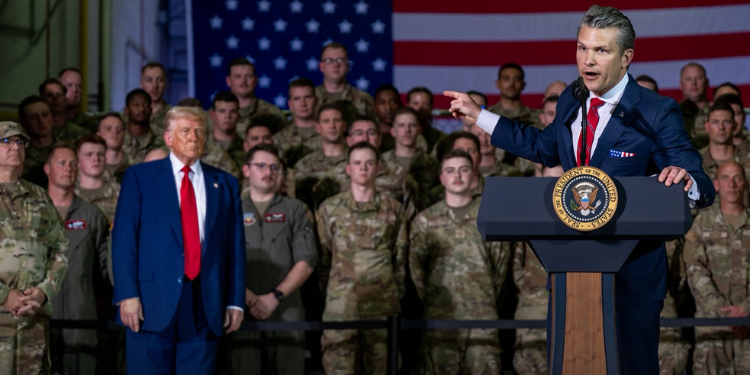
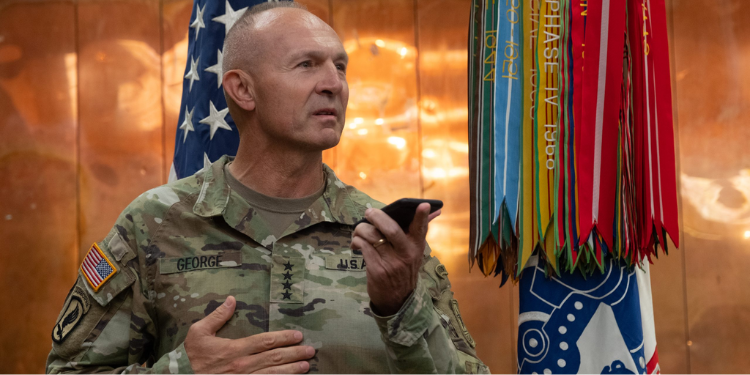
Defense Secretary Pete Hegseth has ordered the immediate removal and retirement of U.S. Army Chief of Staff Gen. Randy George.
The decision, confirmed by multiple officials and first reported by CBS News, occurs as Hegseth advances efforts to appoint senior military leaders who closely align with the administration’s vision for the armed forces.
Gen. George, a four-star general and career infantry officer, was asked to step down less than two years into what is normally a four-year term.
He had been nominated by former President Joe Biden and confirmed by the Senate in 2023, with his term expected to run until 2027.
Hegseth Boots Randy George
His sudden departure signals the increasing rate of leadership changes under Hegseth, who has already dismissed over a dozen senior military officers since taking office.
Senior Defense Department officials said the decision was not related to misconduct or a specific operational failure.
Instead, sources familiar with the matter said Hegseth wants Army leadership that will fully implement both his own and President Trump’s vision for the future of the force.
Also Read: Trump Appoints His Former Personal Lawyer After Firing Pam Bondi as AG
A Pentagon official called the move a leadership change, and expressed gratitude to George for his many years of service.
According to officials briefed on the decision, Hegseth has been seeking senior commanders who are willing and able to carry out a broad restructuring of the U.S. military.
That effort includes revisiting force posture, warfighting doctrine, and internal culture, all framed under what the administration calls a return to combat readiness and traditional military priorities.
Randy George’s Career
Randy George leaves behind a long military record spanning nearly four decades.
A graduate of the U.S. Military Academy at West Point, he was commissioned as an infantry officer in 1988 and served in Operation Desert Shield and Desert Storm, as well as deployments in Iraq and Afghanistan.
Before becoming Army chief of staff, he served as vice chief of staff and earlier as senior military assistant to former Defense Secretary Lloyd Austin.
Just hours before news of his ouster became public, the U.S. Military Academy posted photos of George visiting West Point, where he spoke to cadets about leadership and service.
The images highlighted the abrupt nature of his departure and the limited public explanation surrounding it.
The removal is part of a broader pattern by Trump’s administration.
Also Read: Trump Issues Ultimatum After Destroying Iran’s Biggest Bridge
Since assuming office, Hegseth has dismissed senior figures including the chairman of the Joint Chiefs of Staff, the chief of naval operations, the Air Force vice chief of staff, and the director of the Defense Intelligence Agency.
Supporters of the measures argue they are essential to break free from entrenched Pentagon thinking, while critics caution that they could politicize the military’s upper ranks.
For now, the Army’s top leadership will function under an interim arrangement while the White House prepares a formal nomination for George’s successor, a choice that will need Senate confirmation.
Hegseth’s Demands on War
Hegseth’s demands on war focus on speed, dominance, and clear results.
He has called for strong military action, quicker decision-making, and fewer internal restrictions on commanders in the field.
The War Secretary states that wars should be won quickly, not prolonged over time.
Hegseth has pushed for stronger rules of engagement, expanded authority for combat commanders, and less tolerance for what he views as risk‑avoidance inside the Pentagon.
He has also stressed loyalty to presidential objectives, saying senior officers who disagree with the administration’s war strategy should step aside.