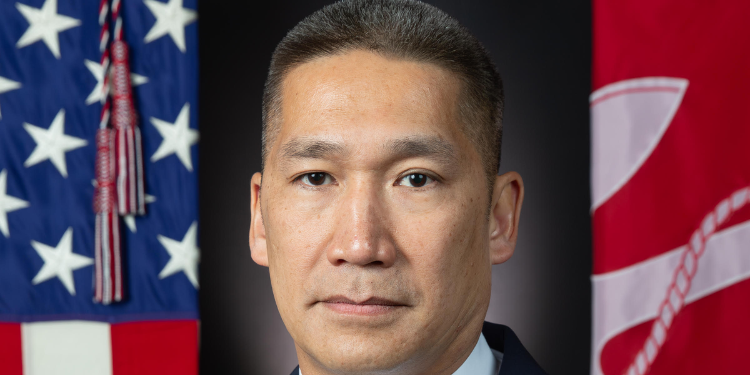
The newly appointed Acting Secretary of the Navy, Hung Cao, has issued his first public remarks since assuming the role, outlining priorities focused on personnel, shipbuilding, and national defense as the service navigates heightened global tensions.
In a statement released on Thursday, April 23, following his appointment, Cao said he had formally taken on the duties of the office and was immediately moving to address key operational areas.
“I am grateful to President Trump and Secretary Hegseth for the opportunity to serve as the Acting Secretary of the Navy,” he said.
Cao has signaled continuity in core military objectives while also emphasizing readiness and force support, stating that his “immediate priorities are taking care of our Sailors and Marines, advancing shipbuilding initiatives, and ensuring the defense of our homeland.”
He added that he remained “fully committed to accomplishing the core mission of the Department of the Navy as a premier warfighting organization and providing unwavering support to our warriors downrange.”
Hung Cao assumes the duties and responsibilities of Acting Secretary of the Navy
The statement also acknowledged the departure of his predecessor, John C. Phelan, with Cao saying the department was “thankful” for his service and wishing him well in future endeavors.
Cao’s remarks come a day after his sudden elevation to the top civilian role overseeing the U.S. Navy, following Phelan’s exit amid internal leadership changes within the Pentagon.
Also Read: Navy Secretary John Phelan Ousted as Trump Admin Names Acting Replacement Amid Iran Tensions
The transition occurs at a time when U.S. naval forces are engaged in multiple theaters, including operations linked to tensions in the Middle East and broader strategic competition with China.
Officials familiar with internal Pentagon dynamics have described Cao as having already built a reputation within the department as a detail-oriented operator, particularly on shipbuilding programs.
His background as a former Navy officer and prior role as Under Secretary of the Navy positioned him as a candidate with both operational experience and institutional knowledge during a period marked by leadership turnover.
Cao’s military career spans more than two decades, including service as a Navy diver and Explosive Ordnance Disposal officer with deployments in Iraq, Afghanistan, and Somalia.
He retired from active duty as a captain in 2021, then transitioned into defense-related roles in the private sector before later returning to government as Under Secretary of the Navy.
Pressure on the Navy
The administration has framed the leadership shift as part of a broader effort to accelerate naval readiness and expand fleet capabilities.
The U.S. Navy continues to face pressure from lawmakers and defense planners to increase ship production amid concerns over China’s rapidly growing naval capacity.
Efforts to scale the fleet toward long-term targets have faced delays, cost overruns, and industrial constraints, underscoring the urgency of the shipbuilding initiatives referenced in Cao’s statement.
Cao’s appointment also aligns with priorities expressed by President Trump, who has repeatedly emphasized the need to strengthen U.S. maritime power.
Also Read: Trump Orders US Navy to “Shoot and Kill” Vessels in Strait of Hormuz
According to administration officials, discussions between Trump and Hegseth leading up to the leadership change focused heavily on the pace of shipbuilding and broader military readiness.
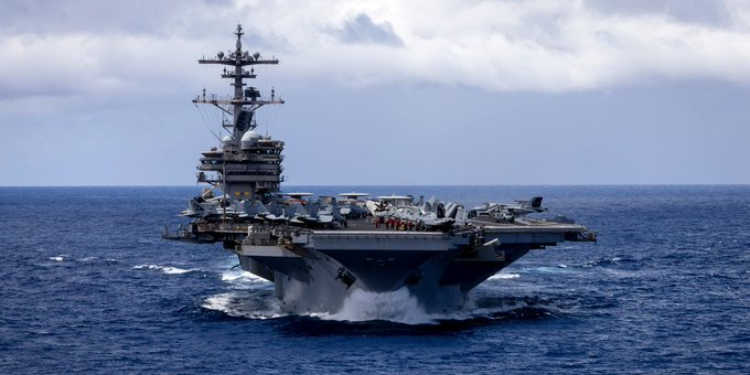
The new acting secretary assumes office as U.S. naval forces continue extended deployments. The USS Gerald R. Ford this week approached a record-length deployment, raising concerns among lawmakers about maintenance backlogs and the strain on personnel once the vessel returns to port.
It departed the Eastern Mediterranean Sea late last week and is now within U.S. Central Command (CENTCOM)’s area of responsibility. Destroyers USS Mahan (DDG-72) and USS Winston S. Churchill (DDG-81) also made the transit into the Red Sea.
Ford departed Split, Croatia, on April 2, after repairs following a March 12 laundry room fire while the carrier was in the Red Sea.
The carrier broke the post-Cold War deployment record this week. As of Friday, the carrier has been deployed for 297 days. Navy officials have said the carrier could be deployed for 11-months.
Ford joins the Abraham Lincoln Carrier Strike Group and the Tripoli Amphibious Ready Group already within CENTCOM’s area of responsibility.