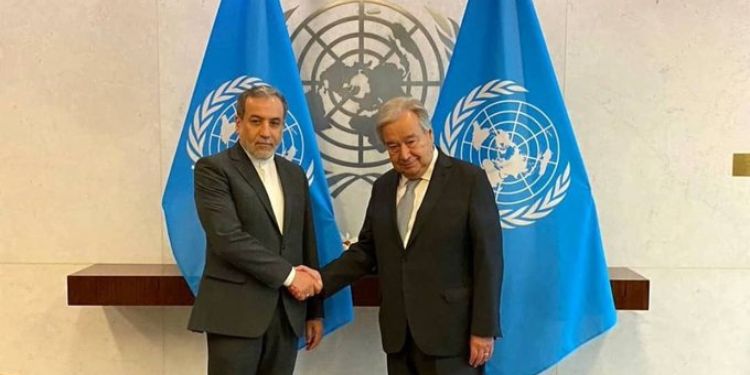
Iran’s Foreign Minister Abbas Araghchi has announced that Iranian armed forces will halt defensive operations if attacks on the country cease. The move follows U.S. President Donald Trump’s decision to suspend threatened strikes on Iranian power plants and other civilian infrastructure for two weeks.
Trump cited mediation by Pakistani Prime Minister Shehbaz Sharif and Field Marshal Asim Munir, as well as Iran’s submission of a 10-point proposal, as a basis for negotiations.
Taking to his social media handle on Tuesday, April 7, Araghchi started by thanking Pakistan’s leadership for its role in de-escalating the conflict.
“We are deeply grateful to Prime Minister Shehbaz Sharif and Field Marshal Asim Munir for their mediation efforts in response to their request and U.S. proposals for talks,” the statement issued on behalf of the Supreme National Security Council read.
He affirmed that Iran would allow safe passage for ships through the Strait of Hormuz for the next two weeks, coordinated with Iranian forces and taking technical limitations into account.
Araghchi also stated that the pause does not mark the end of the war but simply a response to Sharif’s appeal and is consistent with Iran’s position that any agreement must lead to a permanent resolution.
According to media reports, negotiations are expected to begin in Islamabad as early as Friday this week.
Trump’s Truth Social announcement.
Trump declared the suspension on his Truth Social platform hours before his self-imposed deadline expired. He said Iran had presented a “workable” 10-point proposal covering key issues, with “almost all of the various points of past contention” already addressed between the two sides.
The two-week window, he added, would allow time to finalize a wider agreement for sustained peace in the Middle East.
Also Read: British Troops Reportedly Pulled from Foreign Country as U.S.–Iran War Escalates
The U.S. president had earlier threatened to destroy Iran’s power plants and bridges in a rapid operation if Tehran did not reopen the Strait of Hormuz by Tuesday evening.
Iranian officials had rejected prior ceasefire proposals, including one for 45 days, insisting on a definitive end to hostilities and guarantees against future attacks.
State media reported that Iran presented its 10-point framework through Pakistani channels.
However, details of the points remain scanty, but they are understood to include security assurances, an end to strikes on Iranian allies such as Hezbollah, and the lifting of sanctions.
Araghchi, speaking for Iran’s top security body, stressed that defensive operations would stop only if incoming attacks halt. “Iranian armed forces will cease their defensive operations if the attacks on Iran are stopped,” the statement said.
The good news comes after weeks of endless and powerful strikes between Iran, the United States, and Israel.
Recent Israeli operations targeted Iranian petrochemical facilities and energy infrastructure, while U.S. threats focused on crippling Iran’s power generation and transport networks.
Pakistani officials played a central role in last-minute diplomacy. Sharif publicly urged both sides to extend the deadline to allow talks to progress.
Iranian sources described the Pakistani efforts as productive, with Araghchi thanking Islamabad for assisting communication.
Also Read: Trump Folds, Agrees to 2-Week Ceasefire with Iran After Scramble for Last Minute Talks
Global energy markets had braced for disruption if the Strait of Hormuz remained blocked. The temporary reopening is expected to ease immediate pressure on oil supplies.
Diplomats from Egypt and Turkey also contributed to mediation efforts in recent days, according to regional officials.
Phone calls between Araghchi and his counterparts in Islamabad, Ankara, and other capitals intensified as the U.S. deadline approached.
Inside Iran, officials had called on civilians to form human chains around power plants in anticipation of possible strikes. Those preparations now appear on hold, at least for the coming fortnight.
Trump described the Iranian proposal as containing “major points of agreement” and said the pause would help “consummate” a deal.