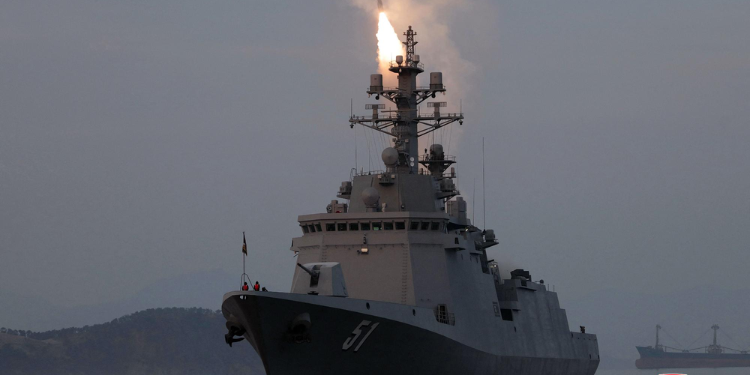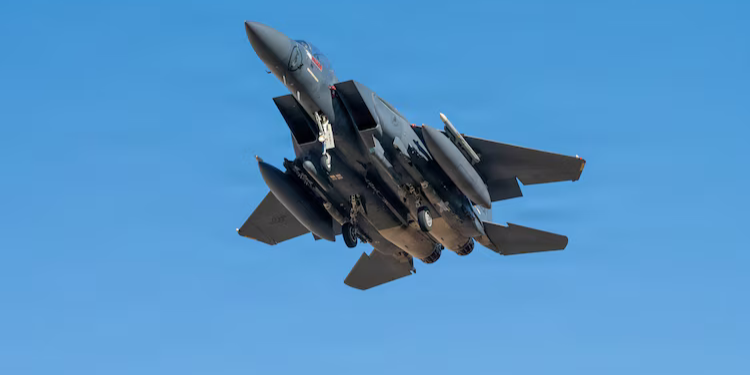
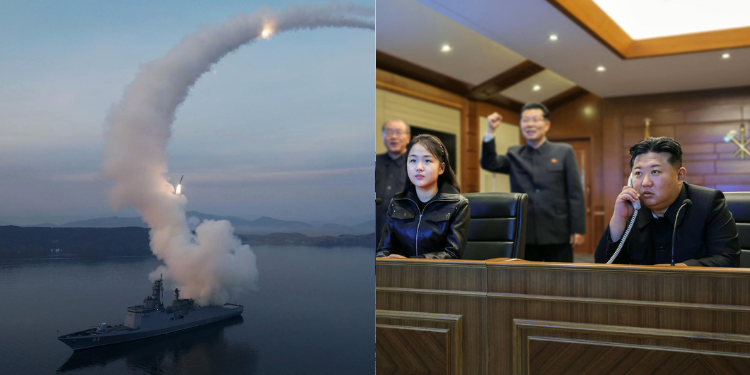
North Korea has launched multiple ballistic missiles toward the sea off its eastern coast, according to officials in South Korea and Japan, marking the latest in a series of weapons tests this year.
South Korea’s Joint Chiefs of Staff said the missiles were fired early Sunday, April 19, from the Sinpo area at about 6:10 a.m. local time.
The projectiles traveled eastward, with one report indicating a flight distance of about 140 kilometers. Japan’s government also detected the launches, stating that the missiles were believed to have landed in waters off the Korean Peninsula’s east coast.
Tokyo confirmed that no missile entered its exclusive economic zone but lodged a strong protest, calling the tests a threat to regional and international peace.
Emergency response after North Korea fires missiles
South Korea convened an emergency security meeting following the launches. At the same time, its Joint Chiefs of Staff (JCS) said it detected the missiles launched from the Sinpho area in the North at around 6:10 a.m., which flew about 140 kilometers.
“Our military is closely monitoring North Korea’s various movements under a robust South Korea-U.S. combined defense posture and maintains the capabilities and posture to respond to any provocation in an overwhelming manner,” the JCS said in a statement.
Also Read: Global Tensions Heighten as North Korea Fires Missiles During South Korean Leader’s Visit to China
Japan’s government, on its part, said the projectiles were believed to have landed outside its exclusive economic zone. Prime Minister Sanae Takaichi said authorities activated an emergency response team and instructed agencies to prioritize information gathering, ensure the safety of aircraft and vessels, and prepare for potential contingencies.
She said Japan is working closely with the United States and South Korea to analyze the launches. An emergency response team was convened immediately, with ministries instructed to ensure public safety and readiness.
Takaichi emphasized that crisis management is central to governance and pledged full preparedness for any contingencies.
“As the government, immediately after the launch, we convened the emergency response team at the Crisis Management Center in the Prime Minister’s Office to collect information, while I instructed relevant ministries and agencies to devote all efforts to information gathering and analysis, to provide prompt and accurate information to the public, to thoroughly confirm the safety of aircraft, vessels, and the like, and to maintain a state of utmost readiness in preparation for any contingencies,” she said.
On his part, Japanese Minister of Defense Shinjiro Koizumi also confirmed that Tokyo detected multiple missiles that had fallen outside Japan’s territorial waters.
Seventh launch this year
Sunday’s activity marked North Korea’s seventh ballistic missile launch in 2026 and its fourth in April alone, reflecting an increased pace of testing.
The country conducted multiple short-range launches earlier this month and, in late March, tested weapons systems including a tactical ballistic missile equipped with a cluster bomb warhead. State media claimed the weapon could “reduce to ashes any target” within its range.
North Korean leader Kim Jong Un has repeatedly emphasized expanding what he calls a “self-defensive nuclear deterrent,” describing the country’s status as a nuclear-armed state as irreversible.
Also Read: Trump Calls North Korea’s Nuclear Weapons an American Failure
The launches come amid warnings from International Atomic Energy Agency Director General Rafael Grossi, who said last week that North Korea has made “very serious” advances in its nuclear weapons program.
Grossi cited a rapid increase in activity at nuclear facilities and indicated the possible addition of a new uranium enrichment site, signaling continued expansion of Pyongyang’s capabilities.
Violations
Ballistic missile tests by North Korea violate United Nations Security Council resolutions banning such activities. Pyongyang has consistently rejected the restrictions, arguing they infringe on its sovereign right to self-defense.
The latest launches also come ahead of a planned mid-May summit between Chinese President Xi Jinping and U.S. President Donald Trump, where North Korea’s nuclear ambitions are expected to be a key topic of discussion.
Earlier on Sunday, January 4, North Korea fired ballistic missiles, which coincided with South Korea’s leader beginning a state visit to China.
According to South Korea’s military, its neighbor launched the missiles at around 7:50 a.m. local time and traveled approximately 900 km.
Japanese officials reported that at least two missiles were launched by North Korea, reaching distances of about 900 km (560 miles) and 950 km (590 miles).
The South Korean military said it, alongside the United States, is closely analyzing the specifications of the missiles while maintaining “a full readiness posture.”
Meanwhile, U.S. forces in the Asia-Pacific region stated that the launches did not pose an “immediate threat to U.S. personnel, territory, or allies.”