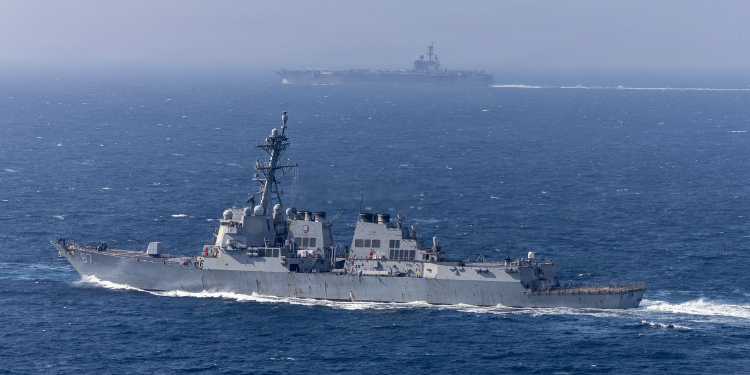
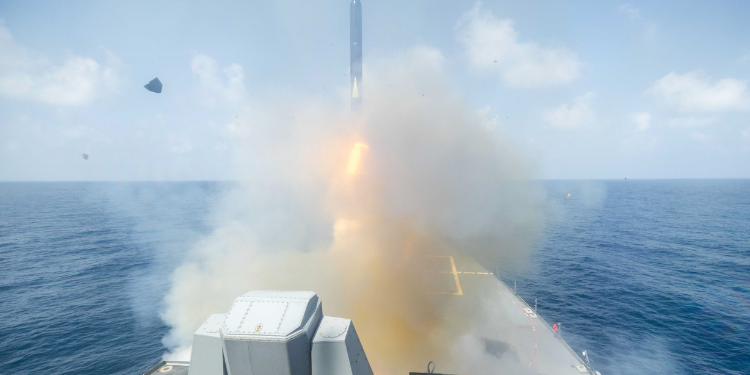
U.S. President Donald Trump has announced the destruction of 10 vessels suspected of laying naval mines by American forces in the Strait of Hormuz
In a statement posted on Tuesday, March 10, Trump said the vessels were “inactive mine laying boats and/or ships” that had been targeted by U.S. forces in the past few hours.
“I am pleased to report that within the last few hours, we have hit, and completely destroyed, 10 inactive mine laying boats and/or ships, with more to follow!”
The U.S. president did not provide additional details about where the vessels were located or the circumstances surrounding the strikes.
Escalating Tensions in Strait of Hormuz
The development comes amid rising tensions in the Persian Gulf as the war between the United States and Iran continues.
President Trump had earlier on Tuesday warned Iran to remove any naval mines that may have been placed in the Strait of Hormuz, threatening severe military consequences if shipping in the key global shipping route for oil and energy supplies is disrupted.
In a message posted on Truth Social, Trump said the United States had no confirmed reports that mines had been deployed but demanded their immediate removal if they had been placed.
“If Iran has put out any mines in the Hormuz Strait, and we have no reports of them doing so, we want them removed, immediately,” Trump wrote.
Also Read: UK Reports Missile Hit on Boat in Strait of Hormuz as Trump Unveils Billions for Maritime Shield
He added that if mines were not removed “forthwith,” the military consequences for Iran would be “at a level never seen before.”
Trump also said the U.S. military was prepared to target any vessel attempting to deploy mines in the strategic shipping corridor.
“If, on the other hand, they remove what may have been placed, it will be a giant step in the right direction! Additionally, we are using the same technology and missile capabilities deployed against drug traffickers to permanently eliminate any boat or ship attempting to mine the Hormuz Strait.”
U.S. officials have warned in recent days that Iran could attempt to disrupt shipping in the Strait of Hormuz by deploying naval mines.
According to American officials cited by CBS News, Iran has smaller vessels capable of carrying two to three mines each that could be used to place explosives in the key narrow waterway.
Estimates over the years suggest Iran may possess between 2,000 and 6,000 naval mines, many believed to have been produced domestically or acquired from China and Russia.
CNN reported earlier this week that Iran had begun laying mines in the strait, although the claim has not been independently confirmed.
U.S. military targeting mine-laying vessels
Speaking at a Pentagon briefing Tuesday, Dan Caine, chairman of the Joint Chiefs of Staff, said U.S. forces were actively targeting suspected mine-laying operations.
He said the United States Central Command, which oversees U.S. military operations in the Middle East, was continuing to strike vessels and storage sites linked to naval mines.
Located at the entrance to the Persian Gulf, the Strait of Hormuz is one of the most important energy transit routes in the world.
Oil tankers carrying crude from countries including Saudi Arabia, Iraq and the United Arab Emirates must pass through the narrow channel to reach international markets.
Also Read: Another Win for Putin? U.S. Considers Sanctions Relief for Russian Oil Amounting Billions
Roughly 20 percent of global oil supply moves through the waterway, meaning even limited disruptions can have immediate effects on energy markets and shipping routes.
Reinsurance program
The U.S. government has already taken steps aimed at protecting maritime trade in the region.
Last week the U.S. International Development Finance Corporation (DFC) announced a maritime reinsurance facility designed to insure shipping losses of up to $20 billion during the conflict.
Officials said the program was intended to restore confidence in commercial shipping through the Gulf and ensure the continued movement of oil, liquefied natural gas and other commodities.
Trump had also indicated that U.S. naval escorts could be deployed if necessary to protect energy shipments moving through the region.
Follow our WhatsApp Channel and X Account for real-time news updates.