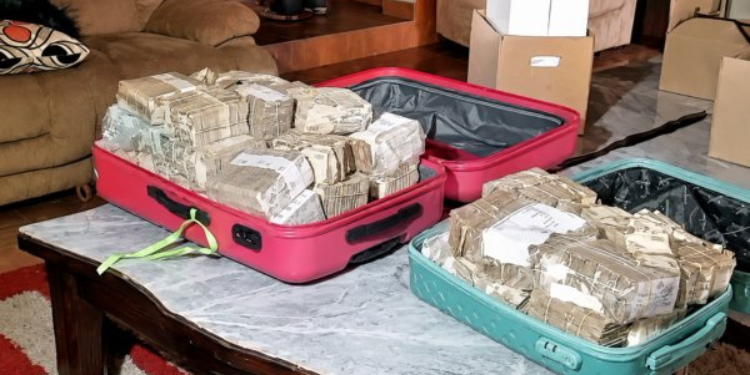
The Ethics and Anti-Corruption Commission (EACC) recovered over Ksh65 million in cash from the home of a senior Nairobi County officer. This recovery has raised questions about what happens to such funds after they are seized.
In a statement on May 4, the EACC confirmed that it raided the residence of Patrick Analo Akivaga, the Chief Officer for Urban Development and Planning at Nairobi City County, as part of an ongoing probe into alleged corruption and economic crimes.
The commission said detectives conducted the search on the morning of Thursday, June 4, recovering Ksh51.3 million in cash and US$113,000 (about Ksh14 million). The total amount recovered stands at approximately Ksh65.3 million.
“Today, EACC conducted a successful search operation at the residence of Patrick Analo Akivaga, Chief Officer for Urban Development and Planning at the Nairobi City County Government, as part of ongoing investigations into alleged corruption and economic crimes within the County,” wrote EACC in the statement.
Money recovered in operations like these is usually traced back to corruption, misuse of public resources, or unexplained wealth accumulated by officials.
EACC investigates and gathers evidence before moving to court to have the assets formally forfeited to the state.
The EACC states that the funds do not automatically become government property upon recovery. Instead, a legal process must be completed first, including court approval. Once that happens, the law directs how money is handled.
Also Read: Patrick Analo: Profile of Nairobi County Chief Officer for Urban Development and Planning
EACC Explains Where Recovered Public Funds Go
According to the EACC, recovered public funds are returned to the government through two main channels.
The first is the Consolidated Fund, the central account managed by the National Treasury, where most recovered cash ends up.
Once deposited, the money becomes part of the country’s general revenue and is no longer kept separate.
Parliament then reallocates it through the national budget to fund services such as healthcare, education, infrastructure, and other government functions.
The second channel is the Criminal Assets Recovery Fund (CARF). This mainly handles assets recovered under proceeds-of-crime laws. It includes not just cash, but also land, vehicles, buildings, and other valuables.
The Assets Recovery Agency manages these assets, ensuring they are preserved, sold where necessary, and their value is returned to the state.
Legal Process and Where Assets Are Directed
Under Kenyan law, including the Anti-Corruption and Economic Crimes Act (ACECA), the Proceeds of Crime and Anti-Money Laundering Act (POCAMLA), and the Constitution, recovered assets follow a structured path.
Cash and monetary proceeds are typically remitted to the National Treasury’s Consolidated Fund, where they become part of national revenue and are later allocated through the budget.
Also Read: EACC Storms FKF Offices as KSh 42 Million CHAN Insurance Probe Deepens
In some cases, specific institutions that lost funds may receive direct refunds.
For example, the Kenya Ports Authority (KPA) or the Kenya Medical Research Institute (KEMRI) Retirement Benefits Scheme have previously received recovered money.
Immovable assets such as land and buildings are often returned to their original public owners, including county governments, the Judiciary, or the National Police Service, or repurposed for public use, such as housing, infrastructure projects, or environmental initiatives.
Once a court orders that the assets be taken by the state, they are handed over to the government, and the Assets Recovery Agency steps in to safeguard, manage, or sell them as needed.
In September 2024, EACC handed over assets worth Ksh5.5 billion to the government, including land valued at about Ksh5 billion and Ksh511.4 million in cash.
Of the cash, Ksh361.4 million was transferred to the Consolidated Fund, Ksh79.3 million to KPA, and Ksh70.7 million to KEMRI.
Who Handles the Process
According to the EACC, it investigates corruption cases and pursues the recovery of stolen public resources through the courts.
The Assets Recovery Agency focuses on tracing, freezing, and confiscating proceeds of crime, while courts determine whether the recovered assets should be permanently transferred to the state.
Importantly, none of these agencies keeps the money; their role is to ensure it is recovered and handed over through the legal system.
The EACC notes that once the funds reach government accounts, they are used like other public revenues. In previous cases, billions of shillings recovered from corruption have been returned to the Treasury and channeled into national priorities.
For instance, some recovered funds were redirected to support Kenya’s COVID-19 response, while recovered land and property have been handed back to public institutions or repurposed for public use.