Iran has sharply increased oil shipments amid rising tensions with the United States and fears of possible military action, new shipping data shows.
According to Bloomberg, Tehran has accelerated crude exports from Kharg Island, the country’s main oil export hub in the Persian Gulf, loading tankers at an unusually rapid pace in recent days.
Data compiled by analytics firm Kpler indicates that about 20.1 million barrels of crude oil were loaded between February 15 and February 20, nearly three times the volume exported during the same period in January. The surge represents an effective export rate of more than 3 million barrels per day, significantly above Iran’s normal shipping levels.
Analysts say the increase suggests Tehran is trying to move as much oil as possible out of its ports before any potential disruption from a U.S. military strike, according to Bloomberg.
Oil exports remain a central pillar of Iran’s economy, providing essential foreign currency and funding for government programs. Rapid shipments would allow Iran to secure revenue and position crude supplies in international waters before any escalation.
Iran stockpiles oil tankers
Satellite imagery reviewed by analysts shows a dramatic rise in tanker activity near Kharg Island during the second half of February.
Between February 15 and February 20, the number of tankers observed in waters southeast of the terminal more than doubled from eight vessels to 18 vessels. A partial satellite snapshot taken on February 22 still showed nine tankers operating in the area.
Most Iranian oil shipments must pass through the strategic Strait of Hormuz, one of the world’s most important maritime oil routes. Many tankers transporting Iranian crude attempt to avoid detection as they head toward international markets.
According to Samir Madani, co-founder of TankerTrackers.com, Iran has recently been loading “as much oil as possible” in anticipation of potential hostilities.
Madani said tankers already loaded with crude will likely disperse widely across the region if tensions escalate further or air strikes occur.
Exports tracked by TankerTrackers.com are expected to average between 1.5 million and 1.6 million barrels per day this month, with the February surge pushing the figures higher.
The company only counts shipments after tankers have fully departed Iranian waters and are clearly headed toward international buyers.
The latest surge in exports follows a pattern seen during earlier periods of military escalation. Last year, shortly before American air strikes, Iran rushed to move oil shipments out of its ports and stockpiled crude aboard tankers. This was also observed during heightened tensions in 2024.
Also Read: All US Navy Ships Moved from Foreign Base Amid Tensions with Iran
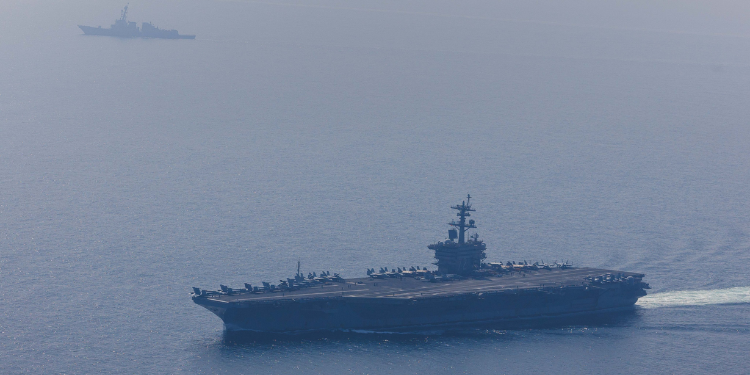
The export spike comes as the United States continues to assemble one of the largest American military presences in the Middle East since the 2003 Iraq War, raising concerns that a new confrontation could be imminent.
The developments come as senior U.S. officials warn that Iran may be attempting to rebuild its nuclear weapons capability.
Vice President JD Vance while speaking on Wednesday, February 25, said Washington has seen indications that Tehran is attempting to restart its nuclear weapons program.
“The principle is very simple. Iran cannot have a nuclear weapon. If they try to rebuild the nuclear weapon, that causes problems for us. And in fact, we’ve seen evidence that they have tried to do exactly that. So the president is sending those negotiators to try to address that problem.”
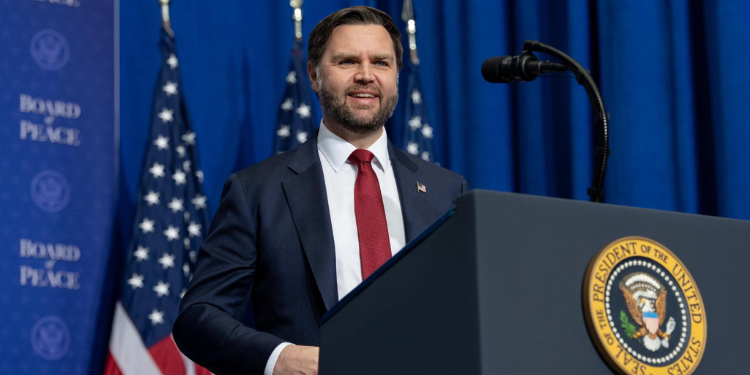
He said the administration prefers a diplomatic solution but warned that military options remain available if negotiations fail.
“The president wants to address that problem diplomatically, but of course, the president has other options as well,” Vance added.
Rubio raises missile concerns
U.S. Secretary of State Marco Rubio on his part said Iran is attempting to position itself to resume uranium enrichment and develop long-range missile capabilities.
Rubio while speaking to reporters in St. Kitts & Nevis noted that Iran is not currently enriching uranium but is trying to reach the capability to do so again.
He also warned that Tehran is pursuing intercontinental ballistic missile technology, describing the issue as a major concern for U.S. negotiators.
The Secretary of State said Iran’s refusal to discuss ballistic missile development in ongoing negotiations in Geneva represented a “big, big problem.”
Meanwhile, the United States has imposed a fresh round of sanctions targeting Iran’s oil trade.
The measures announced by the Treasury Department on Wednesday focus on 12 vessels, along with companies and individuals accused of facilitating Iranian oil sales and supporting missile development programs.
Also Read: Trump Accuses Iran of Sinister Nuclear Ambitions
U.S. Treasury Secretary Scott Bessent said the sanctions are aimed at disrupting financial networks that support Iran’s military and nuclear activities.
“Iran exploits financial systems to sell illicit oil, launder the proceeds, procure components for its nuclear and conventional weapons programs, and support its terrorist proxies,” Bessent said.
The sanctions freeze assets within U.S. jurisdiction and restrict American citizens and companies from conducting business with designated entities.
Iran has condemned the restrictions, arguing that U.S. attempts to block its oil exports amount to economic warfare and piracy.
Military build-up
The United States has deployed large fleets of fighter aircraft and naval forces to the region, including multiple aircraft carriers and advanced strike aircraft. At the same time, hundreds of military cargo flights have supported the buildup.
President Donald Trump has repeatedly warned that Iran must agree to a nuclear deal or face consequences.
In his State of the Union address on Tuesday, Trump said the United States remains open to negotiations but reiterated that Iran must commit to abandoning nuclear weapons.
“We haven’t heard those secret words: ‘We will never have a nuclear weapon.’”
The United States carried out air strikes on Iranian nuclear facilities in June 2025, which Trump has said “obliterated” Tehran’s nuclear capabilities.
Follow our WhatsApp Channel and X Account for real-time news updates.