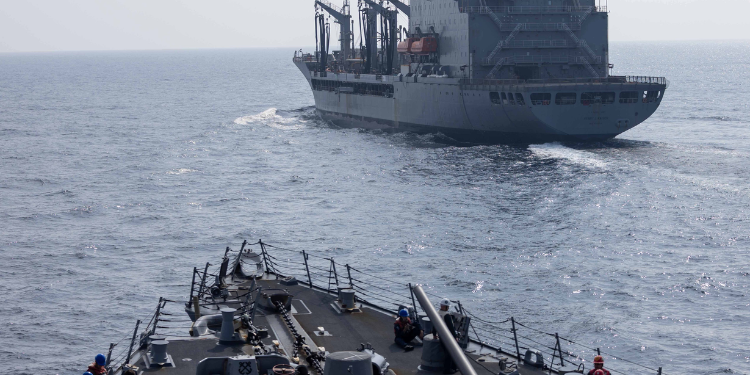
U.S. Treasury Secretary Scott Bessent has announced that the United States could soon deploy naval escorts for oil tankers moving through the Strait of Hormuz, as escalating tensions with Iran threaten one of the world’s most critical shipping lanes.
Speaking in an interview with Sky News on Thursday, March 12, Bessent said the United States Navy may begin escorting commercial vessels through the narrow waterway “as soon as it is militarily possible.”
The strait connects the Persian Gulf to the Gulf of Oman and carries roughly one-fifth of the world’s oil supply, making any disruption a major threat to global energy markets.
Oil tankers still moving through Strait of Hormuz
Despite fears that the waterway had been fully blocked, Bessent said some ships are still transiting the strait.
“There are, in fact, tankers coming through now — Iranian tankers, I believe some Chinese-flag tankers have come through,” he said.
“So we know that they have not mined the straits,” Bessent told Sky News, referring to concerns that Iran might deploy naval mines to halt global shipping.
The situation remains volatile, however, as the ongoing conflict has already forced many commercial vessels to reroute or delay voyages.
Iran has effectively shut down parts of the Strait of Hormuz amid its expanding confrontation with the United States and Israel.
The disruption has pushed global oil prices sharply higher and contributed to rising fuel costs in multiple countries.
Also Read: Trump White House Scrambles After False Claim on Navy Escorting Tanker in Gulf
The waterway sits at the center of the global oil trade, linking major exporters such as Saudi Arabia, Kuwait, and Qatar to international markets.
Bessent’s comments come just days after Chris Wright, the U.S. Energy Secretary, suggested the United States was not yet prepared to escort ships through the waterway.
Speaking to CNBC earlier this week, Wright said the decision ultimately rests with President Donald Trump.
“He’ll make the final decision on that,” Wright said.
War in Middle East escalates
The security situation in the Gulf remains tense as the broader war involving Iran continues to intensify.
According to U.S. Central Command (CENTCOM), American forces have carried out thousands of strikes across Iran under Operation Epic Fury, targeting military infrastructure, missile sites, and naval assets.
The disruption to oil markets has already triggered emergency measures from the international community. The International Energy Agency (IEA) announced that its 32 member nations agreed to release 400 million barrels of oil from strategic reserves to stabilize markets.
Also Read: Why Trump May Have Miscalculated in Releasing U.S. Oil Reserves
As part of the coordinated effort, the United States on Wednesday authorized the release of 172 million barrels from its Strategic Petroleum Reserve.
President Trump welcomed the decision, saying it would help reduce energy prices while the conflict continues.
Iran’s Khamenei signals no retreat
Iran’s new supreme leader, Mojtaba Khamenei, on Thursday warned that the Strait of Hormuz could remain closed as a strategic tool in the conflict.
“The lever of blocking the Strait of Hormuz should still be used,” he said in his first public message after assuming leadership.
The threat has heightened fears that the crisis could further disrupt global oil supplies if the conflict widens.