The United Kingdom has marked a rapid transition from testing to live combat use within months after deploying a new low-cost anti-drone missile system on Royal Air Force (RAF) operations in the Middle East.
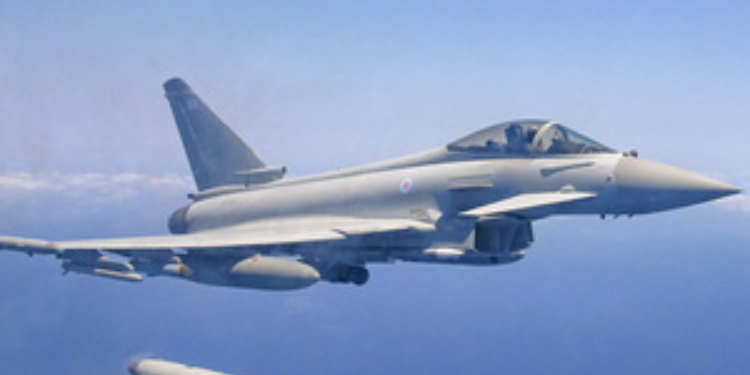
According to a Ministry of Defence statement issued on May 17, 2026, the system—known as the Advanced Precision Kill Weapon System (APKWS)—has been integrated onto RAF Typhoon aircraft currently operating in the region.
The APKWS is designed to convert unguided rockets into laser-guided precision weapons, enabling fighter jets to intercept drones and other airborne threats at a significantly lower cost than traditional air-to-air missiles.
UK deploys new low-cost anti-drone system
The Ministry of Defence said the system was developed through “rapid procurement and testing work” in collaboration with industry partners BAE Systems and QinetiQ, enabling it to move from trials to operational deployment in less than two months.
Also Read: UK Reports Vessel Seized Off UAE Coast, Heading Toward Iran
March testing included a successful strike on a ground-based target, while RAF pilots from 41 Test and Evaluation Squadron completed air-to-air firing trials in April.
The Ministry of Defence said these tests demonstrated the system’s capability against drone-type threats.
Defence officials confirmed that the system is now operational in the Middle East, with RAF Typhoon sorties flown by 9 Squadron as part of ongoing missions to protect British personnel, regional partners, and allied interests.
Minister for Defence Readiness and Industry Luke Pollard said the programme reflects a shift toward lower-cost defensive systems capable of responding to rising drone activity in conflict zones.
He said the system “will help the RAF shoot down many more drones at a much lower cost,” adding that the Typhoon fleet remains the backbone of UK and NATO air defence operations.
The Ministry of Defence also stated that UK aircraft have already accumulated more than 2,500 flying hours in the region since the start of the current conflict environment, describing the sustained deployment as equivalent to over three months of continuous defensive flight operations.
Alongside the APKWS deployment, the UK maintains multiple air defence assets across the Middle East, including ground- and helicopter-based systems deployed in partner countries.
These include Sky Sabre systems deployed in Saudi Arabia, Lightweight Multirole Missile systems deployed in Bahrain, and Rapid Sentry and ORCUS systems deployed in Kuwait, according to the Ministry of Defence.
HMS Dragon deployment
The announcement follows earlier UK planning activity related to maritime security in the region.
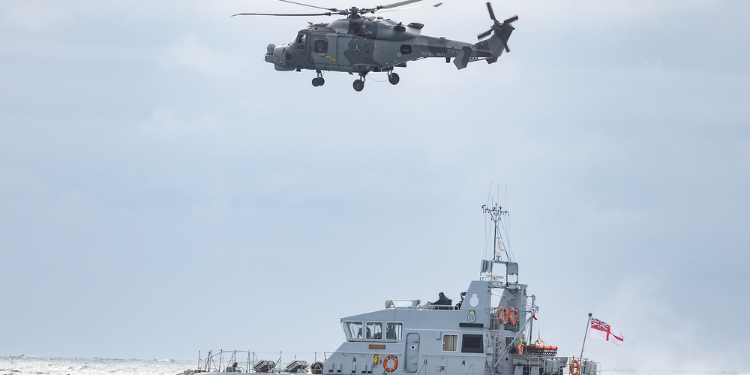
On May 9, 2026, reports indicated that the UK was preparing to deploy the destroyer HMS Dragon as part of a European-led maritime mission to escort commercial vessels through the Strait of Hormuz once conditions allow.
The proposed mission is being developed jointly with France and involves planning contributions from more than 40 countries, with roles including escort operations, de-mining, and air policing.
UK officials have described the deployment of HMS Dragon as “prudent planning” to ensure readiness for a multinational coalition mission designed to secure the waterway when a ceasefire or peace agreement is sustained.
Also Read: Strait of Hormuz: Heavy Exchange of Missiles as 3 U.S. Destroyers Are Targeted by Iran
The Strait of Hormuz remains a focal point of regional tensions following the wider Iran war, which escalated in February 2026 after U.S. and Israeli strikes.
Reports on Saturday indicated that Iran has prepared a mechanism to manage shipping through the strait, including toll collection for vessels passing through the waterway.
Reporting from the Strait, Al Jazeera correspondent Tohid Asadi described the waterway as “a parking lot for ships,” citing local authorities who said heightened tensions have significantly slowed maritime traffic through one of the world’s most critical energy routes.
Iranian officials have also indicated that Tehran will soon announce a formal tolling mechanism for traffic through the Strait of Hormuz.
The UK’s deployment of new anti-drone systems comes as drone warfare has become a growing feature of the regional conflict environment, with multiple actors deploying aerial systems across Lebanon, Gaza, and surrounding maritime corridors.
The Ministry of Defence said the APKWS system enhances the RAF Typhoon’s ability to defend against such threats by providing a precision-guided, lower-cost interception option, complementing existing air defence systems already in operation across the Middle East.
UK defence officials also noted that ongoing procurement efforts include additional interceptor-missile programs aimed at countering “Shahed-style” attack drones, alongside long-term upgrades to the Typhoon fleet intended to extend operational capability into the 2040s.