


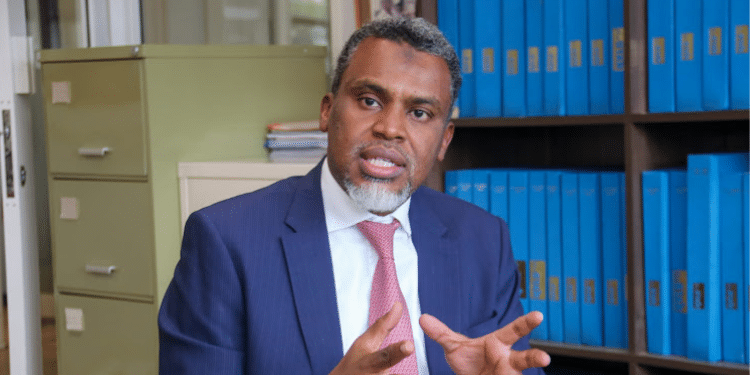
The National Intelligence Service (NIS) is Kenya’s primary intelligence agency tasked with safeguarding national security through intelligence collection, analysis, and dissemination.
The agency operates under an Act of Parliament to provide for the functions, organization, and administration of the National Intelligence Service, pursuant to Article 239(6) of the Kenyan Constitution.
Application Process Through the NIS Career Portal
NIS does not conduct open mass recruitment and job advertisements. individuals interested in joining the service must create a personal profile on the NIS career portal.
After creation of the profile, Applicants are required to provide their personal details and upload documents, including a national ID, passport-size photograph, KCSE certificate, and any relevant college or university certificates.
Also Read: Salaries, Allowances, and Hefty Benefits Kanja, Amin and Noordin Enjoy
Once a profile has been created and submitted, the agency’s talent pool may review the application whenever suitable opportunities become available. Shortlisted candidates are then contacted directly by the NIS.
Eligibility and Academic Requirements for Applicants
Entry-level recruitment is organized into three categories: Graduate Trainees, Diploma Trainees, and Certificate Trainees.
All candidates must be Kenyan citizens with valid national identification documents and must have no criminal record.
Physical and medical fitness is also a mandatory requirement, given the demanding nature of the role.
At the academic level, requirements vary depending on entry category. Age requirement also depends on the entry category.
Graduate Entry Trinees
Kenyan degree holders wishing to join the NIS as graduate trainees should meet the following requirements.
- Be a Kenyan citizen without a criminal record and be physically fit
- Aged between 22-31 years.
- Be in possession of Kenya Certificate of Secondary Education (KCSE), mean grade C+ (plus)
- Be in possession of a degree from a recognized institution
Diploma Entry Trainees
Kenyan diploma holders wishing to join the NIS must meet the following requirements.
- Be a Kenyan citizen without a criminal record and be physically fit
- Must be aged between 20-30 years.
- Be in possession of a Kenya Certificate of Secondary Education (KCSE), mean grade C (plain) .
- Be in possession of a college diploma, earned over at least 18 months of study in a recognized institution.
Certificate Trainees
Kenyan certificate holders wishing to join the NIS must meet the following requirements.
- Be a Kenyan citizen without a criminal record and is physically fit
- Be aged between 20-26 years.
- Be in possession of a Kenya Certificate of Secondary Education (KCSE), mean grade D+ or its equivalent.
- Be in possession of a relevant Certificate from a recognized institution, covering at least 6 months of study.
In addition to academic qualifications, applicants are expected to demonstrate integrity, discipline, and the ability to work in highly sensitive environments where confidentiality is essential.
After the selection, the NIS Director General issues a certificate of appointment to the service.
Salaries of NIS Officers
Article 230(4)(a) of the Constitution of Kenya empowers the Salaries and Remuneration Commission (SRC) to review and set the remuneration and benefits for the National Intelligence Service (NIS).
Salaries of the NIS officers is not publicly disclosed.
Currently, Noordin Haji is the Director-General and earns a gross monthly salary of Ksh 819,844.
This includes a basic salary of Ksh 491,906, a house allowance of Ksh 150,000, an official commuter allowance, and a salary market adjustment of Ksh177,938.
Also Read: How to Join Recce Squad in Kenya in 2026: Requirements and Salary
Functions of the National Intelligence Service
The National Intelligence Service is mandated to handle security intelligence and counter-intelligence to enhance national security in accordance with the Kenyan Constitution. Some of the service functions include:
- Gather, collect, analyse and transmit or share with the relevant State agencies, security intelligence and counter-intelligence
- Detect and identify threats or potential threats to national security
- Advise the President and Government of any threat or potential threat to national security
- Safeguard and promote national security and national interests within and outside Kenya
- Gather, evaluate and transmit departmental intelligence at the request of any State department or organ, agency or public entity
- Regulate, in co-operation with any State department or agency, the flow of security intelligence between the Service and that State department or agency
- Carry out protective and preventive security functions within State departments, agencies, facilities and diplomatic missions
Follow our WhatsApp Channel and X Account for real-time news updates.



I love it
My dreams to join national intelligence of kenya
The more i try to join NIS the more i get lost. these people are super smart. i have tried to look for them everywhere online uncessfully
And those over 40 yes, are they qualified to join NIS
I would to serve the republic of Kenya
I’m really ready
If NIS needs your assistance they gonna recruit you …….just be patient this ain’t a job
I would love to join the team
I wish to work for the our republic of Kenya through this wing of service. Kindly consider.
I shall love to be an asset.
Every time am trying to log in to their portal the site will be unreachable.NIS can you consider me I will be grateful and would love to work with you.
l would like or it is my which to work at National intelligence service (NIS) kindly help me to secure a chance if possible thanks.
I have a strong desire and ambition to work with the National Intelligence Service (NIS) in Kenya. It would be a great honor and opportunity for me to serve my country through the Service. I kindly seek your guidance and assistance on how I can secure an opportunity to join NIS, if possible. Thank you for your consideration and support.
Kindly send me the application link ,thank you in advance
Has previous NIS recruits passed out?or not yet.
Anyone aware to inform me
I would like to serve as a NIS
I would like to serve our country Kenya as a NIS,I’m from West pokot country I’m a graduate with degree holder,I love the job but to apply its a bit tricky even to create a profile.
Kindly consider me i will serve kenya well wholeheartedly and diligently.
Thank you🙏
It has always been my passion to join the NIS as NYS alumin please consider me