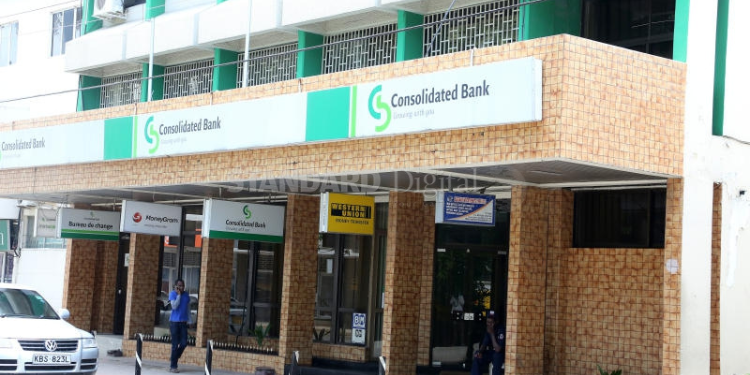
The government plans to inject KSh1.125 billion capital into Consolidated Bank of Kenya in the upcoming financial year, as the lender grapples with weakening capital levels and rising financial pressures.
According to the budget estimates and audited financial statements for the year ending December 31, 2025, the bank’s capital has fallen below regulatory capital requirements.
Capital Position Falls Below Regulatory Threshold
Audited Consolidated Bank’s disclosures indicate that its core capital dropped into negative territory, placing it below the KSh3 billion statutory minimum required by the Central Bank of Kenya (CBK).
The financial statements show a core capital deficiency of KSh3.546 billion in 2025, widening from a deficit of KSh1.731 billion in 2024.
Also Read: Govt Clarifies NYOTA Disbursement Process, Issues New Directives
This weakening underscores the bank’s inability to internally generate sufficient capital to meet the required threshold by CBK.
Core capital ratios also remained below the required levels. The bank’s core capital to total risk-weighted assets ratio and core capital to deposit liabilities ratio both fell short of statutory benchmarks, reflecting sustained pressure on its capital buffers.
The government’s planned injection of KSh1.125 billion is expected to partially address the gap.
Rising Non-Performing Loans Weigh on Asset Quality
The lender’s financial position has also been weighed down by a growing stock of non-performing loans (NPLs).
Gross NPLs increased to KSh4.085 billion in 2025, up from KSh3.637 billion in 2024, highlighting deteriorating asset quality.
After accounting for interest in suspense, total NPLs stood at KSh2.596 billion, compared to KSh2.387 billion the previous year.
Despite provisioning efforts, the persistence of high NPL levels continues to strain earnings and capital.
Loan loss provisions reduced the net NPL exposure, but the bank still faces elevated credit risk.
At the same time, total assets rose to KSh19.49 billion in 2025, from KSh17.52 billion in 2024, indicating some balance sheet growth even as asset quality concerns intensified.
Government Steps in as Shareholder Support Deepens
The planned capital injection is captured under strategic government investments aimed at supporting state-linked entities.
As a majority shareholder, the government’s intervention signals continued backing for the lender amid financial distress.
The bank’s audited figures show retained losses remaining significant, reflecting accumulated deficits that have eroded shareholder funds over time. While paid-up capital stood at KSh3.719 billion, negative retained earnings continued to weigh heavily on total equity.
Liquidity indicators, however, remained above regulatory minimums, with the bank posting a liquidity ratio above the 20% requirement, suggesting it can meet short-term obligations despite capital challenges.
Also Read: KBA Survey Shows Mobile Banking Tops Customer Preferences in Kenya
Who Owns Consolidated Bank of Kenya?
Consolidated Bank of Kenya is a fully government-owned institution, with the National Treasury holding a dominant stake in its shareholding structure.
As of the 2024–2025 period, the National Treasury controls 85.8% of the bank’s shares, making it the principal shareholder and placing the lender firmly under State influence.
The remaining 14.2% stake is held by 25 parastatals and quasi-government institutions.
This structure classifies the bank as a State-owned commercial bank, operating under a government agency framework while providing standard banking services.
The bank was incorporated on 7th December 1989 as part of efforts to stabilize Kenya’s financial sector.
It was formed through the consolidation of nine struggling financial institutions, with a mandate to restore confidence and maintain stability in the banking system.
Over the years, it has operated as a commercial lender with a strong focus on small and medium-sized enterprises (SMEs), offering a range of financial products.